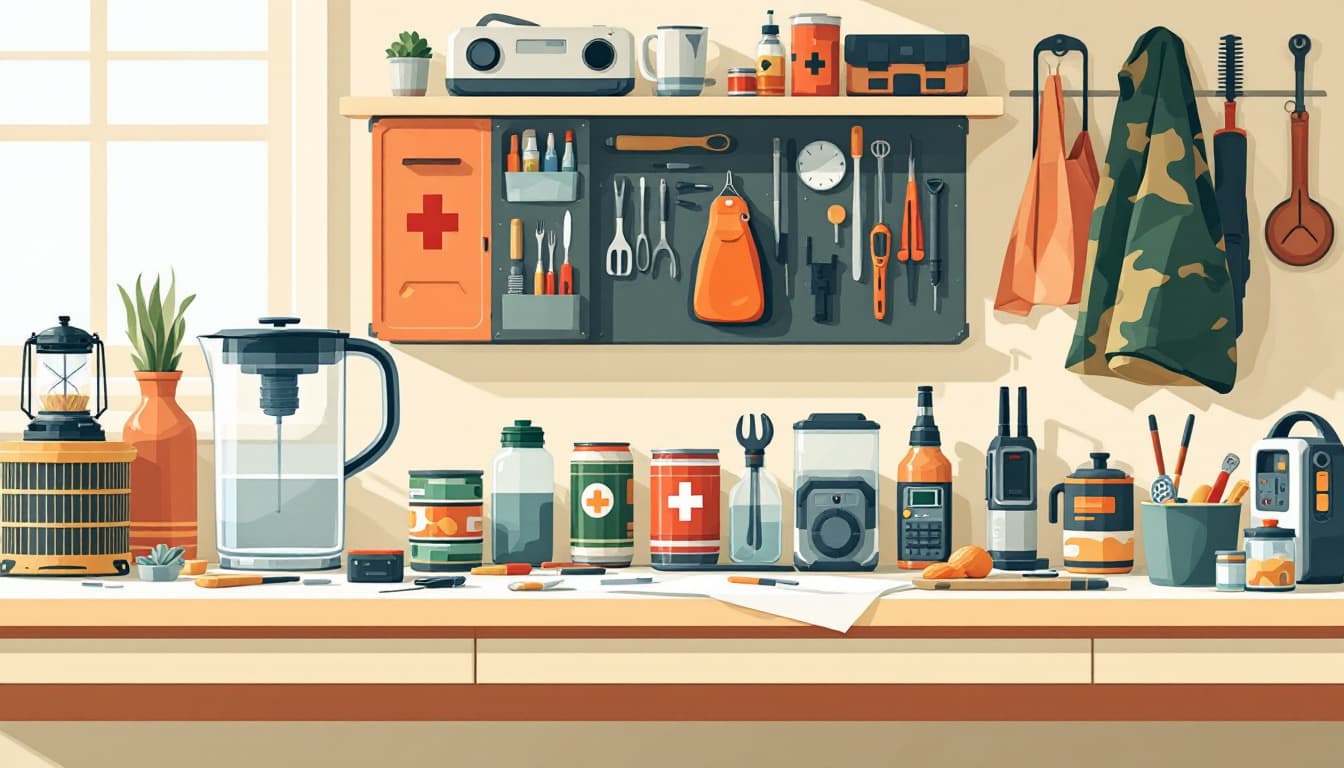
Open any prepper forum and the aesthetic is unmistakable: a garage that looks like a small armory, a wall of ammo cans, a "loadout" post with $4,000 of tactical gear laid out on a tarp like a gun-show display. It's a genre, and it sells — to the people producing the content and to the retailers behind them. It is also almost entirely disconnected from what actually determines whether a middle-class household comes through a bad week intact.
This is the last piece in our five-part household playbook series, and it's the one about the physical layer — the gear and the skills, as opposed to the money (household money playbook), the supply chains (household supply-chain playbook), the AI-driven labor disruption (AI-resilient household playbook), and the wildfire-and-drought risk (wildfire-and-drought-ready household) covered in the first four. Where those four pieces are mostly about decisions, this one is about things you can hold in your hand and skills you can actually perform — and about how small the real list turns out to be once you strip out the theater.
Here is the honest version: what a household actually needs, what it's fine to skip, and the six capabilities worth building this year.
The gear-versus-skill confusion
Preparedness culture has a structural bias toward gear, and it's worth naming why before getting to the list.
Gear is a purchase; a skill is a practice. Buying a $600 trauma kit takes ten minutes and a credit card. Learning to actually use a tourniquet correctly under stress takes a Stop the Bleed class, some repetition, and the discomfort of practicing on yourself or a willing family member. One of these is much more satisfying to complete, and only one of them is instant, which is exactly why gear dominates the content and the retail category. The skill gap hiding in most household preparedness plans isn't a lack of stuff — it's a household with a fully stocked kit and nobody who has ever opened it before the day they needed it.
The gear itself has a tier problem. Every category — water filters, first aid, radios, power — has a "prepper premium" tier priced for people trying to survive an extended grid-down scenario alone in the woods, and a "household adequate" tier priced for the actual failure modes a family is likely to face: a two-to-five-day power outage, a boil-water notice, a wildfire-smoke week, a minor injury with no urgent care open. Almost every middle-class household should be shopping the second tier, and almost every piece of prepper media is implicitly upselling the first.
And a fair amount of the category is just larp. Tactical vests, fixed-blade "survival knives" marketed on doomsday framing, camouflage-pattern anything for a suburban household — this stuff signals identity more than it solves a problem. We're not here to mock anyone's hobby. We're here to be clear that none of it moves the needle on the actual thing this pillar is about: a middle-class household's odds of getting through a bad week calmly.
What the real failure modes actually look like
Before the list, it's worth being specific about what "prepared" is actually insurance against, because the list only makes sense against real failure modes.
For the overwhelming majority of middle-class households in the developed world, the realistic disruptions are: a multi-day power outage from a storm or grid event, a boil-water notice or short municipal water disruption, a wildfire-smoke week that makes outdoor air genuinely unsafe, a minor-to-moderate injury with delayed access to care, a short supply-chain gap that empties a grocery category for a week or two, and a communications disruption — cell towers overloaded or down — during a regional event. Multi-week grid collapse, societal breakdown, and EMP-driven infrastructure failure are the scenarios the tactical-gear content is implicitly built around, and they are — as we've argued elsewhere — vanishingly unlikely relative to the ordinary disruptions above. Build for the week you're actually going to have, not the movie.
Who should weight this list differently
The six capabilities below are the baseline, but the emphasis shifts by household type. A renter in an apartment building has little use for a whole-home generator or a large water-storage footprint, but benefits disproportionately from the communications and first-aid capabilities, since apartment buildings concentrate people who can help each other during a shared outage. A homeowner with a basement or garage has more room to build the deep-reserve food and water layers, and should prioritize the home-systems literacy play, since a house has more systems that can fail quietly. A household with a member on powered medical equipment should treat the power capability as the highest-priority item on the list, full stop, ahead of water and food. And a household in an area with real evacuation risk — wildfire, hurricane, flood — is the one household type for whom a genuine bug-out bag belongs back on the list, not as a first purchase but as a seventh capability layered on top of the six.
None of this changes the underlying principle. It just means "build these six capabilities" isn't a uniform shopping list — it's a framework you weight against your specific household's actual risk.
What we'd actually do
Six capabilities. Each one is a real thing your household can do or own that maps to one of the failure modes above, without turning your garage into a bunker.
1. Water: filtration plus a rotated reserve, not a barrel you forget about
Water is the highest-consequence category on this list because the failure window is short — three days without safe water is a real medical emergency, not an inconvenience. The capability has two parts, and most households build only one.
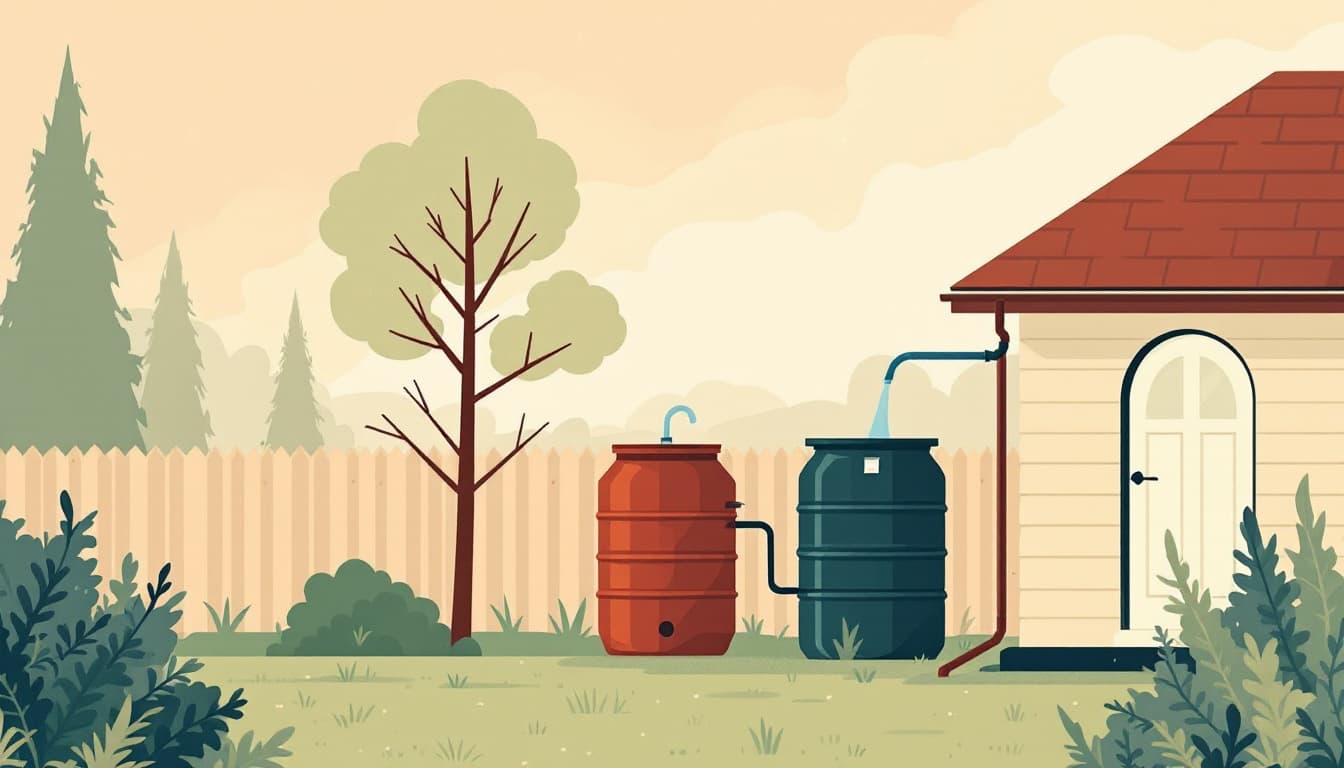
Storage: the standard "one gallon per person per day" rule is a floor, not a plan — the real question is how you'll actually use the water you store, not just how many gallons are sitting in the garage. For most households, that means portable, stackable containers you'll actually rotate rather than a single drum you fill once and forget: something in the Reliance Aqua-Tainer class covers a three-to-five day household buffer without becoming a permanent fixture nobody manages.
Filtration: a household on municipal water doesn't need filtration for daily use, but a boil-water notice or a short disruption changes that fast. The market shifted meaningfully once Berkey lost its EPA registration — the NSF-certified gravity systems and countertop reverse-osmosis units that replaced it are a genuine upgrade in verified certification, not just a substitute. Buy once, keep the filter cartridges in rotation, and know how to set it up before the week you need it.
2. Food: a rotation system, not a bunker pallet
The prepper-culture version of this capability is a pallet of #10 cans in a basement, bought once in a panic and never touched again until the "best by" date has quietly passed. The middle-class version is a rotation system — a defined shelf of shelf-stable staples that gets used and replenished as part of ordinary shopping, the same logic covered in more depth in the supply-chain playbook's pantry-depth play.
Where a dedicated emergency-food product earns its place is as the deep-reserve layer underneath that rotation — the thing you don't touch monthly but do check annually. A 14-day supply in the Mountain House class covers a real short-duration outage without requiring a pallet or a bunker mentality; a 30-day bucket system is the right call only for a household that has already built the rotating pantry layer and wants the deep-reserve tier on top of it, not instead of it.
3. Power: match the tier to your actual outage pattern, not to the worst-case fantasy
This is the category where prepper media does the most damage to a household budget, because the aspirational unit is always the whole-home generator or the massive off-grid power station, and the actual need for 95% of households is much smaller: keep the fridge cold, keep phones charged, keep a CPAP or medical device running, keep a few lights on.
Figure out your household's real load — check your last few outages for duration and what you actually needed — before buying. A portable power station in the 1,000-1,500Wh class covers phones, a router, and a fridge compressor cycling for a day or two, which is the actual outage pattern most households face. Add a foldable solar panel only if your outages regularly run past a day and daylight recharging genuinely matters for your climate. A gas or dual-fuel inverter generator is the right call only for households with a real multi-day annual outage pattern or a household member on powered medical equipment — check what a genuinely quiet inverter generator in the household-appropriate size class looks like before defaulting to whatever wattage a prepper forum recommends, which is usually sized for running power tools on a job site, not a household refrigerator overnight.
4. Communications: redundancy that doesn't depend on the same tower
Most households believe they have a backup communication plan and actually have three versions of the same single point of failure — a cell phone, a second cell phone, and a smart speaker, all routing through the same cell towers and the same home internet connection. A real communications capability means at least one channel that doesn't depend on cell infrastructure at all.
For most households that's a battery or hand-crank emergency weather radio for receiving NOAA alerts when the network is down, plus a set of GMRS or FRS two-way radios for household-to-household contact if everyone's not in the same building — useful for a family sheltering in different rooms, cars, or a nearby relative's house during a regional event. Neither requires a license test to be useful at the FRS tier, and the GMRS tier's $35 family license covers your whole household for ten years.
5. First aid: a Stop the Bleed skill, not just a kit on the shelf
This is the clearest gear-versus-skill gap on the entire list. A trauma kit sitting unopened in a closet is worse than useless in an emergency, because the person reaching for it has never practiced under any pressure at all. The actual capability is a real skill: at least one adult in the household who has taken a Stop the Bleed or basic first-aid course and can apply a tourniquet, pack a wound, and recognize when an injury needs urgent care versus a home fix.
Pair that skill with a kit sized to your household rather than to a tactical fantasy — a MyFAK-class kit built around real trauma supplies rather than the 200-piece drugstore box that's mostly bandaids and alcohol wipes. The kit without the skill is theater. The skill without the kit is still genuinely useful. Both together is the actual capability.
6. Home-systems literacy: know your own house before you need to
The least glamorous capability on this list is also one of the highest-value: knowing where your water main shutoff, gas shutoff, and electrical panel are, and being able to operate all three without a manual. Pair that with basic home-fire response — a properly rated fire extinguisher in every kitchen and garage, mounted somewhere accessible, not buried in a closet — and the ability to actually read your utility bill well enough to catch a leak or a spike before it becomes a crisis. Round it out with one low-tech navigation skill — reading a paper map well enough that a dead phone during a regional event doesn't strand you — and a basic mending skill, since sewing pays for itself in avoided replacement costs long before any emergency ever arrives.
None of this is dramatic. All of it is the difference between a household that responds calmly to a bad afternoon and one that's improvising for the first time under real stress.
What we'd skip
The gear myths prepper culture keeps pushing that don't hold up against the failure modes above.
The bug-out bag as a first purchase. For the overwhelming majority of middle-class households, leaving home is the rare scenario and sheltering in place is the common one — the bug-out bag has become preparedness culture's central icon despite being the wrong first investment for most families. If you live somewhere with real evacuation risk — a wildfire or hurricane zone — build one. If you don't, the money is better spent on the water, food, and power capabilities above.
The 72-hour framing. The three-day preparedness window comes from a 1980s FEMA guideline, not from actual disruption-duration data, and it systematically undersizes the household's real planning horizon. A household that plans to the 72-hour unit buys a kit and stops. A household that plans to its actual risk profile builds the rotation and skill capabilities above, which scale naturally past three days without a hard wall.
Buying the premium tier of everything. The tactical, mil-spec, or "off-grid survivalist" version of every product category above is priced for a use case — extended solo wilderness survival — that essentially no reader of this site has. Buy the household-adequate tier in each category. The savings across water, food, power, comms, and first aid easily run into four figures, and none of it makes your household less prepared for the outage, boil-water notice, or wildfire-smoke week you're actually likely to face.
Faraday cages and EMP-hardening for household electronics. This category exists because it's an easy sell against a scenario that's dramatic to imagine and vanishingly unlikely to occur in a way that matters to a household. Skip it.
Confusing the cache for the plan. The single biggest trap in this entire category is believing that accumulating enough stuff is itself the preparedness. It isn't — the decisions made in the first four hours of a real disruption matter more than anything sitting in storage, and a household with less gear and more practiced judgment will outperform a household with a garage full of supplies and no plan for using them.
The bigger picture
The honest version of this pillar is smaller than prepper culture wants it to be, and that's the point. A middle-class household doesn't need a bunker, a tactical loadout, or a five-figure gear budget. It needs a rotated water and food system, a power tier matched to its real outage pattern, one communications channel that doesn't depend on a cell tower, a first-aid skill paired with a right-sized kit, and a working knowledge of its own house. Add one low-tech navigation skill and one mending skill, and the list is done.
This closes the five-part series that started with the household money playbook and ran through supply chains, AI disruption, and environmental risk. The pattern across all five pieces has been the same: the households that come through a bad year steadiest are not the ones who predicted the specific disruption correctly or spent the most money preparing for it. They're the ones who built a small set of durable, boring capabilities — financial, logistical, and physical — well before they needed them, and then quietly kept them maintained.
Pick one of the six capabilities above this week — water and first aid are the highest-consequence places to start. Skip the tactical gear entirely. The list is short on purpose.