
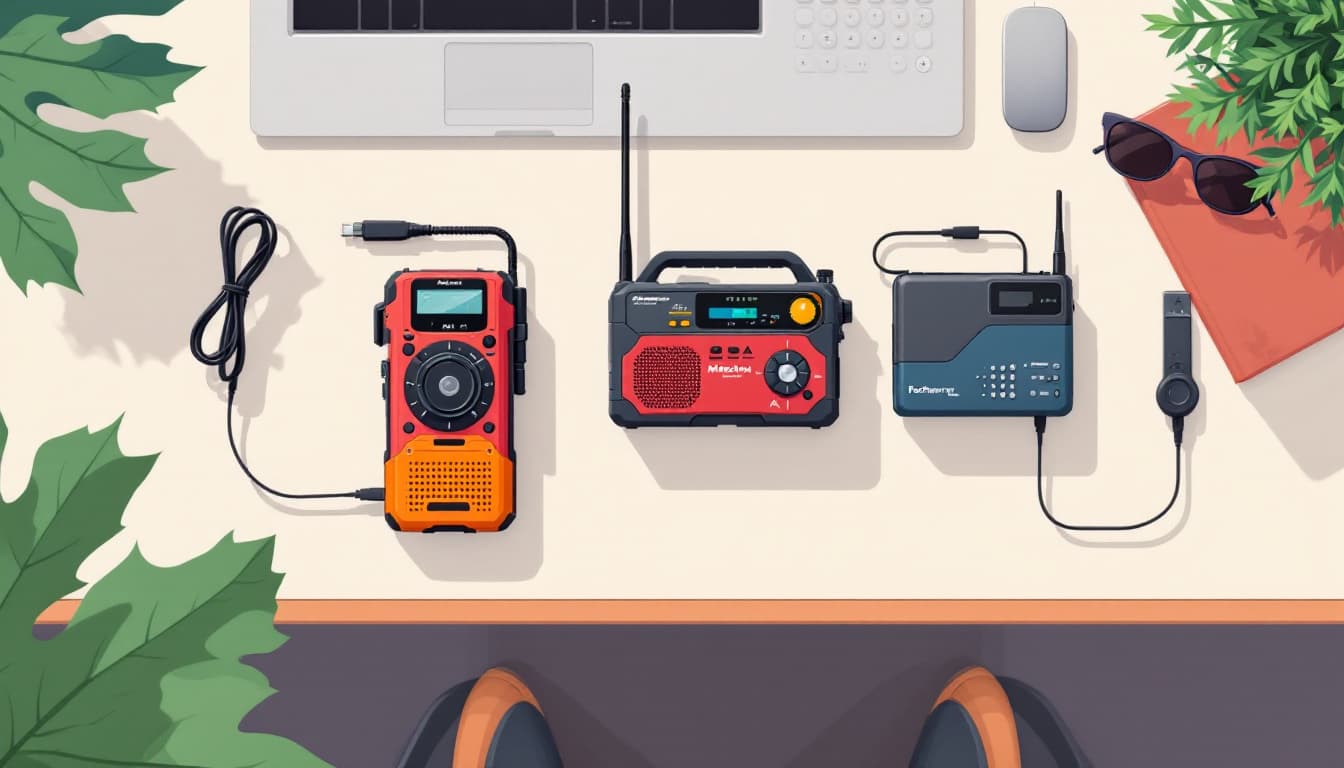
Why every household needs at least one of these
Power outages, hurricanes, ice storms, tornadoes — the one thing they share is that cell networks and internet connections become unreliable exactly when you need information most. A dedicated NOAA weather radio with its own power source sidesteps that entirely. It doesn't need your router, your carrier, or the grid. The National Weather Service broadcasts continuous forecasts and pushes emergency alerts on seven dedicated frequencies around the clock, and a good radio will wake itself up and alarm you even while it sits dormant on a shelf. That's a capability no smartphone app can reliably replicate when the cell tower is overwhelmed or down.
The case for owning one isn't about worst-case thinking. It's about the ordinary Tuesday night when a tornado watch turns into a warning at 2 a.m. and you're asleep. A radio with automatic alert mode handles that for you. Buy one, put fresh batteries or a charge in it, and then largely forget about it — that's the entire ask.
What we actually looked for
Automatic NOAA Weather Scan+Alert was the threshold requirement. A radio that only receives weather band when you manually tune in is a radio you'll fail to tune in at the wrong moment. Beyond that, we weighted power redundancy (the more independent charging methods, the better), battery replaceability, and honest crank-to-runtime efficiency. Bluetooth and phone-charging capability are genuine bonuses for reducing drawer-dweller syndrome — a radio that pulls double duty as an everyday speaker is a radio that actually gets tested and kept charged.
We deliberately skipped units with only a single power source, radios that lock you into proprietary non-replaceable batteries with no workaround, and anything with verified reception or build-quality complaints across multiple review cohorts.
The premium pick: Midland ER310PRO (~$100)
The ER310PRO launched in late 2025 as a genuine generational step up from the ER310, not a minor refresh. The jump to a 10,000 mAh battery — capable of pushing two to three full smartphone charges — transforms this from a dedicated emergency device into something you might actually interact with weekly. Bluetooth 5 streaming means it can sit on your kitchen counter as a speaker; USB-C bidirectional charging means it both accepts fast charging from your wall adapter and pushes charge back out to your phone. GearJunkie's testing confirmed roughly 9 minutes of radio operation per minute of hand-cranking, which is the best efficiency figure in this roundup.
The tradeoffs are real: at roughly 1.3 pounds with shoebox proportions, this is a bedside or shelf radio, not a go-bag radio. And like the ER310, it lacks SAME county-level alert filtering, so you'll receive regional alerts rather than hyper-local ones. If you want something that will live in a bag, look elsewhere. If you want the one device that eliminates the "I should buy a power bank too" purchase and earns its shelf space between emergencies, this is it.
The value pick: Midland ER310 (~$55)
The ER310 is the consensus recommendation from virtually every credible 2026 roundup, and its 4.7-star rating across a large, long-running review base is unusually trustworthy. The feature that separates it from nearly every competitor at this price is the user-replaceable 18650 battery. When the internal cell eventually degrades — and they all do — you swap a standard battery rather than buying a new radio. That one design decision makes the ER310 a genuinely long-term household asset.
Four independent power sources (solar, hand crank, USB rechargeable, and six AA alkaline cells as backup) mean you're unlikely to find yourself with a dead radio during an outage. The automatic NOAA Weather Scan+Alert fires even when the radio isn't actively playing, which is the feature that justifies owning any dedicated weather radio over just bookmarking a weather app. The ER310 has no Bluetooth and won't fully recharge a modern smartphone, so it won't earn daily-use habits the way the PRO might — but for a radio that lives in a cabinet and works without fail when needed, it's the easy recommendation for most households.
The budget pick: FosPower A1 (~$30)
The FosPower A1's strongest argument isn't that it competes with the Midland radios feature-for-feature. It doesn't, and you shouldn't expect it to. Its argument is that at under $30, you can put one in the car, one in a go-bag, and one in an apartment junk drawer and still spend less than a single ER310. The compact, lightweight form factor genuinely fits in a jacket pocket or the side pocket of a child's school bag — the Midlands would feel absurd in either location.
The important limitation to understand: the FosPower has no automatic NOAA alert mode. You must manually tune it to the weather band to receive alerts. That makes it a less reliable "set and forget" option than either Midland. Think of it as a capable emergency information tool when someone is awake and paying attention, and as a strong complement to a primary radio rather than a standalone household solution. For a vehicle kit or supplementary go-bag slot, it's hard to argue with the price.

