
Food storage is the preparedness category where households most often start, most often stall, and most often quietly underdeliver against what they intended to do. The Amazon top-seller chart is dominated by bucket-shaped products promising "365 servings" of "delicious meals." The verified-review patterns are consistent: the food is edible, the math on servings is generous, and most households who buy these never open them.
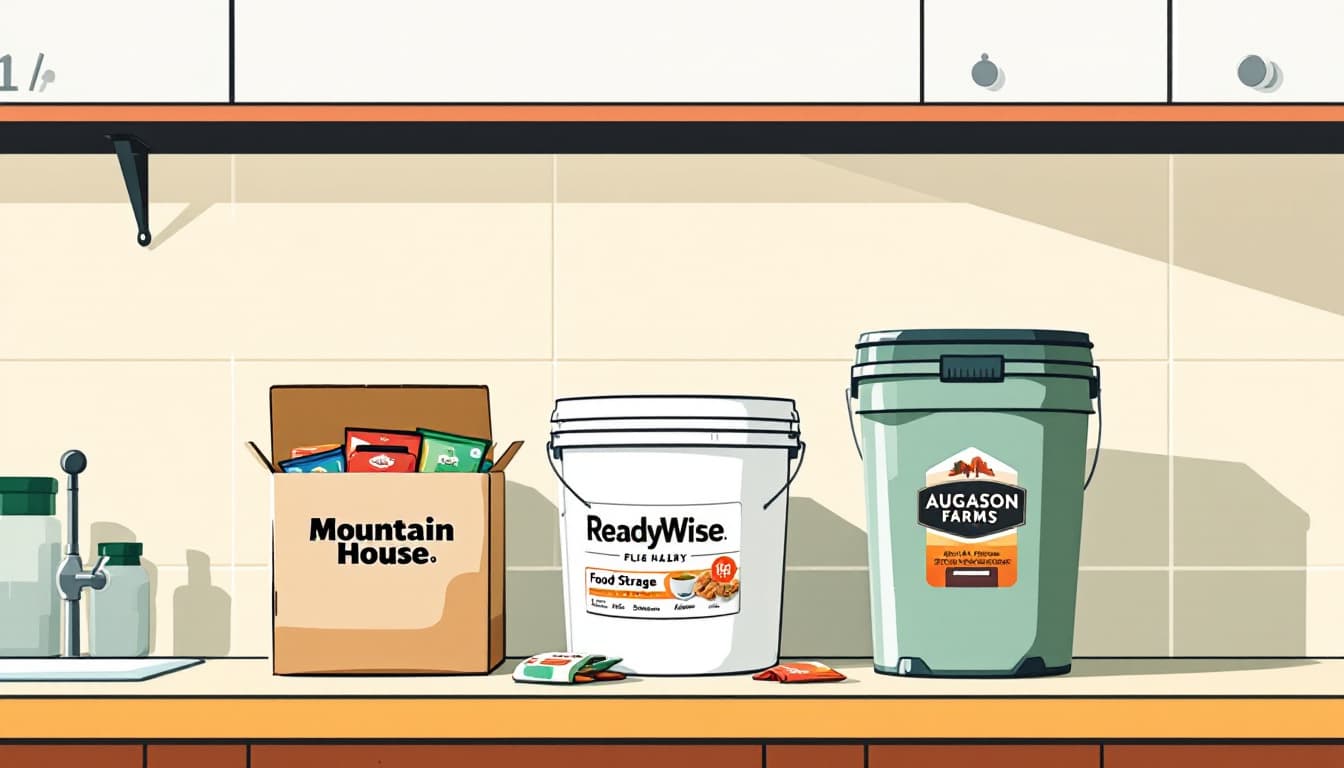
The three picks above are three different answers to the same question — how do you store enough calories to handle a real disruption — at three different price points. Mountain House is the gold-standard freeze-dried answer. ReadyWise is the best-value 30-day bucket on Amazon today. Augason Farms is the cheapest legitimate entry point for households new to food storage.
What "food storage" actually means for a household
There are three real scenarios that drive food storage purchases.
The first is short-term emergency — a multi-day power outage, a snowstorm that closes roads for a week, a localized supply disruption. For this, you need shelf-stable food that you can prepare without a working grid. The Augason Farms bucket covers it for one person for a month. Most households who buy this never need it; the ones who do are very glad they have it.
The second is multi-week resilience — economic disruption, supply-chain failure, a personal-financial emergency where the grocery budget shrinks faster than the pantry. For this, the ReadyWise 30-day bundle is the right answer for most households — enough variety to actually eat through, real freeze-dried protein meals, and 25-year shelf life that lets you ignore it for years.
The third is deep storage — earthquake, multi-month grid event, the scenarios most prepper content focuses on. For this, the math says you want six to twelve months of calories per household member, which means buying multiple Mountain House and ReadyWise sets over time. Most households we hear from aren't there yet, and they shouldn't worry about it. Get the first 30 days first.
A household that has 30 days of stored calories per person has done more food preparedness than 95% of American households. Don't try to do everything at once.
A note on serving counts
The "servings" count on every emergency food bucket is a marketing figure. The food industry standard "serving" for breakfast cereal is roughly 200 calories; for an emergency-meal pouch, it's often 80-150. A working adult needs roughly 1,800-2,400 calories per day, which translates to 3 to 4 marketing-servings per meal, not one.
Practical translation:
- The Augason Farms "30-day 1-person" bucket = 194 servings ÷ ~6 servings/day = roughly 32 real days of household calories.
- The ReadyWise "30-day 2-bucket" set = 296 servings ÷ ~6 servings/day = roughly 49 real days for one person, or about 12 days for a family of four.
- The Mountain House "14-day" kit = 84 servings ÷ ~6 servings/day = roughly 14 real days for one person, exactly as labeled.
Mountain House is the most-honest of the three on this dimension, which is part of why it's the premium pick.
What we'd buy and why
If we were furnishing a household from scratch with a $300 budget, the buy order is:
- The Augason Farms 30-day 1-person bucket, today, $95 per household member. That's the floor — 30 days of known calories on the shelf. For a family of four, $380 buys you to that floor.
- The ReadyWise 30-day 2-bucket set, this month, $220. Adds variety and freeze-dried protein meals on top of the dehydrated Augason staples. Same shelf life, better taste, complementary inventory.
- The Mountain House 14-day pouches, when budget allows, $230. Use them. Rotate. Once you've cooked a few of their pouches you'll understand why we put them in the premium tier — the food actually tastes like food. That's a morale lever in a real event.
A household that has all three has 30+ days of immediate cushion, a serious variety of options, and a freeze-dried system that performs in real use.
The freezer-dryer and Mylar questions
Two approaches we deliberately did not tier:
The Harvest Right Freeze Dryer ($2,495) is a remarkable piece of equipment. It does for your own meats, vegetables, and prepared meals what commercial freeze-drying does — and at home-production cost roughly 1/5 the cost of buying the equivalent products from Mountain House or ReadyWise. For a household that cooks in volume, gardens, raises animals, or hunts, it's a serious investment that pays back over years.
It's also $2,500, takes up a third of a chest freezer's worth of floor space, runs noisily for 36-hour cycles, and requires real attention to vacuum-pump maintenance. For most households, the Mountain House pouches are the better entry point. If you decide after a year of freeze-dried use that this is a category you want to own permanently, the Harvest Right is the right tool.
Mylar bags + oxygen absorbers ($20-30 for a 50-pack) is the DIY long-term storage approach. You buy bulk rice, beans, oats, pasta, flour, and sugar; pack them in 1-gallon Mylar bags with an oxygen absorber; heat-seal with a regular kitchen iron; and you have 20-25-year storage for the cost of an extra $20-30 in groceries each month. The right answer for households that want food storage to be a rolling habit rather than a one-time purchase.
We didn't tier the Mylar approach this year because it's not a single Amazon SKU — it's a workflow that requires the bags, the absorbers, the heat sealer or iron, and the discipline to use them. For a launch buying guide, the bucket-based commercial products are the more useful answer. We'll cover the Mylar workflow in a dedicated DIY article later this year.
What we didn't recommend
The Thrive Life Freeze-Dried Starter Kit was on our 2025 pick list. We removed it this year because Thrive Life has moved most of its product line to a direct-to-consumer subscription ("Q-Club") model with limited Amazon availability — the starter kit appears intermittently on Amazon now with murky pricing and stock issues. If you want to commit to Thrive's product line, buy from thrivelife.com directly.
The Mountain House Just-In-Case Bucket ($150) is a fine product but pricier per-serving than the ReadyWise 2-bucket set at the same total cost. We picked the ReadyWise specifically because the math on cost-per-serving is better.
The Wise Company 5-Day Emergency Food kits ($45) are the budget commercial option. We didn't include them because the Augason Farms bucket gives you 6× the calorie coverage at 2× the cost — much better calorie-per-dollar math at the same shelf life.
The larger Augason Farms 4-person 30-day pail ($300+) is fine for households with cabinet space but the 1-person sized buckets stack and rotate more easily for most homes.
The MRE (Meal, Ready-to-Eat) military-surplus market is a category we deliberately avoid. The math on cost-per-calorie is bad, the taste is poor, the shelf life of commercial "MRE-style" products often disappoints, and the genuine military-issue MREs are not sold to civilians.
How we researched these picks
We read every one-, two-, and three-star verified review on the top thirty emergency-food kits, bucket products, and freeze-dried product listings (roughly 2,300 reviews). We pulled nutritional labels and shelf-life specifications from each manufacturer, cross-referenced against the LDS Provident Living long-term food storage guidance (the most-tested civilian food-storage methodology in the world), and weighted heavily against any product whose 1-star complaints clustered around the failure modes that matter (premature spoilage, false serving counts, taste-inedibility).
The Mountain House vs ReadyWise vs Augason Farms taste comparison is one of the few in this category where you can find genuine A/B blind taste tests on YouTube. Mountain House wins those tests consistently. ReadyWise and Augason are both edible; Mountain House is the only one where the food tastes like food.
We'll revisit this review when Augason Farms updates their bucket formulations (rumored for late 2026 in line with their parent company's product refresh) and if pricing shifts meaningfully on the ReadyWise multi-bucket sets.

