Picture a household that has genuinely thought about preparedness. They have a go-bag, a water supply, a three-week pantry. When asked about communication, they answer confidently: "We have our cell phones, plus we can use Wi-Fi calling if the towers are congested, and we also have each other's numbers memorized."
Those are three answers. They are not three options. They are one option — a smartphone with an internet connection — described in three ways. If that single dependency fails, the whole plan fails with it.
This is what we've been calling the landline fallacy: the tendency to mistake variety in form for diversity in infrastructure. It shows up everywhere in household preparedness thinking, but it's most dangerous in communication, because communication is the thing you need first when everything else goes wrong.
The pattern worth naming
Every major communication infrastructure has a distinct failure profile. Cellular networks congest during mass emergencies because everyone reaches for their phone at the same time — this is well-documented in after-action reports from hurricanes, earthquakes, and large-scale power outages. VoIP and Wi-Fi calling fail when either your home internet or the broader backbone goes down. Landline copper circuits, where they still exist, have their own vulnerabilities but historically remain functional longer into a grid disruption because they carry their own low-voltage power. Satellite-based texting services (now available on newer consumer devices through carrier partnerships) operate on entirely separate infrastructure but have latency and coverage limitations.
The point isn't that any one of these is reliable. The point is that they fail differently, at different times, for different reasons. A household with two options that fail simultaneously is worse off than it appears on paper — and better off than one with five options that all share a cellular backbone.
Why most people get this wrong
The preparedness industry tends to frame communication as a gear problem: buy a ham radio, buy a satellite communicator, done. But the gear answer skips the harder question, which is what does your household actually need to accomplish during a disruption?
Most families need three things: to confirm that immediate family members are safe, to receive official updates about the situation, and to coordinate a meeting point if normal routes are blocked. Each of those functions maps to a different infrastructure requirement — and only the first one is usually thought through carefully.
The second failure mode is assuming that because something worked last time, it is a plan. Cell service held up during the last regional storm. Great. That data point is one storm, under one set of conditions, during which most of your neighbors were also fine. It does not tell you how that infrastructure performs when the emergency is larger, longer, or more concentrated.
The third is the assumption that someone else in the household has thought about this. In most families, one person does the pantry and the go-bags, and no one does the communication plan. That asymmetry is worth addressing directly.
What to do this week
Audit your current plan against infrastructure, not device count. List every communication method you'd use in an emergency. Next to each one, write down what it depends on to function (cellular tower, home internet, power grid, satellite). Count how many distinct infrastructure dependencies you have. If the answer is one or two, your plan needs work.
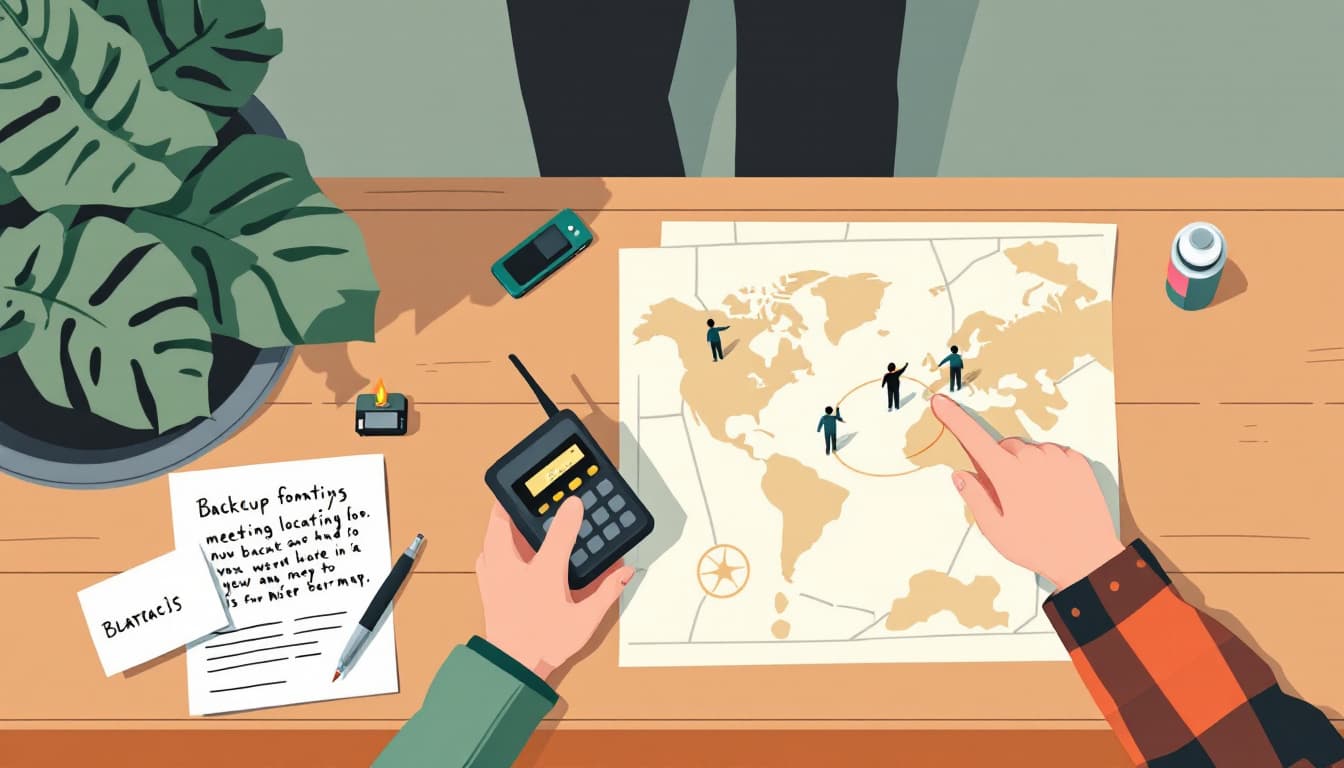
Establish an out-of-area contact and a written meeting protocol. During regional emergencies, it's often easier to reach someone outside the affected area than to reach someone across town. Choose one person — a relative, a friend in another city — who becomes the family's communication hub. Write down their number. Write down your household's default meeting point if phones are completely dark. Put both on a laminated card in each family member's everyday carry.
Test one non-phone communication method in the next 30 days. This doesn't require a ham radio license or expensive gear. A basic NOAA weather radio covers the receive side. If you want two-way redundancy, FRS/GMRS radios are inexpensive, require no infrastructure, and work within a neighborhood or small geographic area — which is usually the range that matters most in the first hours of a disruption.
The bigger picture
The landline fallacy is really a version of a broader preparedness mistake: optimizing for the best scenario within a category rather than planning for the worst scenario across categories. Three cell phones in a household is not a communication strategy. It's a bet that the cellular infrastructure stays up — which, most of the time, is a perfectly reasonable bet.
Until it isn't. And communication is the one resource you need before you can fix anything else.