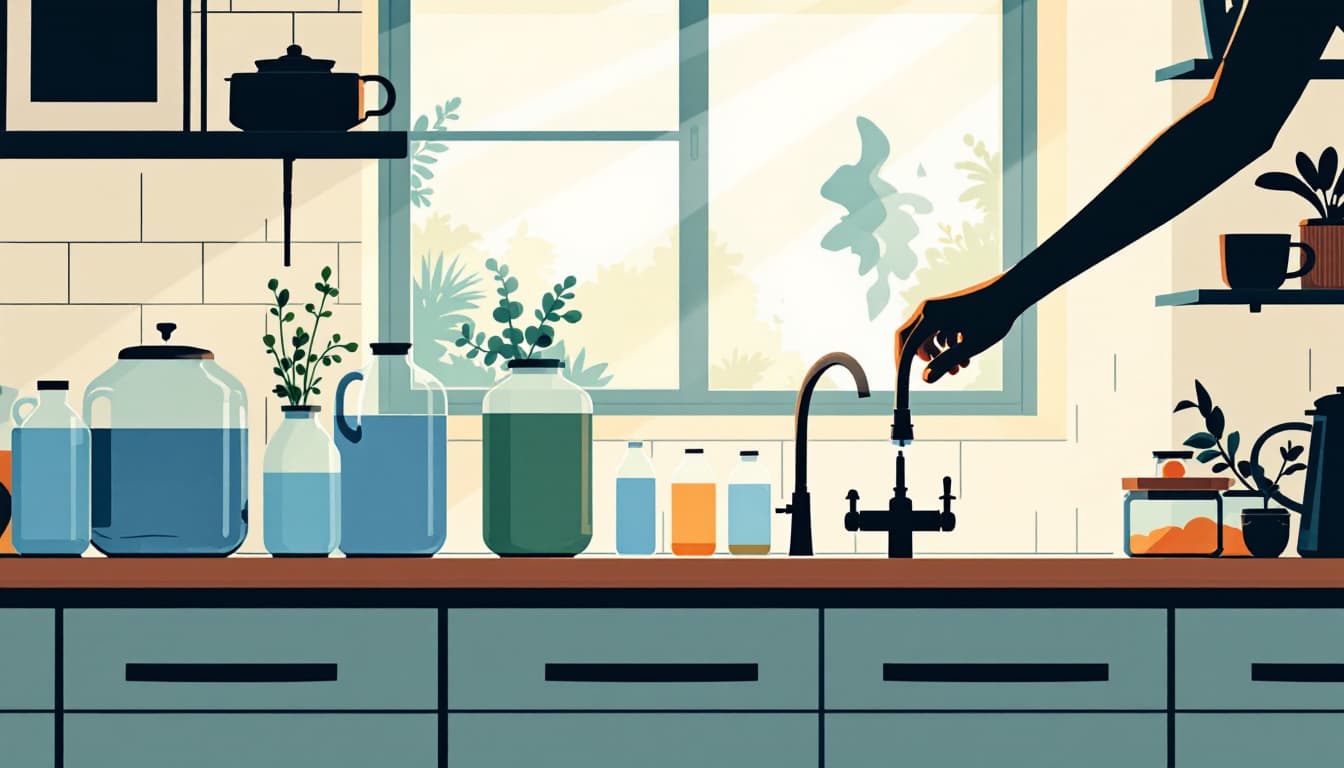
Imagine you've done everything right. You have fourteen one-gallon jugs lined up in your basement — two weeks of water for a single adult, according to the math you read on roughly every preparedness site that exists. You feel prepared. You've checked the box.
Then a boil-water advisory hits your neighborhood after a main break. It lasts five days. You come home from work on day two, genuinely thirsty, and realize you've been unconsciously avoiding your stored water because it's inconvenient to access — the jugs are stacked behind the camping gear — and also because you haven't thought through what "fourteen gallons" actually means when you're living a normal life in a house with a dishwasher you're not going to run.
The water breaks down. The counting begins. And you discover that the number on the label was never really the problem.
The orthodoxy and why it sticks
The "one gallon per person per day" guideline comes from FEMA and has been echoed by the Red Cross and virtually every state emergency management agency for decades. It's not wrong, exactly. For survival — drinking and basic sanitation — it holds up reasonably well in mild conditions.
But it's been laundered through so many blog posts and YouTube channels that it's acquired false precision. People treat it as a complete answer when it's really just a floor — a number designed for the most austere possible scenario, not for the reality that most disruptions aren't austere. Most disruptions are inconvenient. You still go to work. You still cook. Kids still want to wash hands before dinner. The dog still needs water.
The preparedness internet has compounded this by turning water storage into a quantity competition: how many gallons can you fit in your basement? Five hundred? A thousand? There are entire subreddits dedicated to storage vessel specifications. What you almost never see is a conversation about use modeling — actually tracking how your household uses water on a normal day and building your storage plan around that number.
What the math actually looks like
The USGS estimates that the average American uses roughly 80–100 gallons of water per day when you include toilet flushing, laundry, showering, dishes, and cooking. Obviously, you're not going to replicate that from stored supplies during an emergency. But "1 gallon" assumes you're in a desert survival scenario. The realistic disruption — a boil advisory, a winter pipe freeze, a brief infrastructure outage — lands somewhere in the middle.
A more honest planning number for a household that wants to stay reasonably comfortable during a 3–5 day event is probably 3–5 gallons per person per day, once you account for cooking water, pets, hand washing, and basic hygiene. That's three to five times what most families are storing.
Here's the counterintuitive part: the answer is not necessarily to store more water. It's to have a clearer map of which uses you'd cut first, which you'd protect, and what alternatives you have for each.
Toilet flushing? Fill a bathtub in the first hours of an advisory — that water is fine for flushing for days. Cooking? Most households can shift to no-cook meals for a week with modest pantry depth. Pets? They need roughly the same amount per pound as humans. Drinking? Absolutely protect this from your stored supply.
Once you've done that mapping, you might find you need more stored water than you have. You might also find that a $35 LifeStraw filter you can use on tap water that's microbiologically suspect gets you further than two more cases of Poland Spring.
What to do this week
-
Run your own number. Track a rough estimate of your household's daily water use across categories — drinking, cooking, hygiene, pets. Don't use the national average; use yours.
-
Audit your stored water for access, not just volume. Is it actually reachable at 11pm when you don't want to move boxes? If not, reorganize before you buy more.
-
Identify your lowest-cost gap-fillers. A collapsible 5-gallon jug ($10–15) stored flat under a sink can be filled at the first sign of trouble. A bathtub bladder insert (~$30) gives you 100 gallons from your tub in a boil advisory — filtered water you can use for sanitation.
-
Match your filter to your scenario. Boil advisories are about bacteria and protozoa. A basic gravity filter handles those. You don't need a $400 setup for a suburban water disruption.
The bigger picture
The preparedness industry — including well-meaning government agencies — tends to package guidance in ways that feel actionable without requiring much thought. "Store one gallon per person per day" is that kind of guidance. It's not wrong. It's just incomplete in a way that makes people feel done when they're not quite there yet.
The families who handle disruptions best aren't the ones with the most gallons in the basement. They're the ones who've spent an hour actually thinking through what water does in their house, and where the seams are. That's not glamorous. It doesn't make for a great YouTube thumbnail. But it's the difference between a preparedness plan and a preparedness prop.