
Why your household needs to think about this now
A portable inverter generator occupies a strange middle ground in home preparedness: too expensive to buy impulsively, too important to skip if you live somewhere that loses power more than once a year. Unlike a whole-house standby unit, a portable inverter generator is something you can actually own on a middle-class budget, store in a garage, and have running within five minutes of a grid failure. The inverter part matters more than most buyers realize — the clean sine wave output (measured as total harmonic distortion, or THD) is what makes it safe to plug in a CPAP machine, a laptop, a modern refrigerator's control board, or a router without risking damage. Conventional generators, even good ones, can't always say the same.
The category has matured considerably. All three picks here produce clean power, run quietly enough that neighbors won't call the police, and will start reliably if you've kept up basic maintenance. The real decisions are about capacity, fuel strategy, and how much weight (literal and financial) you're willing to carry.
What we actually looked for
Specs matter less than most reviewers let on. A generator that looks impressive on paper but gums up its carburetor after six months of storage is worse than useless in an emergency. So beyond raw wattage and noise figures, we weighted: fuel flexibility (propane stores indefinitely; gasoline goes stale in 30–90 days without stabilizer), cold-start reliability, THD for sensitive electronics, and realistic runtime per tank at a load you'd actually run. We also looked hard at weight — a 260-lb generator that requires two people and a dolly to deploy is a different product category than a 39-lb unit that fits in a car trunk.
Matching the pick to the household
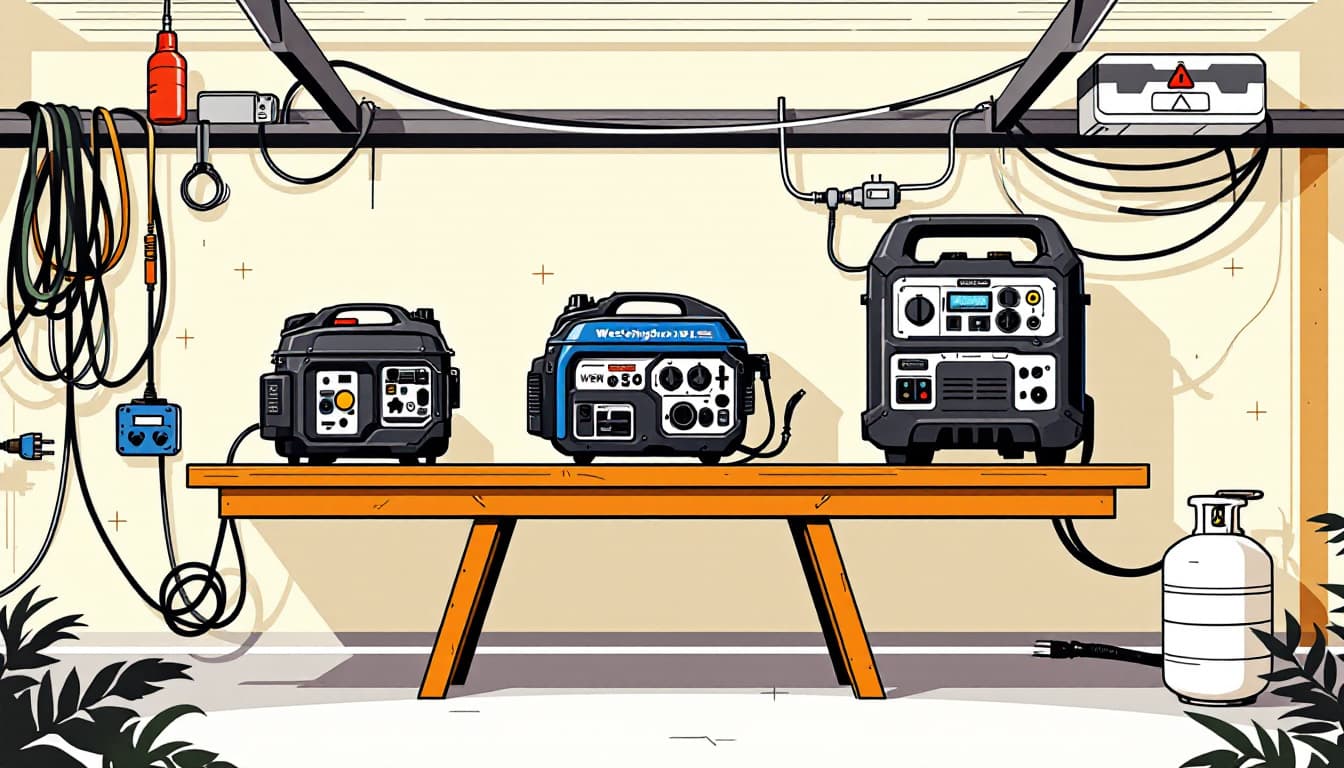
The WEN 56235i is for people who have been putting off buying anything because the good generators felt unaffordably expensive. At under 40 lbs and under 1.2% THD, it is genuinely one-person portable and genuinely safe for sensitive electronics. Its 1,900W of running watts will keep a full-size refrigerator running, power lights, charge phones and laptops, and run a CPAP — but not all of those things at peak draw simultaneously, and certainly not alongside a window air conditioner. The 1.1-gallon tank is the other honest limitation: during a multi-day outage at moderate load, you will be refueling more often than you'd like. Pull-start only, gasoline only. But for an apartment, a small house, or a household where the generator is primarily a medical-device insurance policy, nothing else at this price delivers comparable inverter quality.
The Westinghouse iGen4500DF is the pick for the majority of single-family homes. The dual-fuel capability — switchable between gasoline and propane even while running — is not a marketing footnote; it is a genuine preparedness advantage. Propane doesn't degrade in storage, which means a household that keeps a full 20-lb tank on hand (the same one that feeds the backyard grill) has a generator that is always ready. On gas, the 18-hour runtime at 25% load is outstanding. At 3,700W rated output, it handles a refrigerator, sump pump, furnace blower, and basic lighting simultaneously — the core of what most households actually need to sustain during a multi-day outage. The wireless remote start is a genuine quality-of-life feature when it's raining and the generator is in the backyard. The one meaningful infrastructure caveat: no 240V outlet, so connecting it to a whole-home transfer switch requires some electrical planning. For most households running extension cords or a 30-amp interlock on a partial panel, this won't matter.
The Honda EU7000iS is a serious piece of capital equipment, not an impulse purchase. At roughly $4,200, it costs more than many used cars. What you are buying is a GX390 engine engineered for a 20-plus year service life, electronic fuel injection that eliminates the carburetor reliability problems that plague emergency generators, CO-MINDER auto-shutoff that protects your family if you make a dangerous placement error, and 7,000W of 120/240V peak power that can start a 3-ton central air conditioner. The Bluetooth app for remote monitoring is a convenience; the EFI and the Honda dealer network are the real value propositions. If you have a well pump, a medical dependency on powered equipment, or simply live somewhere that loses power for a week at a stretch, the math on the Honda becomes defensible. One thing to know before ordering: Amazon listings for this unit are sold through authorized third-party dealers rather than directly by Amazon — verify the seller's credentials before completing the purchase.

