
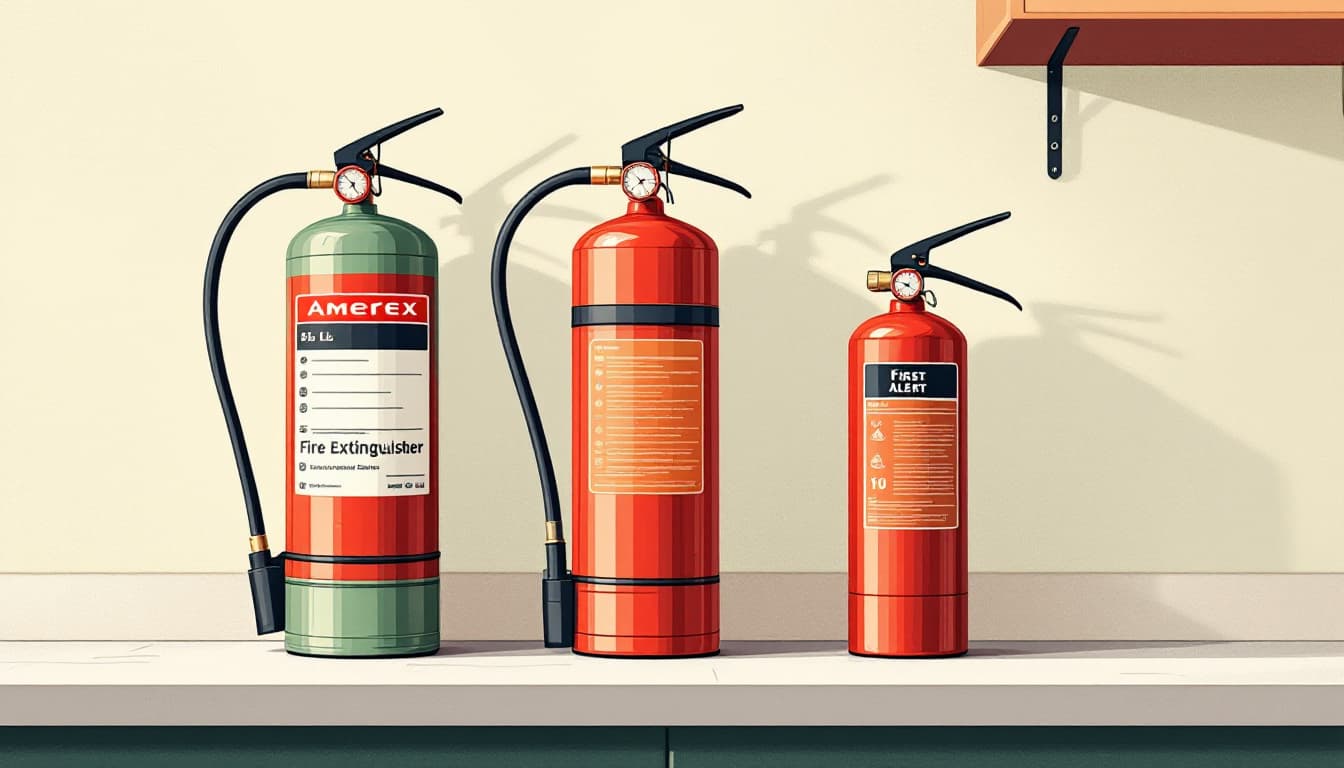
Why this category deserves a real decision, not an afterthought
Most households own a smoke detector and call it fire preparedness. That's necessary but not sufficient. A working extinguisher in the right place — wielded in the first thirty seconds of a kitchen fire — is the difference between a ruined pan and a gutted house. The National Fire Protection Association recommends at least one extinguisher per floor, with particular attention to the kitchen and garage, the two rooms where ignition risk is highest. For a category that costs under $100 and lasts years, there's no good reason to leave this undone.
The harder question isn't whether to buy one — it's how many and which kind. The market sorts neatly into rechargeable units you treat as permanent household assets and disposable units you treat as affordable redundancy. Both approaches are legitimate. What's not legitimate: buying one cheap single-use extinguisher, hanging it in the kitchen, and assuming you're covered.
What actually matters when choosing
UL rating first. The alphanumeric on the label (like 1-A:10-B:C or 3-A:40-B:C) tells you how big a fire the unit can handle. Higher numbers mean more effective range against larger fires. For a kitchen or garage, more rating headroom is better. For a bedroom hallway where you're buying a third unit as redundancy, the minimum residential rating is fine.
Rechargeable vs. disposable. A rechargeable unit, after discharge, can be refilled by a certified technician and returned to service — making it a true long-term asset. A disposable unit must be replaced after any discharge, and again at end of service life. If you're placing a single extinguisher in a critical location, rechargeable is the smarter long-term spend. If you're buying three or four units to saturate every floor, disposables can make economic sense.
Valve and handle materials. All-metal valves and handles hold up to the stress of emergency use and decade-long storage better than plastic components. This isn't a minor detail — a seized plastic valve under adrenaline is a useless extinguisher.
Weight and wieldability. A 10-pound extinguisher is meaningful protection. It's also heavy for a smaller adult or older household member in a panic. Match the unit to the person most likely to use it.
Who each tier is right for
Premium (Amerex B500): If you're buying one or two extinguishers and want to be done with the decision for a decade or more, this is your pick. The all-metal construction, rechargeable design, and top-tier 3-A:40-B:C UL rating make it the closest thing to a commercial unit that will fit on a residential kitchen wall. The 2-pack configuration is the real value unlock — cover the kitchen and garage simultaneously, the two rooms that account for the majority of residential fires. The weight (around 10 lbs when full) is a genuine consideration for households with smaller adults as primary users.
Value (First Alert HOME1): This is the right extinguisher for most households. It's rechargeable, all-metal, lightweight enough for nearly any adult to wield confidently, and has the broadest verified real-world trust base in the category. The 1-A:10-B:C rating is lower than the Amerex, which matters at the margins — but for a kitchen grease fire caught early, it's more than adequate. The included wall bracket and U.S. Coast Guard approval add quiet confidence. Check the safety pin monthly; it can sit loosely.
Budget (Kidde FA110G): Don't read "budget" as "inferior for its purpose." The FA110G meets NFPA minimum recommendations and is Amazon's best-selling extinguisher for good reason. Its purpose is coverage breadth: at $22 a unit, a household can place one in the kitchen, one in the garage, and one near the bedroom hallway for less than the cost of a single premium pick. The trade-offs are real — it's single-use, lighter-duty, and the aluminum body feels less substantial — but as a saturation strategy, it's defensible and smart. Just keep a rechargeable unit in the kitchen, where you're most likely to need it, and use the Kidde units to fill the gaps.

