
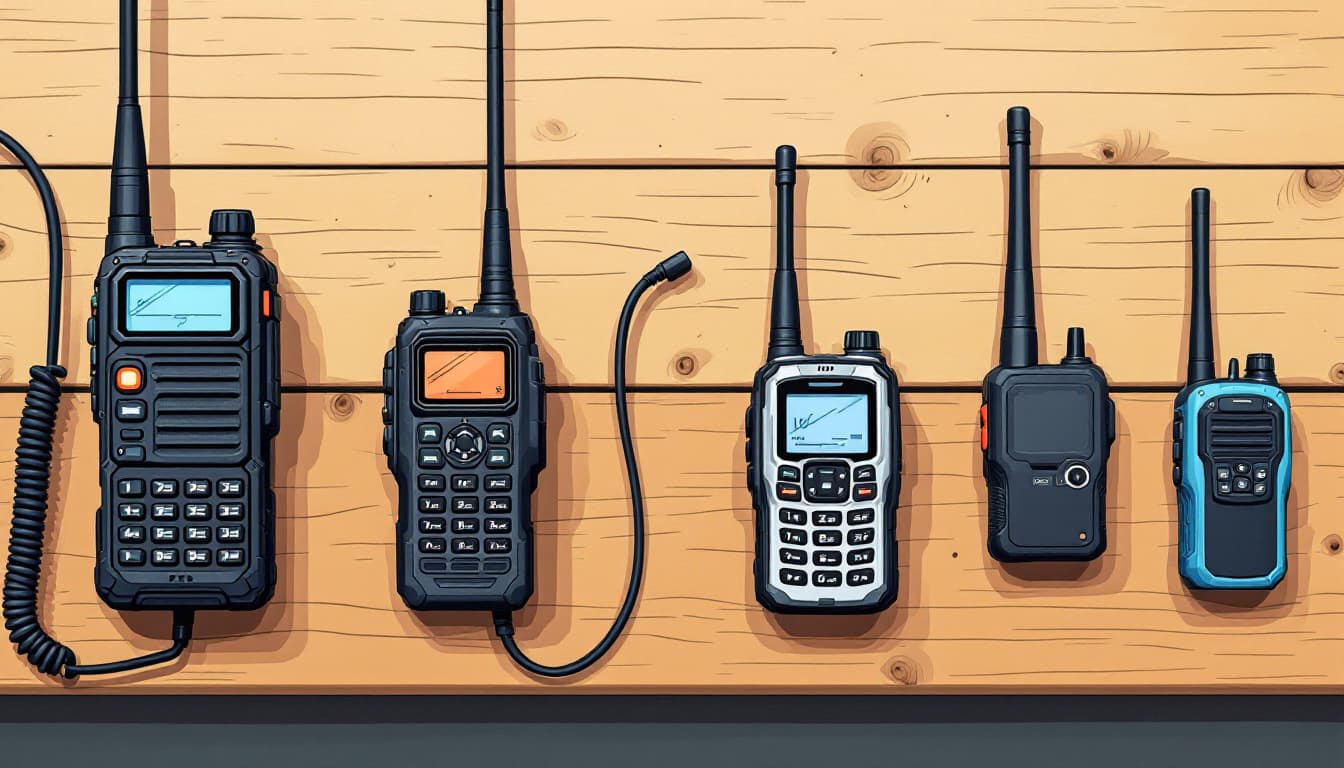
Why every household needs two-way radios
A cell phone is a wonderful thing until the network it depends on is congested, the tower loses power, or you're somewhere the signal never reached in the first place. Concerts, stadiums, wildfire evacuations, regional storms, and ordinary neighborhood power outages all share the same failure mode: everyone reaches for their phone at once and the system buckles. A pair of two-way radios doesn't care how many other people are trying to make a call at the same moment — it just works, point to point, as long as the batteries are charged.
This isn't bunker gear. It's the same category of tool a family already half-owns in the form of a cheap pair from a big-box store, just upgraded to something that actually reaches across a neighborhood, a campground, or a hiking group spread out on a trail. The practical use cases are mundane and constant: keeping track of kids at a crowded event, coordinating a caravan on a road trip, staying in touch during a power outage when cell towers are running on backup batteries, or simply talking house-to-yard without shouting.
We're deliberately not covering NOAA weather radios here — that's a separate category for passive weather monitoring, and we've reviewed it elsewhere. This review is about two-way sets: radios built for a family or small group to talk to each other, not just listen to a broadcast.
What we actually looked for
We focused on GMRS (General Mobile Radio Service) and FRS (Family Radio Service) handheld sets sold as multi-packs, since that's how households actually buy these — two, four, or more radios at once for the whole family. We weighed advertised range against realistic range reported by actual owners and independent testers, since every radio in this category is marketed with a best-case, no-obstruction, mountaintop-to-valley number that has little to do with how it performs in a neighborhood or on a wooded trail. We also rechecked current Amazon stock and pricing directly — our first-choice budget pick, the Motorola T107, turned out to have no current new stock at anything close to a budget price, which is exactly the kind of thing that goes stale if a list isn't rechecked.
We also weighed license requirements honestly. GMRS radios need an FCC license to operate legally — as of this writing, that's a flat $35 fee, good for 10 years, with no test required, and it covers every member of your immediate family under one license. FRS-only radios need no license at all but are capped at lower transmit power by law, which caps their real-world range in exchange.
The premium pick: BTECH GMRS-PRO (~$155)
The GMRS-PRO earns its price by doing things the other radios here simply can't: it transmits at the full 5 watts GMRS handhelds are permitted, and it's built to work with GMRS repeaters, which can turn a few miles of range into real regional coverage if you're near one. The IP67 housing is rated for 1 meter of submersion for 30 minutes, not just splashes.
Where it earns its "premium" label most clearly is the Bluetooth and app layer: pairing two GMRS-PRO units lets you share GPS locations, send off-grid text messages, and program channels from a phone app instead of wrestling with tiny buttons and a manual. That's a genuinely different tier of capability than a basic Midland or Motorola offers.
The tradeoffs are real. This radio is sold individually, not as a 2- or 4-pack, so equipping an entire family costs meaningfully more than the multi-packs below, and Amazon itself flags it as a "frequently returned item" — worth knowing going in, even with a strong spec sheet. It's the right pick for the household that wants the best tool available and is willing to pay and learn for it, not the default recommendation for everyone.
The value pick: Midland GXT1000VP4 GMRS Two-Way Radio, 2-Pack (~$79)
This is the pick that will satisfy the overwhelming majority of households without any buyer's remorse. It carries the deepest review base of any radio in this review — over 13,000 ratings at 4.4 stars — and its extra transmit power gives it clearly better range and audio clarity than FRS-only radios in side-by-side use. The 50-channel, 142-privacy-code system makes it easy to find a quiet channel away from other GMRS users in a crowded area, and the built-in NOAA weather alert function is a genuine value-add for a household radio.
It runs on 8 AA batteries rather than a sealed rechargeable pack, which is a plus if you want to keep it running with off-the-shelf batteries during a long outage, but means an ongoing cost unless you supply your own rechargeables. It's water resistant, not waterproof, and the menu system takes a few minutes with the manual to fully understand the first time. None of that changes the basic math: for around $40 per radio, this is the multi-pack most families should actually buy.
The budget pick: Motorola Solutions T270 Talkabout, 2 Pack (~$45)
We'll be upfront about how we got here: our original budget pick, the Motorola T107, currently has no new stock on Amazon — only used units priced close to the Midland above, which isn't a real budget option anymore. The T270 is Motorola's rechargeable step-up radio, carrying an Amazon "Overall Pick" badge and a stable listing at roughly $45 for the pair, genuinely cheaper than the Midland.
It's FRS-only, meaning it's legal to use straight out of the box with no FCC license, no application, and no waiting period, and its rechargeable battery packs avoid the ongoing AA cost of disposable-battery radios. The honest tradeoff is range and reviews: FRS power is capped by law, so realistic range is well under the advertised 25 miles, closer to a quarter-to-half mile in a typical neighborhood, and its review base (150 ratings) is far thinner than the Midland's. It also skips NOAA weather scanning entirely. For backyard, campsite, or "keep track of the kids" duty on a tighter budget, it's a reasonable, currently-available choice — just go in knowing it's a step down from the Midland, not a clone of it.

