The dry season usually arrives in your house through the weather app. A red-flag warning you swipe away. An air-quality number that turns the sky the color of a dirty penny by mid-afternoon. A note from the water district about voluntary restrictions that you mean to read and don't. By the time wildfire and drought are something your household is actively thinking about, the season is usually already underway, and the calm afternoon you needed to prepare has been replaced by a hot Tuesday morning and a column of smoke on the horizon.
This is a piece for the household that wants to think about it earlier — not anxiously, not in bunker mode, but seriously. Middle-class preparedness around fire and water is less about predicting which town burns this year and more about positioning your household so that whatever the season brings flows around you rather than through you. The risk is real and it is growing. It is also, for most readers of this site, navigable with a handful of unglamorous moves made before you need them.
Here is what is actually happening, who is most exposed, and the six concrete plays a thinking family can make over the next few months.
The shape of the disruption
There are three forces pushing on the household at once, and it helps to name them separately rather than letting them blur into a single sense of dread.
The first is a longer, drier fire season. The window when the landscape is dry enough to burn has stretched at both ends — fires that once belonged to August now show up in late spring and linger into the fall. This year that pattern arrived early again: fuel-moisture readings across the West hit midsummer dryness while the calendar still said spring, and the season's outlook called for above-average fire potential across large stretches of California, Oregon, Washington, Colorado, and Arizona. We wrote about that early start when wildfire season opened roughly six weeks ahead of schedule, and the underlying driver — drier fuels for more weeks of the year — is the part that doesn't reset when the rains finally come. Smoke compounds the reach: a fire two states away can put your own neighborhood under an air-quality advisory for a week, which is why the instruction to "keep your windows closed" quietly asks more of a household than people realize.
The second is tightening water. Across the interior West and the Southeast alike, the margin between what falls from the sky and what households, farms, and utilities want to draw has narrowed. The signs are everywhere once you start noticing them: Oregon treating drought as a household problem and not just a farm problem, sharper Colorado River forecasts translating into real cuts for Arizona households, NOAA's seasonal drought outlook setting the tone for Texas, and Florida moving from voluntary asks to formal water-shortage orders. For most households this shows up first as a higher water bill and a watering-day schedule, then as the slow realization that the cheap, reliable, always-on water of the last few decades is becoming a managed resource.
The third force — and the one that hits the middle-class balance sheet hardest — is the insurance and cost retreat. As losses mount in fire- and drought-stressed regions, insurers raise premiums, tighten terms, or stop writing new policies altogether, and state insurers-of-last-resort absorb the risk no one else will take. The cost lands on you as a renewal letter, a non-renewal notice, or a quote that doubles. It is telling that in some Colorado markets realtors have started hosting wildfire-preparedness webinars — when the people who sell houses start running fire clinics, the financial system is repricing the risk in real time, and the household feels it through the mortgage escrow account.
None of these three forces is apocalyptic on its own. A single bad fire year passes. A drought breaks. An insurer can be replaced. Together, though, they form an environment where the middle-class household has to be a little more deliberate than it used to be — not afraid, just awake.
Who is most exposed
We do not write here to alarm. We write to help readers see themselves in the pattern, because exposure to fire and drought is far more legible than people assume. It is mostly about where you live and how your house is built, and both are things you can partly act on.
Most exposed: households in the wildland-urban interface — the zone where neighborhoods meet brush, forest, or grassland. If you can see undeveloped vegetation from your property line, your home's risk is set less by the structure itself than by what surrounds it. Add an older roof, wood fencing that runs right up to the siding, a deck with stuff stored underneath, and a single defensible-space rule no one has enforced in years, and you have a house that an ember storm treats as kindling. The same households are often the ones facing the steepest insurance repricing, which means the exposure is financial and physical at the same time.
Moderately exposed: households on stressed water systems and aging grids. If your water comes from a single reservoir, a declining aquifer, or a river basin already under allocation fights, your supply is more fragile than your tap suggests — and your bill will move first. Heat and fire also lean on the electrical grid exactly when you need it most, so the same regions tend to face rotating outages and red-flag power shutoffs during the worst stretches. You may never see a flame and still spend a week each summer managing smoke, heat, a watering ban, and a precautionary power outage at the same time.
Less exposed but not insulated: suburban and urban households well away from the interface, on diversified water systems. Your home is unlikely to burn. But smoke does not respect zip codes, drought sets the price of water and a surprising amount of your food, and the insurance and tax effects of regional disasters socialize across whole states. "Less exposed" means you have time and options, not that the season skips you.
Genuinely immune: almost no one. Even households far from any fire perimeter are paying for the dry decade through grocery prices, utility rates, and the slow upward drift of what it costs to insure a home anywhere in a state with a bad loss year. The right mental model isn't "will my house burn" but "what does a hot, dry, smoky, expensive ten weeks look like for my household every year — and am I set up to move through it without a crisis?"
What we'd actually do
Here is the playbook. Six plays. Some protect the structure, some protect the budget, some protect the people. They are all things a middle-class family can act on this season without buying a compound or a bunker.
1. Win the defensible-space game in the first five feet
The single highest-leverage fire move is also the cheapest, and almost nobody finishes it: clear the zero-to-five-foot band immediately around your house of anything that burns. Most homes that ignite in a wildfire are not torched by a wall of flame — they are lit by wind-blown embers that land on a dry doormat, a wood mulch bed against the foundation, a stack of firewood on the deck, or leaves in a gutter. Embers travel far ahead of any fire, which is why this play matters even for households that aren't in the deepest interface.
Pull combustible mulch back from the siding and replace it with gravel or bare soil in that first band. Move the firewood pile away from the structure. Clean the gutters and the roof valleys. Screen the vents and the gap under the deck so embers can't blow into the crawlspace. Trim the branches that overhang the roof. None of this requires a contractor or a permit, and a determined household can do the whole first-five-feet zone in a weekend with a rake, a pair of loppers, and some gravel. It is the rare preparedness move where the recommended version and the affordable version are the same version.
2. Pack the go-bag your family will actually grab
Plan to leave early, because the households that get hurt are usually the ones that wait for certainty that never comes. The point of evacuation prep is to make leaving a non-decision: when the alert comes, you grab and go, you don't deliberate.
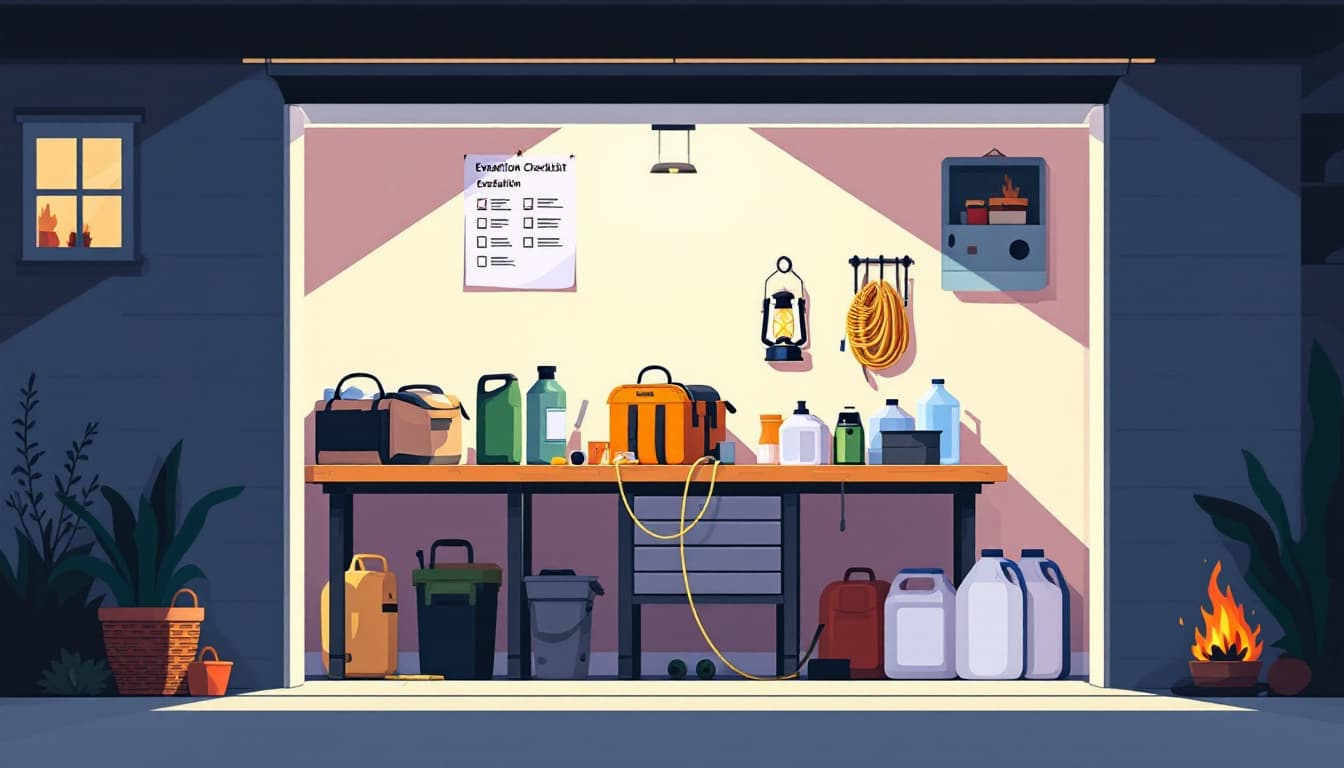
Stage one waterproof bin per person near the door you'd actually use, packed now, not the night of. In each: two changes of climate-appropriate clothes, a copy of insurance documents and IDs and the deed or lease, any prescriptions, a phone charger and battery pack, a little cash, and the irreplaceable items — photos, a hard drive, the small box of things you'd grieve. Keep one go-bag list on the fridge for the things that can't be pre-packed (the laptop, the medications in current use, the pet) so a stressed person isn't trying to remember them. Photograph every room and closet on your phone today; that five-minute video is the single most useful thing you can have when filing a claim, and it's worthless if you shoot it while the smoke is already in the driveway.
3. Build a one-week buffer of water, air, and power
The most common dry-season experience is not evacuation — it's a stretch of days where the supply you take for granted gets unreliable. Smoke makes the outdoor air unhealthy, heat strains or trips the grid, and a watering ban or a main break makes water something you ration. A modest buffer turns each of those from an emergency into an inconvenience.
For water, store roughly one gallon per person per day for a week, rotated a couple of times a year, plus a plan for the toilet and the pets. For air, own at least one room's worth of real filtration — a HEPA purifier sized to a bedroom, or the box-fan-and-furnace-filter version that costs a fraction as much and genuinely works — so there is one clean room in the house when the smoke settles in. For power, a few charged battery banks, a battery or crank radio, and a way to keep phones and a CPAP or a fridge of medications going through a multi-hour outage. This is the buffer that lets you stay calm and home through the ordinary bad week, which is the scenario you'll actually face most years.
4. Harden the house one upgrade per season
Beyond the five-foot zone, a home's fire survivability comes down to a handful of structural details, and you do not have to do them all at once. Pick the highest-risk one each season and retire it. Ember-resistant vents. A Class A roof when the current one is due for replacement anyway. Tempered or dual-pane windows on the exposures facing vegetation, since radiant heat breaks single-pane glass and lets embers inside. Non-combustible fencing in the last stretch where the fence meets the house, so a burning fence doesn't become a fuse. Boxing in the eaves and the underside of decks.
The discipline here is sequencing rather than spending. A household that adds one hardening upgrade a year — ideally folded into maintenance you were going to do anyway — ends up, in five years, with a meaningfully more survivable home and a much better insurance story, without ever having faced a single overwhelming bill. The same logic applies to drought-proofing the yard: each season, replace one thirsty patch of lawn with native, low-water plants, so your landscape and your water bill both get more resilient on a schedule you control.
5. Get ahead of the insurance and money side before it gets ahead of you
The financial hit from the dry decade often arrives faster than the physical one, and it rewards households that move first. Read your homeowner's policy now, while nothing is on fire, and find three numbers: your dwelling coverage (can it actually rebuild your house at today's construction costs, which have risen sharply?), your deductible (is there a separate, larger wildfire or wind deductible buried in there?), and your coverage for additional living expenses if you're displaced for weeks. Underinsurance is the quiet way disasters turn middle-class families into financially precarious ones.
If you've had a non-renewal or a brutal quote, document your hardening work — photos, receipts, a written defensible-space record — because it increasingly affects both eligibility and price. Understand your state's insurer of last resort as the backstop it's meant to be, not a permanent home. And keep this in the same frame as the rest of household preparedness: the deep cash buffer we've written about for riding out other kinds of disruption does double duty here, covering the deductible, the evacuation hotel, and the gap before a claim pays out. Time and liquidity are what turn a disaster into a manageable expense.
6. Wire yourself into the local signal before the season peaks
Most households consume disaster information through the worst possible channel: national news and social media, which arrive late, generalized, and tuned for alarm. Replace it with the local signal. Sign up for your county's official emergency alert system — the one that texts evacuation orders to your specific zone — today, because registering takes five minutes and is useless to do during an evacuation. Know your zone name or number. Identify the two roads out of your neighborhood and a backup in case the obvious one is closed or jammed. Pick an out-of-area relative as the family's contact point, since local lines and towers fail exactly when everyone needs them.
Then make it neighborly. The household with a generator, the friend across town with a guest room and clean air, the neighbor who'll grab your pets if you're at work when the order comes — that mutual-aid web is the most durable resilience asset there is, and it's built in calm weather over a fence, not improvised in an emergency. A short conversation now ("if it ever goes sideways, here's my plan, what's yours?") is worth more than most of the gear in this article.
What we'd skip
A few things the wildfire-and-drought discourse will push on you that we'd let go past.
Don't sink your budget into a whole-house standby generator as your first move. They're wonderful and they're expensive, and a household that spends five figures on backup power while skipping the free five-foot defensible-space work has bought the trophy and ignored the homework. Battery banks and a clear evacuation plan protect more for less. If you eventually want whole-house backup, buy it after the cheaper, higher-leverage moves are done.
Don't over-invest in a respirator collection or exotic survival gear. A couple of well-fitting N95s per person and one good room air purifier handle the smoke scenario the overwhelming majority of households actually face. The pallet of gas masks and the wall of specialized equipment are answering a movie, not a season. Spend the money on the boring buffer instead.
Don't treat "this place is doomed" as settled wisdom — or as nothing. The discourse swings between "the West is uninhabitable" doom and a shrug. Both are wrong. Most homes in fire country are defensible with work, and most droughts are managed, not biblical. But if your specific property is in a severe interface zone with one road out and an insurance market that's actively fleeing, that's real information, and a multi-year plan to harden, sell, or relocate is a legitimate adult decision rather than a panic. Hold both: don't catastrophize the region, don't ignore a genuinely bad lot.
Don't fixate on the cinematic grid-collapse scenario. It's easy to spend your preparedness energy on the permanent, civilization-ending blackout. We've argued before that the months-long grid-down scenario is not the threat worth planning your life around. The realistic dry-season risk is a smoky, hot, expensive week with a precautionary outage in the middle of it — and the buffer that handles that handles almost everything short of the apocalypse you're better off not organizing around.
The bigger picture
The dry decade is real and it is structural. The seasons are longer, the water is tighter, and the financial system is repricing where it's safe to live. That is the honest backdrop. It is also, for the careful household, a manageable adjustment rather than a catastrophe.
The pattern of every slow-moving environmental shift is the same: the households that moved five years early — who cleared the defensible space, hardened the house one upgrade at a time, built the buffer, read the policy, and wired into the local signal — come through each bad season tired but fine. The households that wait for certainty discover that certainty arrives as smoke in the driveway, when every option is more expensive and most of them are gone. The window for this kind of preparation is the calm part of the year, which for most readers is right now.
The household that does the playbook above ends up with a more survivable home, a lower water bill, a buffer that absorbs the deductible and the hotel, a better insurance story, and a neighborhood it can lean on. None of those moves require predicting which town burns this year. All of them just require taking an ordinary Sunday seriously before the season makes the decision for you.
The household that does nothing will probably be fine in a mild year. The household that does the playbook will be fine in a bad one too. That asymmetry is the entire point of preparedness.
Pick one of the six plays this week — the five-foot zone is the one we'd start with — and finish it before the weekend ends. The dry season doesn't wait, and neither does the calm you need to get ready for it.