The National Interagency Fire Center's May outlook landed Friday, and it's the most aggressive May briefing we've seen since 2021. Significant fire potential is elevated through July across most of California, Oregon, southern Washington, western Colorado, and northern Arizona. Dead and live fuel moisture readings in the Sierra and Coast Range are running 30-50% below the ten-year average for this date — which is to say, the kindling is already at July dryness in May.
If you live in any of those geographies, or downwind of them, here are three things worth doing this weekend. None of them require shopping for anything fancy. All of them get easier with a calm Sunday afternoon and harder with a hot Tuesday morning at 6:14 a.m. when you're watching the smoke column from your driveway.
1. Pack the go-bag your family will actually grab
Most preparedness lists tell you to pack a 72-hour kit. Most families don't, because the typical kit is built for an imaginary household with infinite trunk space and no actual life. Here's a more realistic version.
One waterproof plastic bin per adult, lid included, near the door you'd use to leave. In each bin:
- Two changes of clothes (climate-appropriate)
- A copy of insurance documents, IDs, and the front of the deed
- Phone chargers and a power bank, fully charged, that you actually rotate
- Any prescription medication, with a printed list of dosages
- A list of phone numbers on paper (when cell towers burn, your phone's contacts go with them)
- Cash, $200-$500 per household, small bills
- A photo of every room in your house, taken on your phone right now, for insurance purposes
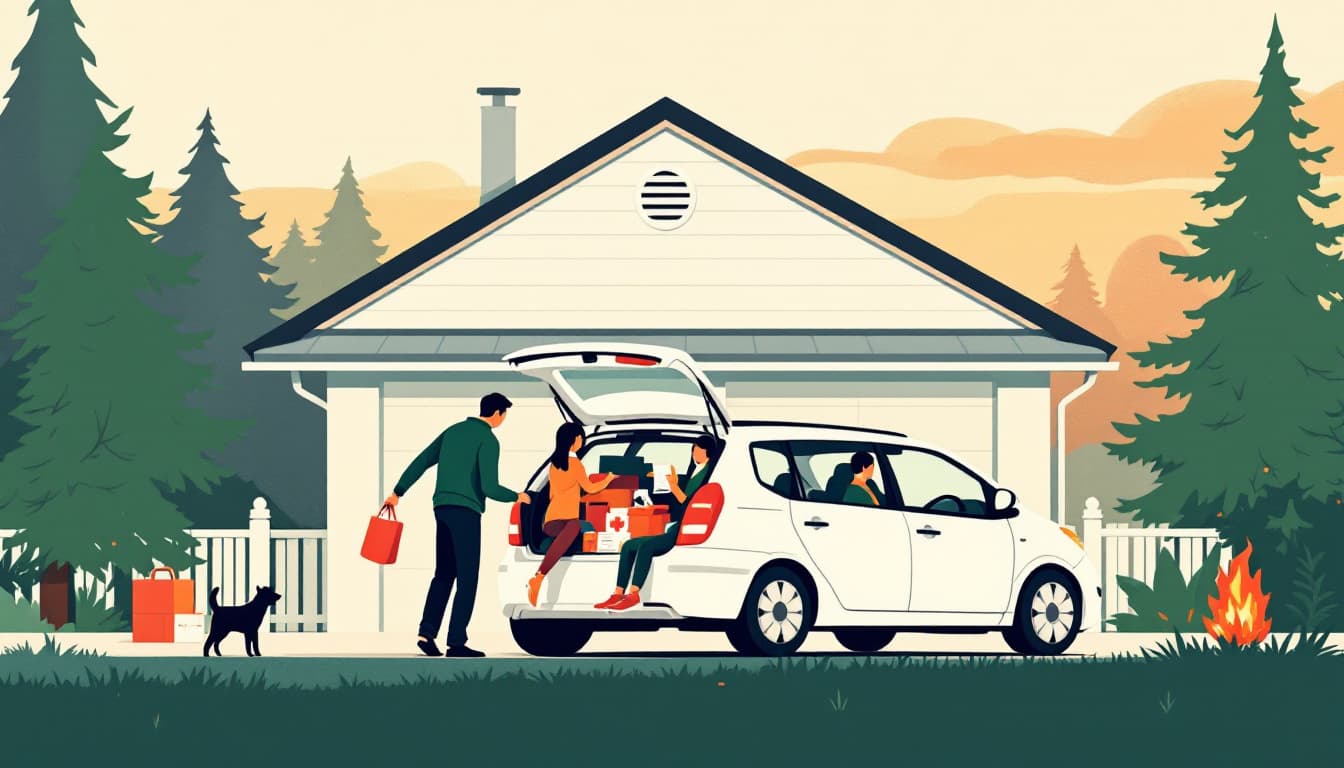
That's it. No tactical anything. No three days of MREs. A bin you can grab and throw in the back of a Subaru in under ninety seconds.
Bonus move: put one in each vehicle, too, in case you're not home when the order comes.
2. Walk your home's "defensible space" with a contractor's eye
Stand 30 feet from your house. Look at it the way a fire would.
What you're looking for: anything within 5 feet of the structure that will burn — wood mulch against the foundation, dry leaves in gutters, juniper bushes against siding, firewood stacked against the wall, a wooden fence connecting directly to the house. These are not aesthetic problems. They are wicks.
A single Sunday afternoon with a rake, a ladder, and a pair of pruners will do more for your home's survival than $5,000 of fire-rated upgrades. The Insurance Institute for Business & Home Safety's research is unambiguous on this: the homes that survive the wildland-urban interface fires are overwhelmingly the ones with clean 5-foot zones, not the ones with stucco siding.
If you do nothing else: clean your gutters, move firewood at least 30 feet from the house, and rake the leaves out from under your deck.
3. Sign up for your county's emergency alerts. Today.
This is the highest-leverage, lowest-effort task on this list, and almost nobody does it until they wish they had.
Every county in the affected geography has an emergency notification system — usually CodeRED, Everbridge, or Genasys. They send evacuation orders, road closures, and air quality warnings directly to your phone. They are not the same as Wireless Emergency Alerts (the federal ones that come automatically). The county systems are opt-in and are usually faster and more granular.
Go search "[your county name] emergency alerts signup." Spend five minutes. Add every adult in your household.
What we're not telling you
We're not telling you to buy a generator, a $400 air purifier, or an N95 stockpile. Those may be reasonable purchases for your situation, but they are not the high-leverage moves. The high-leverage moves are the ones above. They are unglamorous, they are free or close to it, and they are the things people who lost their homes in 2017, 2018, 2020, and 2024 wished they had done.
If you want a thorough, household-specific evaluation of your wildfire exposure — what's actually a risk for your geography, your home construction, and your family — that's a conversation worth having.
Stay calm. Get the alerts. Walk the perimeter. Pack the bin.