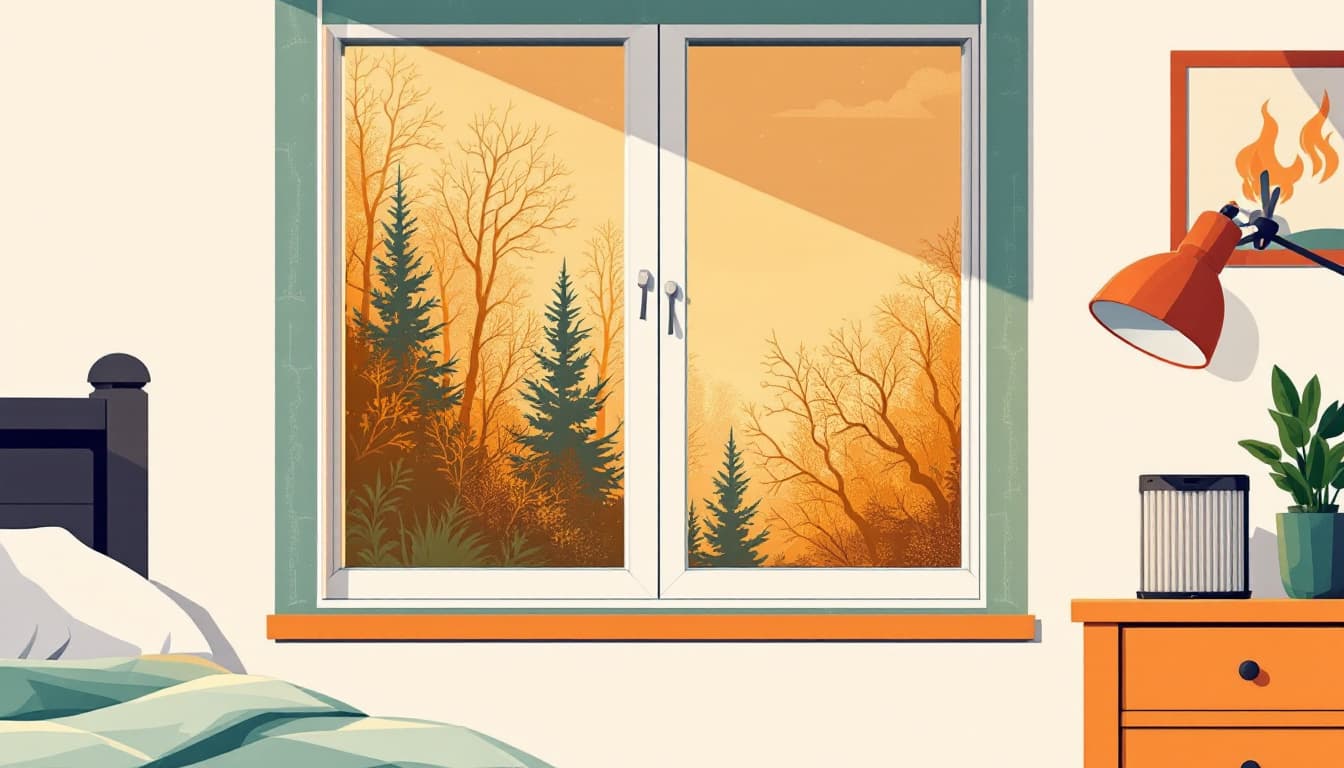
A wildfire burning somewhere upwind. A smelter flare. An industrial accident. The specific trigger changes; the instruction does not. "Keep your windows closed." Newsweek reported this week that thousands of households in California and Colorado received exactly that guidance as air-quality conditions deteriorated across both states. Most people read the alert, close a window or two, and move on. That response misses most of what the warning actually asks of a home.
What the warning actually means
An air-quality alert is not a request to be slightly more comfortable indoors. It is an instruction to convert your house into a controlled environment for an unknown number of hours or days. The gap between "windows closed" and "air genuinely filtered indoors" is where most households fall short.
Modern homes are not airtight. A typical house exchanges its indoor air with outdoor air multiple times per hour through gaps around doors, recessed lighting, fireplace dampers, bathroom exhaust fans, and the HVAC system itself. Closing windows reduces that exchange but does not stop it. If your furnace or central air system pulls from outside without filtering fine particulate matter — specifically PM2.5, particles smaller than 2.5 microns — you are still cycling smoky or chemically contaminated air through every room.
The pattern is also expanding geographically. Wildfire smoke events that were once concentrated in the Pacific Northwest now regularly affect the Mountain West and reach the Midwest and East Coast. Industrial air incidents are not rare outliers. Families who live nowhere near active fire lines have received these same alerts in recent summers.
What we'd actually do
Get a MERV-13 filter into your HVAC system this week. Standard 1-inch filters sold at hardware stores typically rate MERV-8 or below, which captures dust but not fine smoke particles. A MERV-13 filter fits the same slot, costs roughly $20-30, and is the minimum rating the EPA recommends for smoke events. Check your system's manual first — some older systems cannot handle the increased airflow resistance of a denser filter. If yours can, swap it in now, before you need it.
Buy one room air purifier with a true HEPA filter and stage it in the room where your family spends the most time. One unit will not clean your whole house, but it will create a clean-air refuge. A bedroom matters more than a living room if an alert runs overnight. Consumer-grade HEPA purifiers adequate for a medium-sized room run $80-150 from several established brands. Avoid anything marketed only by CADR numbers without a HEPA certification label.
Locate and close every passive opening before the next alert, not during it. Fireplace dampers are the largest single gap in most homes and are almost always left open. Bathroom and kitchen exhaust fans vent directly outside; switch them off. Check that your dryer vent flap closes fully. This walk-through takes 20 minutes and costs nothing.
Stock two to three days of medications for anyone in your household with asthma, COPD, or cardiovascular disease. Air-quality events are the emergency most likely to land a family member in an urgent-care clinic. The problem is almost never the air alone — it is the air combined with a nearly empty rescue inhaler. A 72-hour buffer of maintenance medication is cheap insurance.
Know your local air-quality index before you feel it. AirNow.gov (run by the EPA) publishes real-time PM2.5 and ozone readings by zip code. Bookmark it. An AQI above 150 is the threshold at which sensitive groups are genuinely at risk; above 200, the guidance applies to everyone. Most families find out an event is serious when their eyes start burning, which is several hours too late to make the useful decisions.
The bigger picture
These alerts are not a sign that everything is collapsing. They are a sign that the range of conditions a household should be prepared to manage has widened. A family that can seal its indoor environment for 48-72 hours — filtered air, sufficient medications, no need to open doors for supplies — has solved a problem that will recur. That is not catastrophizing. It is maintenance, the same category as checking your smoke detectors or keeping your gas tank above a quarter full.
The goal is a house that works when conditions outside temporarily do not. That is a narrow, achievable target, and most of the steps to reach it cost less than a single urgent-care copay.