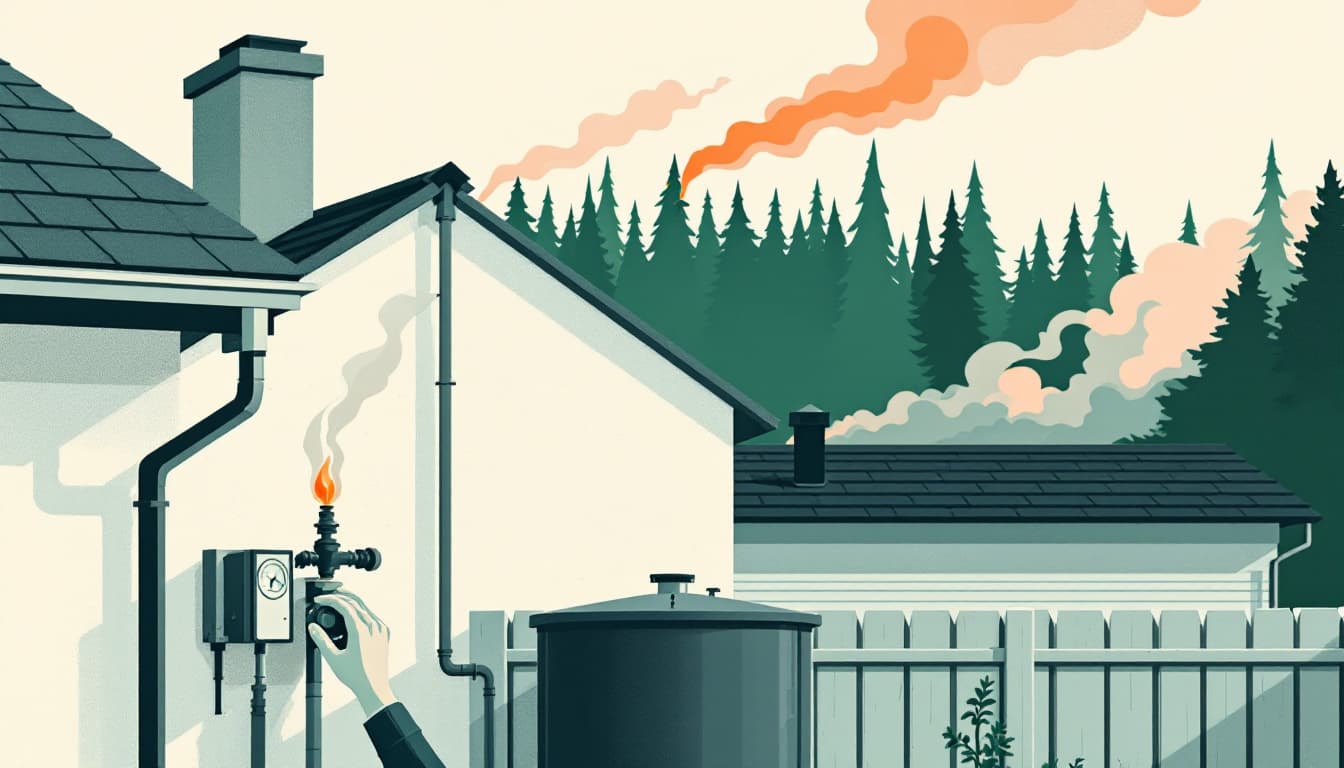
A county in Colorado is installing 21,000-gallon water tanks at strategic points in the wildland-urban interface. That's not a curiosity item. It's a signal that local fire officials have done the math and found the existing water supply unreliable when it matters most.
A report this week from dailydispatch.com covers the effort without spelling out what it means for the family at the end of a rural road or in a foothill subdivision. That's the gap worth filling.
What's actually changing
Colorado's wildfire seasons have been compressing. Fires that used to follow a predictable summer arc now start in March, pause, and resume in October. The Front Range foothills, the Western Slope, and the I-25 corridor communities — places like Monument, Evergreen, Woodland Park, and Rist Canyon — sit in terrain where municipal water pressure can drop to near zero within minutes of a fire call. Hydrant systems were designed for structural fires, not simultaneous structure ignition across half a ridge.
A 21,000-gallon tank sounds large. A single aerial drop from a Type 1 helicopter can exceed 2,000 gallons in one pass. Tanker trucks running relay operations on a single-lane mountain road can burn through a county cache in an afternoon. The tanks matter, but they are a community resource, not a household guarantee.
What the county's investment actually signals: officials have concluded they cannot rely solely on the existing network, and they're patching the gap with fixed infrastructure. The household version of that same logic is what's missing from most families' plans.
What we'd actually do
Audit your address's defensible space right now, before July. Colorado's CSFS (Colorado State Forest Service) offers free defensible space assessments in many counties — call your county's CSFS district office and get on the schedule. Clearing vegetation within 30 feet of a structure is not optional in fire-prone zones; it's the single action that most affects whether a structure survives a passing fire front when crews are nowhere near you. This week's task: walk the perimeter and identify anything combustible within 10 feet of the foundation.
Store at least 300 gallons of water on your property if you're on a well or a marginal pressure line. Municipalities in WUI zones routinely lose pressure during large fire events as hydrants are bled and pumps are overwhelmed. A 275-gallon IBC tote costs roughly $150-$250 used and can be plumbed with a gravity-feed valve. It won't save a fully involved structure, but it can suppress embers on a roof or deck long enough for a structure to survive a fast-moving front. Two totes, kept full and shaded, is a realistic household goal.
Build a go-bag that can leave in under four minutes. The Marshall Fire in Boulder County in December 2021 gave some households less than 15 minutes of warning. The bottleneck for most families isn't the bag itself — it's the decision latency. Assign roles now: who grabs the documents box, who gets the kids and pets, who starts the car. Time a dry run. Four minutes is achievable. Twenty minutes is not always available.
Sign up for your county's emergency alert system, and verify it works. Colorado uses a patchwork of county-level systems — Larimer uses CodeRED, Jefferson County uses Genasys, El Paso uses a hybrid. Each requires active opt-in. Check your county's OEM (Office of Emergency Management) website this week, confirm your cell number is registered, and test the system. A surprising number of households in high-risk zones are not enrolled.
Check your homeowner's insurance policy for actual replacement cost coverage. Post-fire total losses in Colorado communities have repeatedly revealed that families were underinsured by 30-50%, based on reporting from state insurance commissioners following recent fire seasons. Rebuild costs in the foothills are not what they were in 2019. Request a replacement-cost review from your insurer before fire season peaks.
The bigger picture
County water tanks are infrastructure investment, not household insurance. They help crews protect more homes. They do not change what happens in the 20 minutes before a crew arrives — or in the scenarios where they never do. The families who fare best in Colorado wildfires are the ones who have already reduced ignition risk on their own properties, know their evacuation routes cold, and have made leaving early a reflexive default rather than a last resort.
Durability here isn't about surviving a catastrophe through gear. It's about reducing the probability that your house becomes fuel, and reducing your decision time to near zero when the sky turns orange.