A small electric cooperative in west Tennessee suspended shutoffs for late-paying customers this week because the heat outside became genuinely dangerous. That's a reasonable, humane call. It's also a signal worth reading carefully, because it tells you something the utility's press release doesn't: your household's ability to stay cool during a heat event depends, right now, on the discretionary goodwill of a local co-op board.
That's not a stable foundation.
What's actually changing
A report this week from WSMV described Benton County Electric's decision to pause disconnections during a dangerous heat blast across the region. Utilities in Tennessee — a mix of TVA-fed co-ops, municipal systems, and investor-owned providers — are not uniformly required to maintain service during extreme weather. Tennessee has no statewide law mandating heat-related shutoff moratoriums the way some northern states have cold-weather rules. Individual cooperatives and municipal utilities make these calls on their own, and they can reverse them.
The Tennessee Valley Authority supplies power to nearly all of the state, but retail delivery — and disconnection policy — sits with roughly 150 local distributors. Your neighbor two counties over may be under completely different rules than you are. That patchwork matters when temperatures push into the upper 90s and heat index values climb well past 100°F, which western and middle Tennessee routinely see from late June through August.
The deeper issue isn't one co-op's policy. It's that most Tennessee households have no heat resilience independent of the grid. When the power stays on, everything is fine. When it flickers — from storms, from overloaded infrastructure, from a billing dispute that falls through the cracks — the house becomes dangerous within hours for elderly residents, young children, and anyone with cardiovascular or respiratory conditions.
Tennessee's summer storms compound this. The combination of heat and convective storm activity means the grid is most stressed exactly when losing it is most dangerous.
What we'd actually do
Find out your utility's actual disconnection policy before you need it. Call your co-op or municipal provider and ask directly: do you have a heat moratorium policy, and what triggers it? Get this in writing if you can, or at least note the date and who you spoke with. Don't assume Benton County Electric's decision applies to your distributor — it almost certainly doesn't automatically.
Many households don't know which utility serves them or how to reach billing. Spend ten minutes this week locating your account number, the utility's customer service line, and any low-income assistance programs they administer. TVA's EnergyRight program and the federal LIHEAP program both have Tennessee-specific components; eligibility thresholds are broader than most people assume.
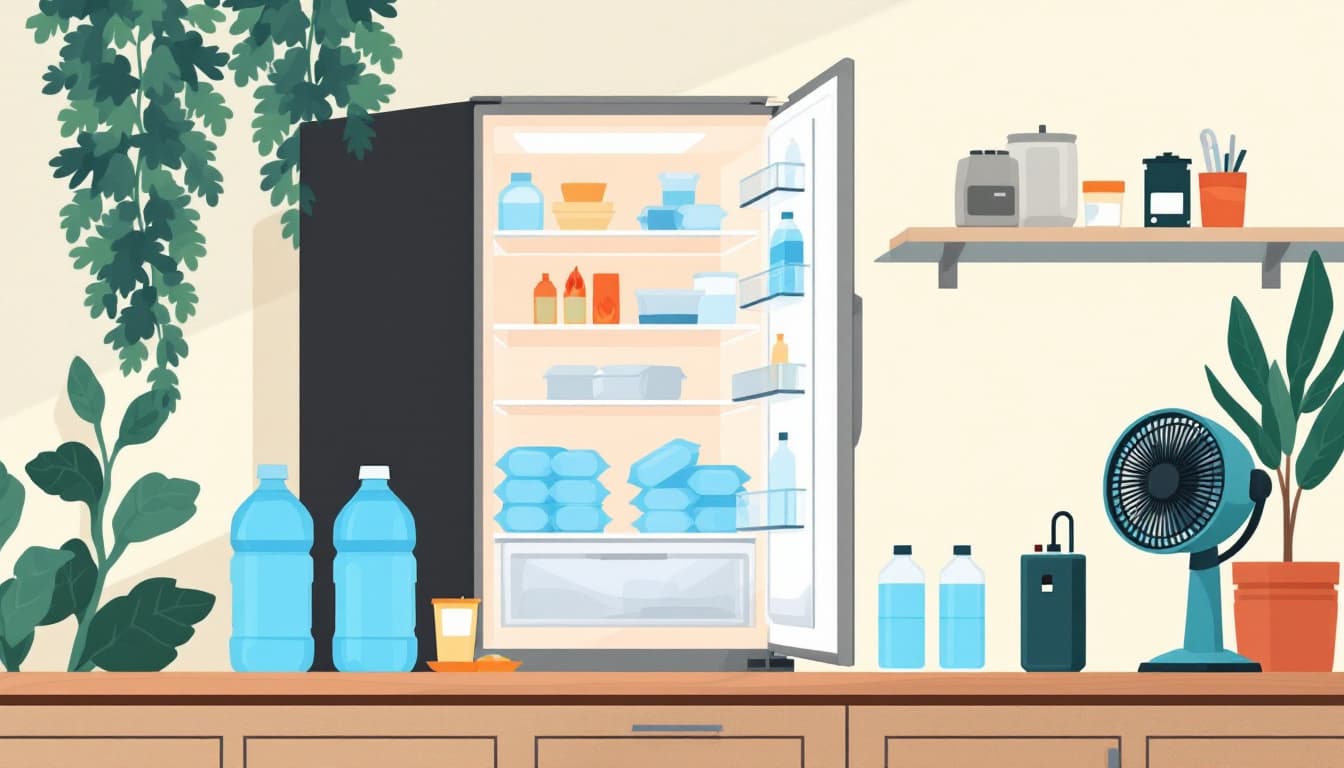
Create at least one room in your home that stays cooler without mechanical cooling. This doesn't require a whole-house retrofit. A north-facing interior room with blackout curtains, a ceiling fan running counterclockwise on low, and a door you can close at night stays meaningfully cooler than the rest of the house. In a grid outage lasting more than a few hours, that room becomes your household's survival space. If you rent and can't modify the space, identify it now and buy a battery-powered fan before mid-July inventory tightens.
Own at least one window AC unit or portable cooler that can run on a generator or battery station. A single 5,000 BTU window unit running on a mid-sized portable power station can cool a 150-square-foot room for several hours. That's enough to protect a sleeping child or an elderly family member through a night-time outage. This is not about prepping for the apocalypse — it's about the four-hour gap between a storm knocking out your neighborhood's transformer and the crew getting it back online. Memphis, Nashville, and Chattanooga all have documented multi-day outage events in recent summers.
Know your county's cooling centers. Tennessee Emergency Management Agency maintains updated lists through county emergency management offices during declared heat events. These are real, functioning resources — libraries, community centers, county health buildings — and they are underused. Map the two nearest to your home now, including hours of operation. If you have elderly neighbors who don't drive, this information is worth sharing proactively.
The bigger picture
Benton County Electric made a good call. The problem is that "a co-op made a good call" is not a household resilience strategy. Tennessee summers are getting longer and hotter — recent NOAA seasonal outlooks have consistently flagged the Southeast for above-normal temperatures through late summer. The grid is not getting younger, and demand is increasing as data centers and light manufacturing expand across middle and east Tennessee.
None of that is catastrophic. But it does mean the margin for error is thinner than it was ten years ago. The households that weather this well are the ones that don't need the utility to make the right call — because they've already built a buffer of a few hours or a few days.
That buffer is achievable. It doesn't require a bunker or a $10,000 generator. It requires a cooler room, a backup fan, a phone number, and a plan.