A KTLA report this week confirmed what anyone in the Los Angeles Basin or Inland Empire already knew in their body: Southern California was sitting through the hottest day of an extreme heat warning that had already stretched multiple days. Temperatures in inland valleys routinely ran 10 to 15 degrees above coastal readings, and the gap between "uncomfortable" and "dangerous" closed faster than most households were ready for.
Heat events in California are not rare. What is changing is their density — longer streaks, higher overnight lows, and the compounding effect on a grid that is simultaneously absorbing more AC load and shedding the kind of dispatchable generation that used to buffer demand spikes. That combination is what turns a hot week into a household emergency.
What's actually changing
The heat itself is one variable. The grid is another. Flex Alerts from CAISO — the California Independent System Operator — have historically asked households to cut usage between 4 and 9 p.m., the window when solar generation drops and demand peaks. During multi-day heat events, that window stretches and the buffer shrinks. A rolling outage during a heat spike is not a hypothetical; it has happened in California during previous August events, and the conditions that caused it have not been structurally resolved.
There is also a medical reality that preparedness coverage tends to gloss over. Heat illness does not announce itself clearly. Confusion, irritability, and fatigue are early signs of heat exhaustion. By the time someone stops sweating during extreme heat, they may already be in heat stroke territory. The California Department of Public Health lists outdoor workers, adults over 65, children under 5, and people on diuretics or antipsychotic medications as the highest-risk groups — but a household that runs warm, sleeps poorly, and does not drink enough water is also at real risk.
What we'd actually do
Identify your coolest room now, before the next spike. Most California homes built before 1990 have limited insulation and west-facing windows that turn bedrooms into ovens by 3 p.m. Walk the house in the afternoon and find the room that stays coolest — often a north-facing interior room or a basement if you have one. Know where you're sleeping before you need to decide.
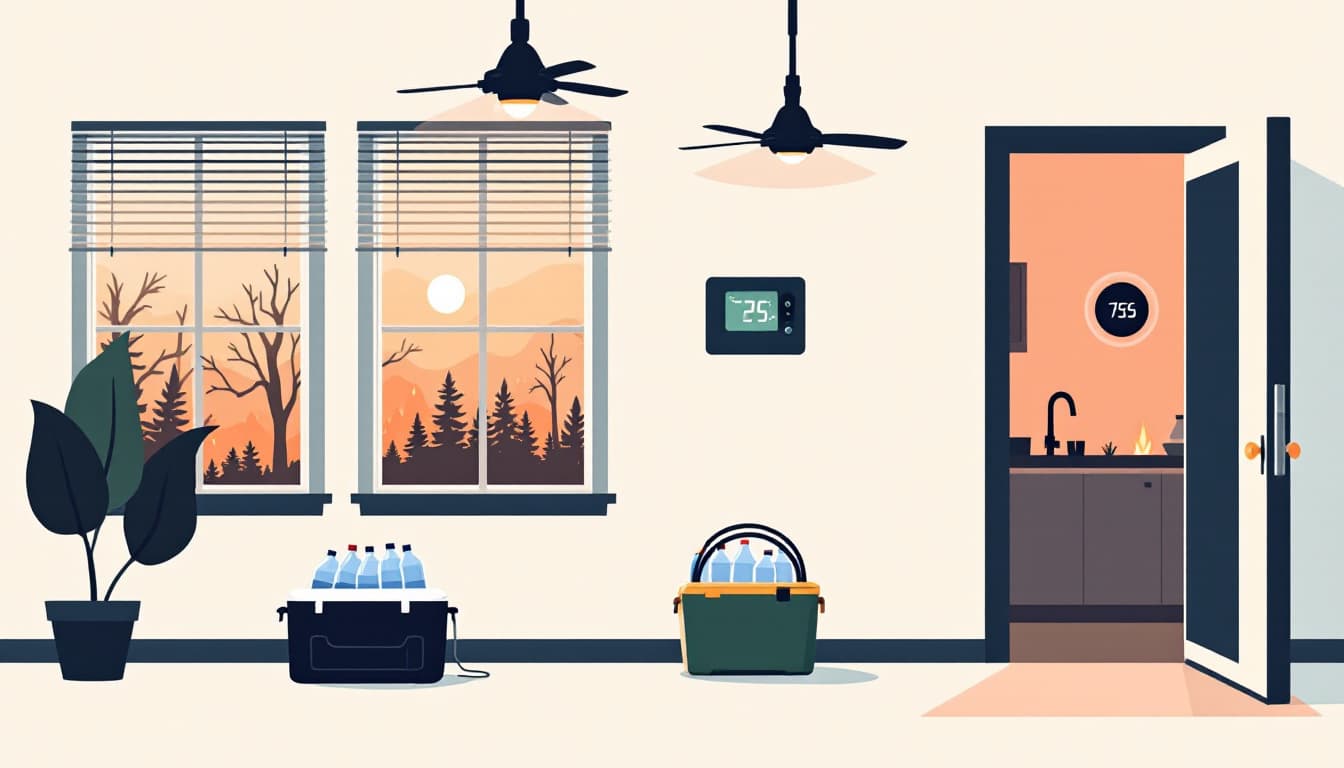
Cooling decisions made at 11 p.m. under heat stress are worse than decisions made at noon on a mild day. A box fan in the right window combined with a pre-cooled room can maintain a survivable environment even during a brief outage. Write down the plan. Tell everyone in the house.
Stock oral rehydration salts, not just water. Water alone does not replace sodium and electrolytes lost through prolonged sweating. Oral rehydration salts (ORS packets, available at most pharmacies for under $10) are more effective than sports drinks and have a long shelf life. Keep a box in the house from June through September. This is especially important for households with elderly relatives or young children.
Know your nearest cooling center before you need it. The Los Angeles County Office of Emergency Management and equivalent offices in San Diego, Riverside, and San Bernardino counties maintain cooling center locators online. They go live during heat emergencies. Look up the nearest one this week — address, hours, whether pets are allowed — and write it on a card. If your power goes out for more than two hours during a heat spike, the decision to leave should already be made.
Sign up for your utility's medical baseline program if anyone in your household is heat-sensitive. Both SCE and SDG&E offer reduced rates and, in some cases, prioritized restoration for customers with qualifying medical conditions. The application is free. Most households that qualify have never applied.
Lower your AC setpoint the night before a forecast spike, not the morning of. Thermal mass matters. A house pre-cooled to 72°F overnight holds that temperature longer into a hot afternoon than a house that started at 78°F. Running AC harder at night — when grid demand is lower — is both cheaper and more effective than trying to recover in the afternoon.
The bigger picture
California heat emergencies follow a pattern: the news covers the peak, households scramble, and a week later most families have not actually changed anything structural. The goal here is not to survive this week's warning. It is to have a household that handles heat events with less scrambling each time — better information, better habits, and a short list of actions that are already done before the next Flex Alert lands.
Durability does not require a bunker. It requires a note on the fridge, a box of ORS packets, and a cooling center address you looked up on a Tuesday when it was still 75 degrees.