The Shasta Cascade is warning you. The question is whether you're listening — or assuming it's someone else's problem until August when the warning covers your county.
A report this week from the San Luis Obispo Tribune details an extreme heat warning issued for California's Shasta Cascade region running from Sunday through Tuesday. Temperatures in that corridor — Redding, Red Bluff, and the surrounding valleys — can routinely push past 110°F during these events. That's not unusual for inland Northern California in June. What matters is that this is the first major multi-day extreme heat event of 2026 for the state, and the first event of a season is always the one households are least ready for.
What's actually happening here
Early-season heat warnings are operationally different from mid-August events. In August, people have adapted their habits. In June, air conditioners have often sat idle for months, HVAC filters haven't been changed, and households haven't thought about where they'd go if the power went out for 18 hours on a 108-degree afternoon.
California's grid operator, CAISO, issues Flex Alerts when electricity demand strains supply — typically asking households to reduce usage between 4 and 9 p.m. These alerts are reactive, not predictive. By the time you see one, the stress is already happening. The Shasta Cascade event this week will generate real load on transmission lines that also serve the Bay Area and Sacramento Valley. Localized heat doesn't stay local on a connected grid.
This is also the first real test of how much cooling infrastructure California added after the 2020 and 2022 heat emergencies. The honest answer: incremental improvements, not transformation. Cooling centers exist in most counties, but they are not evenly distributed, and many households don't know where theirs is before they need it.
What we'd actually do
Find your county's cooling center locations now, before Saturday. Cal OES maintains a disaster relief locator, and most county OES pages list cooling centers once a warning is active — but you want that address before you're hot, stressed, and trying to load a slow county website on a throttled cell network. Search "[your county] cooling center 2026" and bookmark the page.
Check your air conditioner before you need it this weekend. Run it for 20 minutes today. If it's blowing warm or making new sounds, you have a few days to call someone. HVAC technicians in California get booked out within hours once a heat event is forecast. A dirty filter is a $15 fix you can do yourself; a refrigerant issue is not. Know which one you have before Sunday.
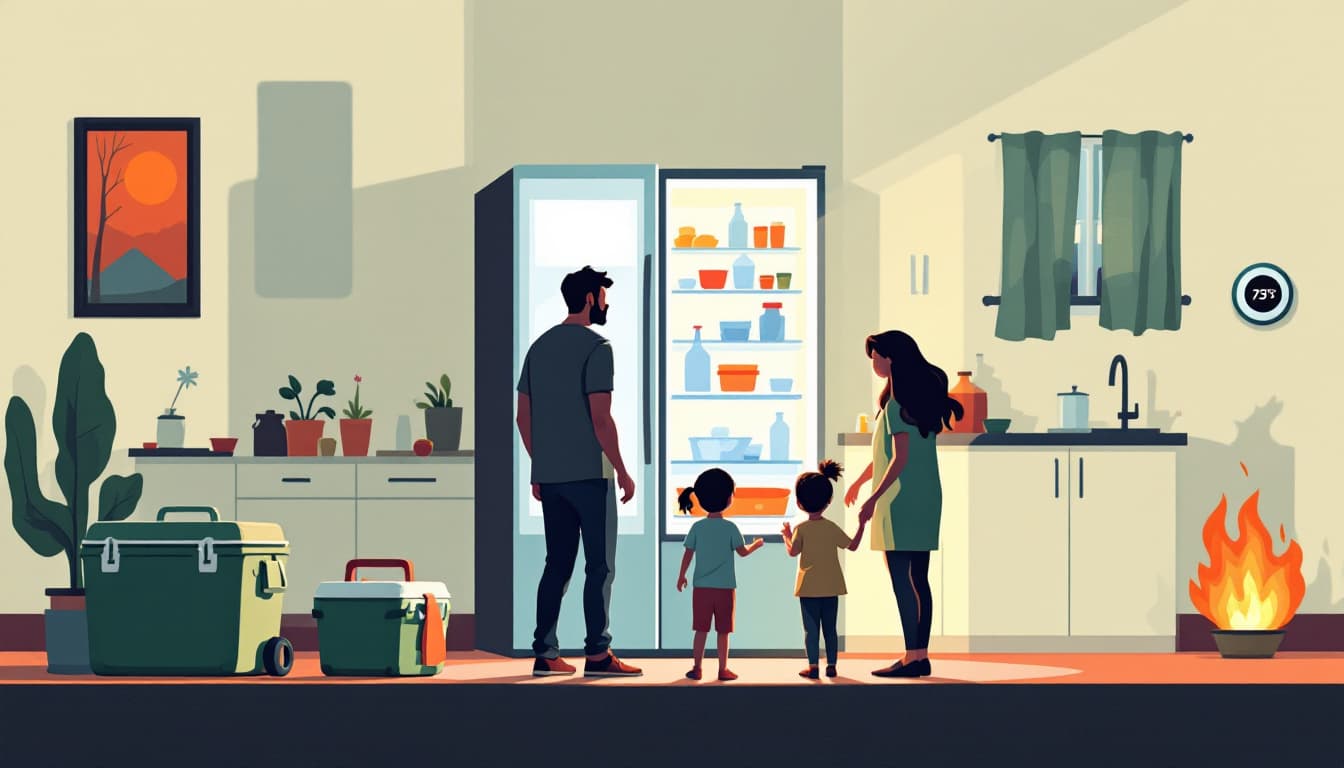
Freeze water now. Not as a survival stockpile — as a practical thermal buffer. Freeze a dozen water bottles or a couple of 2-liter bottles. If power goes out, they extend the safe window in your refrigerator and give you something cold to hold against pulse points (wrists, neck). This costs nothing and takes three minutes.
Know your household's most vulnerable person and make a specific plan for them. The deaths in California heat events are disproportionately elderly adults living alone, people on medications that impair sweating (antihistamines, diuretics, certain antipsychotics), and outdoor workers. If someone in your network fits that description, a daily check-in call during a multi-day heat event is more useful than any gear.
Watch for CAISO Flex Alerts and pre-cool your home. If a Flex Alert is called for your region, the strategy is to run your air conditioning hard between noon and 3 p.m. — before the peak demand window — and then raise your thermostat slightly from 4 to 9 p.m. Your home's thermal mass holds some of that cool. It's not comfortable, but it reduces grid strain and keeps your unit from running at maximum load during the highest-risk hours.
The bigger picture
The Shasta Cascade event ends Tuesday. The next one will hit somewhere else — the Central Valley, the Inland Empire, the Sacramento suburbs. California households that treat each warning as a regional curiosity rather than a seasonal rehearsal are the ones who end up making bad decisions in the heat: driving to a store that's also without power, discovering their generator hasn't been started in two years, or realizing they have no plan for their 78-year-old neighbor.
Durability isn't about predicting which week will be the worst one. It's about running through your household's heat protocol in June, when you still have time to fix what's broken.