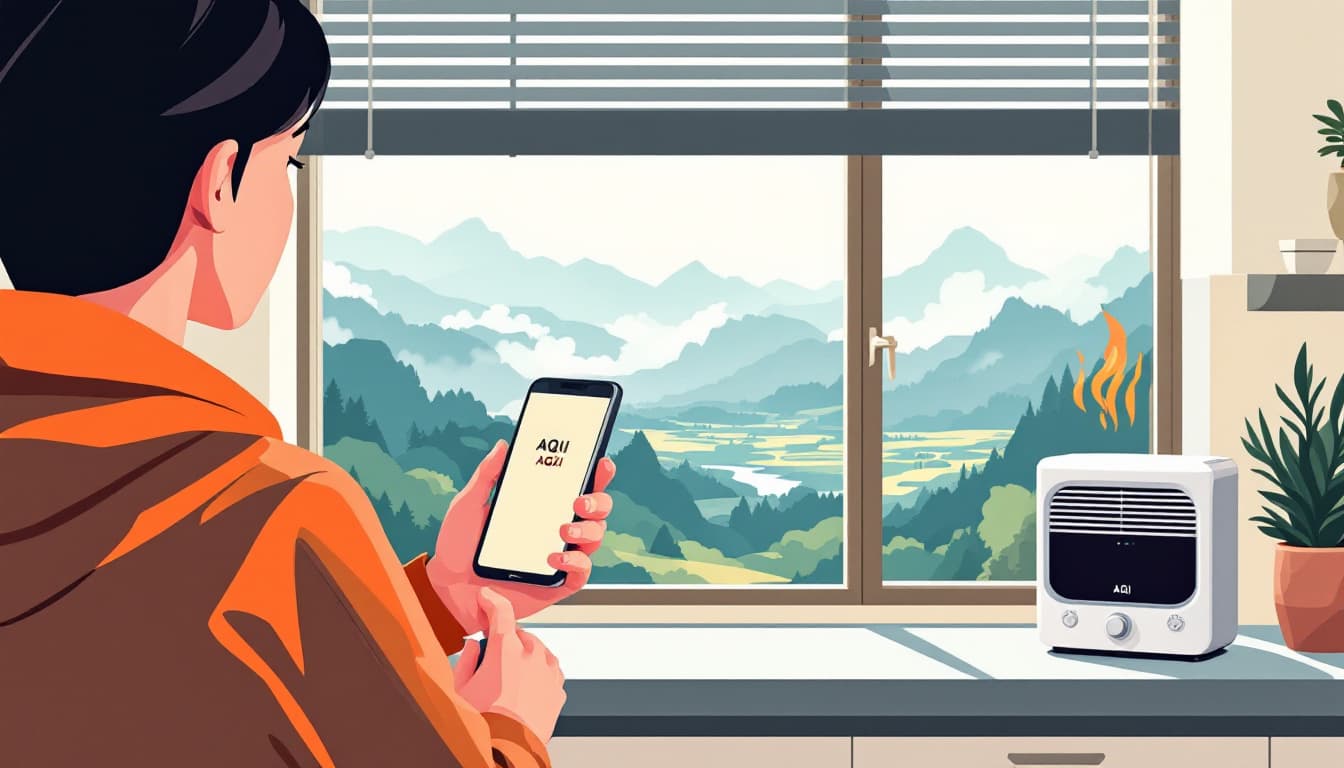
A report this week from 9News confirmed what anyone who stepped outside already knew: every one of Colorado's 64 counties is under an Air Quality Alert due to wildfire smoke. That includes not just the Western Slope counties closest to fire activity, but Denver, Boulder, the San Luis Valley, the Eastern Plains — all of it. A blanket statewide alert of this scope is a signal worth pausing on.
What's actually happening
An Air Quality Alert doesn't mean the air will kill you. It means particulate matter — specifically PM2.5, the fine particles that penetrate deep into lung tissue — has reached levels where sensitive groups (children under 14, adults over 65, people with asthma or heart disease) face real physiological risk, and where healthy adults should limit prolonged outdoor exertion.
What most coverage skips: the alert applies outdoors, but smoke infiltrates homes. A typical Colorado house without active filtration can reach 50–80% of outdoor PM2.5 levels within a few hours of a high-smoke event. Older homes, homes with evaporative coolers, and homes at higher elevations with greater wind exposure are the most vulnerable. If your household has been running a swamp cooler this week, you have been pulling smoky outdoor air directly inside.
Colorado's Front Range population centers sit in a basin geography that traps particulates. Smoke that drifts east from fires near Glenwood Springs or Steamboat doesn't just pass through — it settles.
What we'd actually do
Switch your evaporative cooler to recirculate or shut it off. Most Coloradans know to do this during heavy smoke, but forget that even "closed" swamp coolers bleed outdoor air. Set it to recirculate-only mode if your unit supports it, or turn it off and switch to fans and window AC if you have it. Yes, your house will get warmer. That is the correct tradeoff for a two- to three-day smoke event.
Build a box fan filter if you don't own an air purifier. A 20x20-inch MERV-13 furnace filter taped to the intake side of a box fan creates a functional particle filter. This is not a substitute for a true HEPA unit, but independent testing by researchers at the University of Michigan and replicated by the EPA's own guidance has confirmed it meaningfully reduces indoor PM2.5. Cost: under $30 at any hardware store. You can build one in five minutes. Place it in the room where your family spends the most time.
Check your HVAC filter and your runtime settings. If your home has central forced air, your furnace filter is your first line of defense — but only if the system is running. During mild weather, many Colorado households let the system sit idle. Set your thermostat to run the fan continuously (the "on" setting, not "auto") so air circulates through the filter even when you're not heating or cooling. Replace any filter that is visibly gray or that you haven't changed in the last 60 days.
Identify your highest-risk household members and create a specific plan for them. "Sensitive groups" is abstract. In your household, it's your seven-year-old who plays soccer, your mother-in-law with COPD, your partner who runs at altitude. Those people should not be doing moderate-to-heavy outdoor exercise during this alert period. Colorado's CDPHE posts county-level AQI forecasts at colorado.gov/airquality — bookmark it and check it each morning until the alert lifts.
Keep N95s accessible, not buried. If you need to be outdoors for work or an errand, an N95 worn correctly filters PM2.5 effectively. Surgical masks and cloth masks do not. If your household's N95s are in a bin in the garage from 2021, retrieve two or three and put them near the door. This is a five-minute task.
The bigger picture
Colorado has averaged more acres burned per decade each successive decade since the 1980s, and the wildfire season has lengthened at both ends. A statewide smoke alert used to be unusual enough to generate real alarm. It is becoming a recurring summer feature for Colorado households. That's not a reason to panic — it's a reason to treat smoke prep the way you treat winterization: a known seasonal task with a short checklist, not a crisis.
Durability means your household can maintain normal function through a smoke week without scrambling. A box fan filter, a MERV-13 furnace filter you replace on schedule, and a habit of checking CDPHE's air quality page each July and August morning gets you most of the way there.