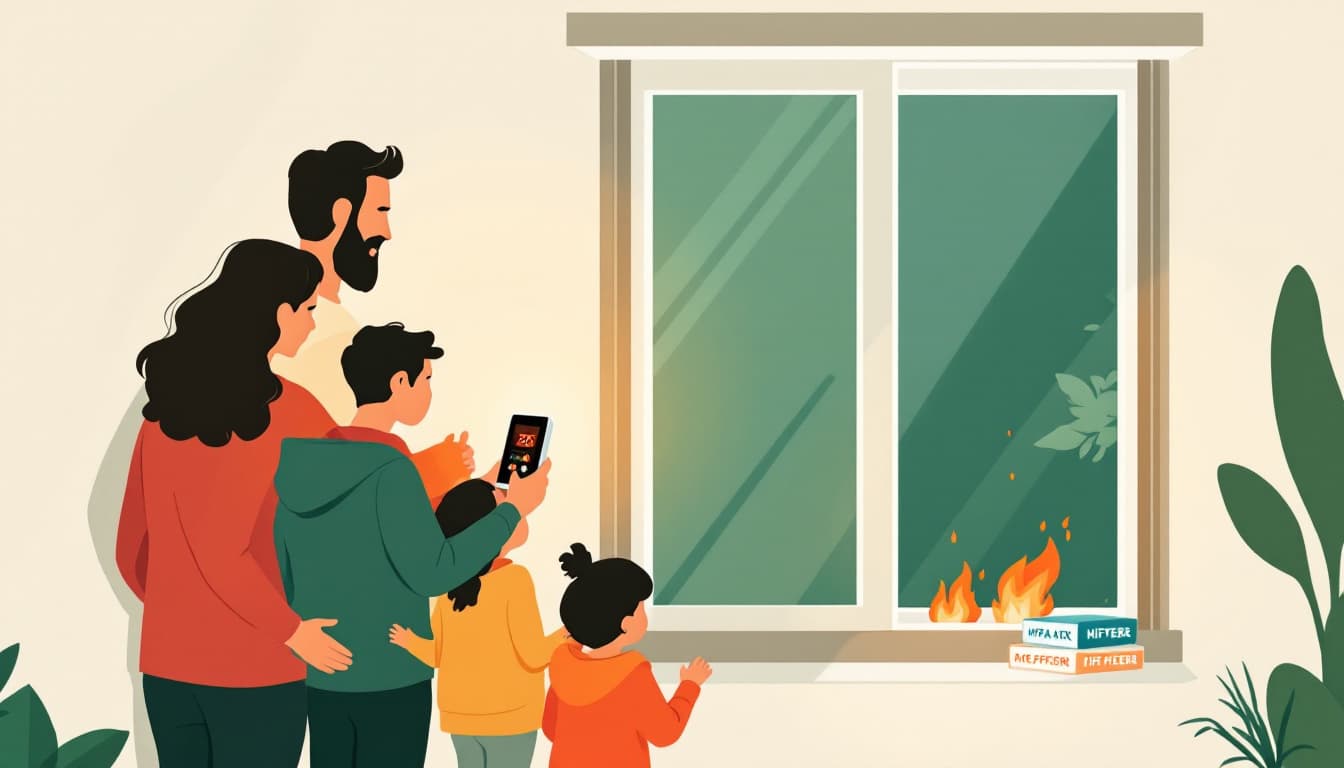
A Live 5 News First Alert issued this week flagged wildfire smoke degrading air quality alongside critical fire weather conditions. If you live in or near an affected region, you already noticed the sky. The question worth spending ten minutes on is not "is this bad?" — it is "what does my household actually need to do, and in what order?"
What's actually changing
Wildfire smoke is not uniform. It varies by distance from the fire, wind direction, time of day, and what's burning. The number that matters to your family is the AQI — Air Quality Index — specifically the PM2.5 reading. Fine particulate matter at 2.5 microns or smaller bypasses your nose and throat entirely and deposits in the lung tissue. At AQI above 150, that's a real short-term health concern for healthy adults. At AQI above 100, it matters more for children, anyone over 65, and anyone with asthma, cardiovascular disease, or a compromised immune system.
The pattern worth watching: wildfire smoke events that once lasted a day or two now routinely run a week or longer as fire seasons extend. Families who treat each event as a freak occurrence and gut it out are making a different calculation than families who build a basic indoor air capability they can activate any summer.
There is also an economic dimension. During prolonged smoke events, hardware store stocks of N95 respirators and portable air purifiers move fast. Buying at the signal, not the panic, is a real advantage.
What we'd actually do
Check your local AQI before opening windows each morning. The EPA's AirNow.gov updates hourly and is free. A reading below 50 means you can ventilate normally. Between 100 and 150, keep windows closed and minimize outdoor time for vulnerable household members. Above 150, you are running indoor air management. This five-second check prevents you from accidentally ventilating your home with smoke while thinking you're getting fresh air.
Run a DIY box-fan filter in the room where you sleep. A standard 20-inch box fan taped to a MERV-13 furnace filter — filter facing the intake side — creates a functional particle filter for under $30 total if you already own the fan. Research out of several university extension programs has documented meaningful PM2.5 reductions in single rooms using this setup. It is not a substitute for a good HEPA unit, but it is what you build this week from hardware-store parts. Replace the filter when it turns visibly gray.
Locate your N95s now, not when AQI hits 175. If you bought respirators during the last respiratory illness season, find them today and confirm they are still sealed and not expired. If you do not have any, add a box to your next shopping run. A well-fitting N95 filters roughly 95% of airborne particles when worn correctly. Surgical masks and cloth masks do not filter PM2.5 meaningfully.
Identify your household's two most vulnerable members and write down their action thresholds. For a child under 12 or an adult with asthma, the threshold for staying completely indoors is lower than for a healthy adult. Write it on the fridge: "At AQI above 100, [name] does not go outside." This sounds obvious until 6 a.m. when you're rushing kids to school and the sky looks only slightly hazy.
Pre-position a three-day indoor supply in case you need to shelter in place. Not a bug-out bag — just enough food, water, and medication that you do not need to make a grocery run during peak smoke. For a family of four, that's roughly 12 liters of water and three days of shelf-stable meals. If you already maintain a two-week pantry, confirm your medications and any refrigeration-dependent items are covered.
The bigger picture
Wildfire smoke is not a fringe event for remote communities anymore. Recent summers have placed hazardous AQI readings over major metro areas hundreds of miles from any fire. The households that manage this well are not the ones with elaborate bunkers. They are the ones who built a small indoor-air capability, know their AQI thresholds, and keep a week of supplies on hand.
Durability means the smoke comes, you close the windows, you check the number, you run the filter, and you get on with your life. That is the goal. Not catastrophe. Not a new identity as a prepper. Just a household that handles a bad air week without scrambling.