On a clear June morning in Eugene or Medford, wildfire smoke feels hypothetical. By late July, it is the air you breathe. Oregon's fire season has been arriving earlier and staying longer over the past decade, and the stretch from July through October now routinely pushes Air Quality Index readings into the "Unhealthy" and "Very Unhealthy" ranges across the Willamette Valley, the Rogue Valley, and Central Oregon.
NPR for Oregonians' Oregon Ready series recently covered the basics of preparing for smoke and ash season. That's a useful public service. What the radio format can't give you is the granular, household-level detail that actually changes outcomes. That's what this is.
What's actually different about smoke versus "bad air"
Wildfire smoke is a mixture of fine particulate matter (PM2.5), carbon monoxide, volatile organic compounds, and, in the post-structure-fire ash that increasingly blankets Oregon neighborhoods, heavy metals and asbestos from burned buildings. The PM2.5 fraction is the one that gets into lung tissue. Oregon DEQ and AirNow track this in real time by county.
The practical implication: a standard paper dust mask does nothing for PM2.5. An N95 or KN95 respirator, properly fitted, filters at least 95% of airborne particles at that size. A surgical mask filters roughly 40-60% under real-world conditions. This distinction matters most for people doing outdoor work during a smoke event — yard cleanup, ash removal, anything that keeps you outside for more than a few minutes.
Ash on the ground after a nearby fire is a separate problem. Oregon State Fire Marshal guidance treats structure-fire ash as hazardous waste. Don't sweep it dry; wet it first, use gloves, and bag it. Children and pets track it indoors.
What we'd actually do
Check your HVAC filter rating and replace it before July. Most residential HVAC systems ship with MERV-8 filters, which are essentially useless against fine smoke particles. A MERV-13 filter captures a meaningful share of PM2.5 and fits most standard systems without straining the fan motor. Check your furnace manual for the maximum rated MERV before upgrading. A two-pack of MERV-13 filters runs $20-40 at most hardware stores and will last you through the season if you check them monthly.
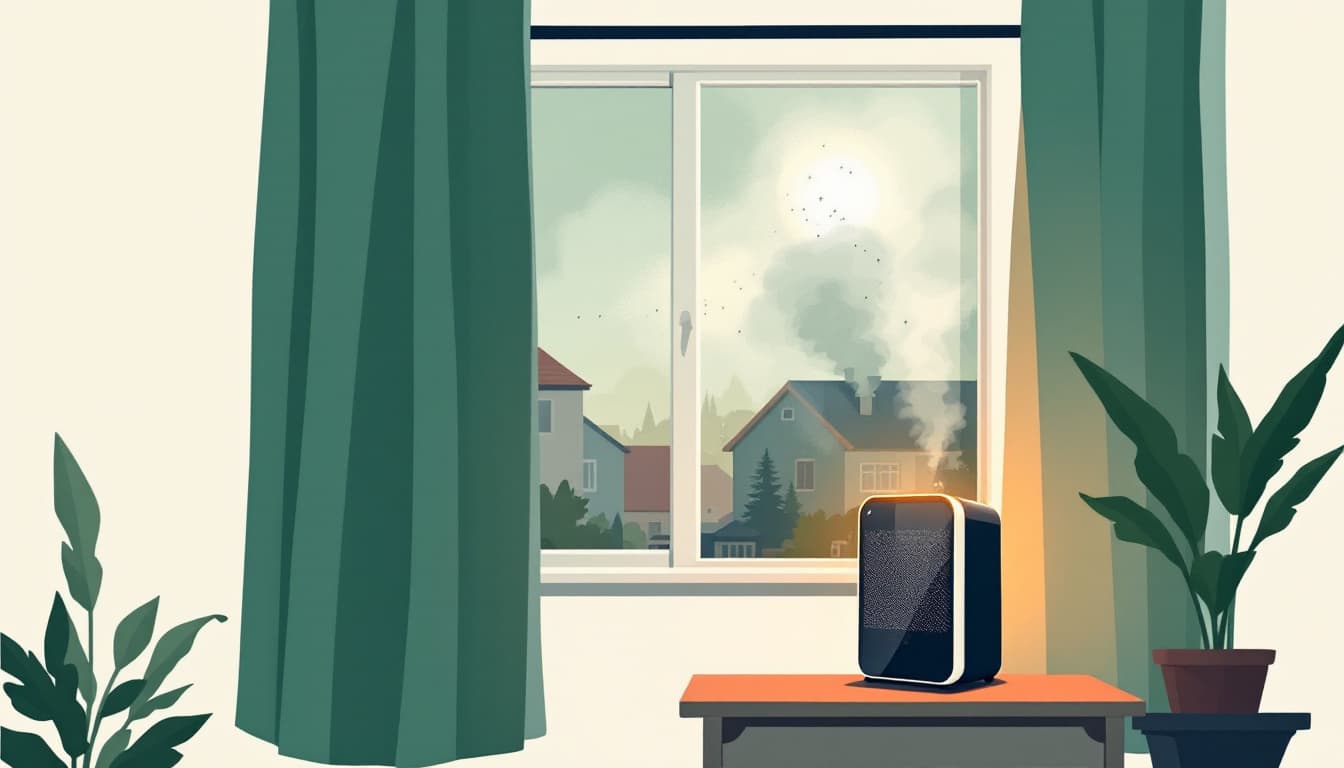
Buy one room air purifier with a true HEPA filter and designate a clean room. You don't need to purify your whole house. Pick the room where your family spends the most time — usually the main bedroom — and run a HEPA purifier there continuously during smoke events. Look for a unit rated for at least 200 square feet with a CADR (Clean Air Delivery Rate) above 150 for smoke. Budget units from established brands run $60-120. The Oregon Health Authority has recommended this single-room approach as practical for renters and homeowners alike.
Download AirNow and set a PM2.5 alert threshold. AirNow.gov and its companion app pull real-time data from Oregon DEQ monitoring stations. You can set alerts for your zip code when PM2.5 crosses specific AQI thresholds. An AQI above 100 is the point at which sensitive groups — children, elderly adults, anyone with asthma or cardiovascular conditions — should limit outdoor time. Above 150, that guidance extends to everyone. Having the alert means you're not guessing based on how hazy it looks outside.
Stage your N95 supply now, not in August. Buy a box of NIOSH-approved N95s or KN95s this month. Smoke events that push AQI above 200 — the "Very Unhealthy" threshold — do happen in the Rogue Valley and Willamette Valley in bad years, and they happen fast. When they do, local stores sell out of respirators within 48 hours. A box of 20 N95s costs roughly $15-25 and stores indefinitely in a sealed bag. Keep a few in your car as well.
Know your evacuation air quality plan, not just your fire plan. Most Oregon households with a go-bag have thought about fire evacuation. Fewer have thought about what they do if smoke makes staying home unhealthy but there's no evacuation order. Oregon's 2-1-1 service maintains a list of cooling and air quality shelter locations, typically libraries, community centers, and rec centers, that open during extreme smoke events. Find the nearest one to your home before you need it.
The bigger picture
Wildfire smoke prep is not about stockpiling. It's about closing the gap between a bad air day and a health event, mostly through decisions you can make in the next two weeks for under $100. Oregon's fire seasons are now a reliable annual pattern, not an anomaly. The households that handle them well are the ones that treat the prep like changing smoke detector batteries — quiet, undramatic, done before it's needed.
Durability doesn't require a bunker. It requires a MERV-13 filter and knowing your zip code's AQI.