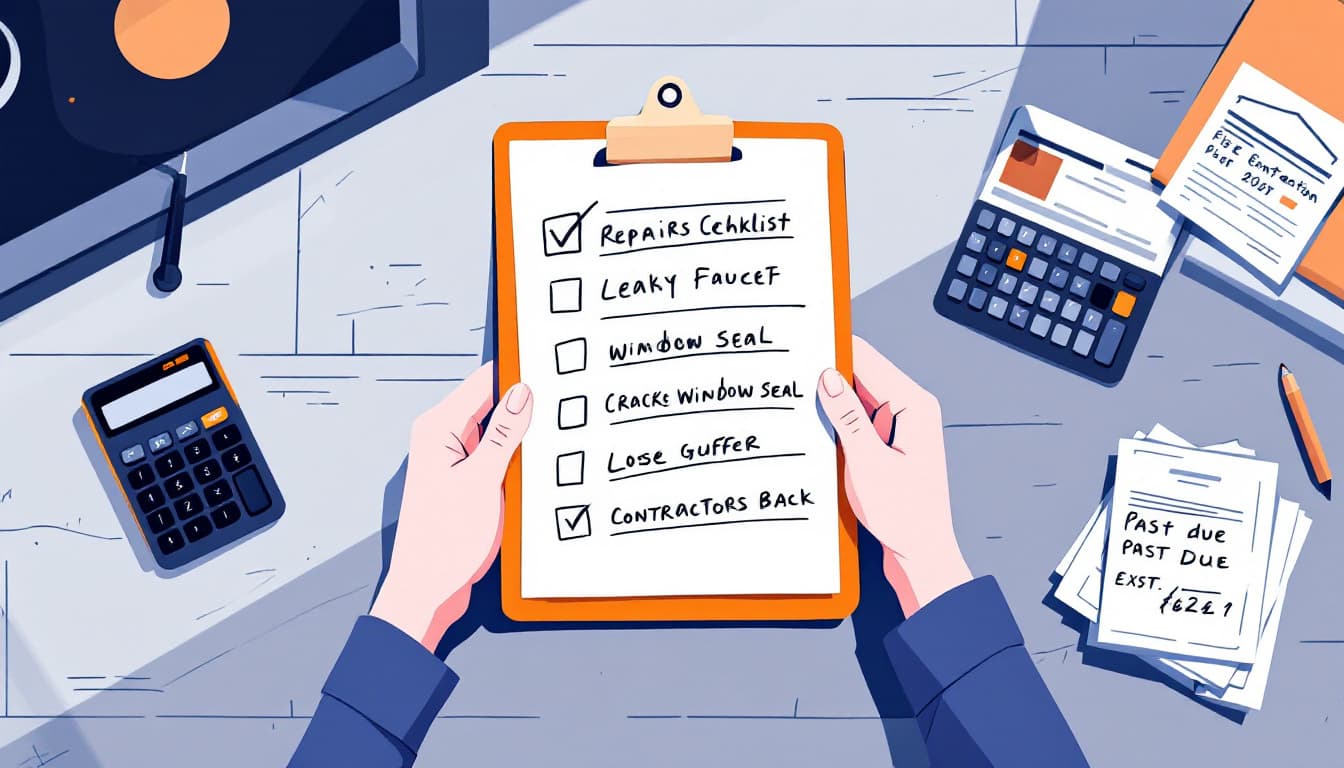
The furnace that's been "running a little rough" since February. The sump pump that hasn't been tested in three years. The roof that probably has two seasons left in it, maybe three. The electrical panel that the last inspector flagged as a code issue but not an emergency.
None of these will kill you this week. That's exactly the problem.
The compounding math most households ignore
Here's a rough framework worth sitting with. The typical owned home requires ongoing maintenance spending equal to somewhere between one and two percent of its value per year — a range you'll find cited by home financial planning sources with some consistency. On a $350,000 house, that's $3,500 to $7,000 annually. Most households spend considerably less than that in good years and rationalize it: things seem fine, money is tight, the problem isn't urgent.
What this creates is a deferred maintenance liability — a running total of repairs not made that doesn't disappear, it accumulates. Roofing materials don't care that you were busy. A water heater that's 14 years old doesn't reset its actuarial clock because you've had a hard year financially.
The slow-leak risk isn't any individual item on that list. It's the collision probability: the likelihood that a disruption event — a job loss, a medical bill, a natural disaster — lands at the same moment your deferred tab comes due. And that probability is not small, because both tend to cluster around the same conditions: aging housing stock, financially stretched households, periods of economic stress.
Run the numbers simply. If your household has $8,000 in deferred maintenance and your emergency fund holds three months of expenses, a single forced repair — say, an emergency HVAC replacement at $6,000 to $9,000, which is a realistic current range — can effectively zero out your liquid cushion before any actual emergency has even arrived. The emergency fund you thought you had was already spoken for. You just didn't know it yet.
Why people get this wrong
The preparedness community talks constantly about gear, supplies, and skills. The personal finance community talks about emergency funds and liquid reserves. Almost nobody bridges the two by asking: what hidden liabilities are already committed against those reserves?
Deferred maintenance is particularly easy to underweight because it's invisible in the way debt is visible. A credit card balance shows up on a statement every month. A roof that needs replacing just sits there, not sending invoices. It has no due date until it does.
There's also a cognitive trap in the way we frame home repairs versus home investments. A new water heater feels like a cost. Putting a full emergency fund in a high-yield savings account feels like progress. Both are true, but the water heater that fails at year 14 on a cold January night — when you also happen to have a family member in the hospital — converts from a "cost" into a crisis faster than almost any other household scenario you could model.
The insurance parallel is worth noting. You wouldn't skip renewing your homeowner's policy to pad your emergency fund. Deferred maintenance is effectively the same category of risk: you are self-insuring against a known, quantifiable liability and hoping the timing works out.
What to do this week
Do a deferred maintenance audit. Walk through your home with a notepad. Write down every system or component you've been meaning to address. Assign a rough replacement cost to each item — contractor quote apps and services like HomeAdvisor's cost estimator can give you ballpark ranges without a service call.
Add those numbers up. If the total is more than 50 percent of your liquid emergency fund, you have a shape problem, not just a savings problem. Your emergency fund is already partially committed.
Triage by failure consequence, not cost. A leaking roof that damages insulation is a different risk tier than a cracked driveway. Prioritize items whose failure would force a decision during a period of financial stress, not items that are merely annoying.
Set one repair in motion this month. Not all of them. One. The goal isn't to solve the backlog immediately — it's to interrupt the compounding. Households that fix one deferred item per quarter make steady progress. Households that wait for "a better time" financially often find that time never comes.
Rethink your emergency fund target. A rough rule: your liquid emergency fund should equal three to six months of expenses plus your estimated deferred maintenance liability. If that number feels uncomfortably large, it should — it's an accurate picture of your household's actual risk exposure.
The bigger picture
Preparedness planning that ignores the state of the physical infrastructure you're planning around is incomplete planning. Your home is the platform on which most emergency responses are built — shelter-in-place scenarios, power outage management, water storage, all of it. A house with a compromised roof, an aging electrical panel, and an untested sump pump is a less resilient platform regardless of how good the gear inside it is.
The slow drain of deferred maintenance isn't dramatic enough to make anyone's threat list. That's exactly why it belongs on yours.