A heat-risk researcher writing in the Houston Chronicle this week made a point that should stop every Texas homeowner mid-scroll: the buildings most of us live and work in were designed for a climate that no longer exists. Not a provocative claim — a structural one. Texas residential construction standards, set largely in the 1970s and 1980s, assumed summers would be uncomfortable but finite. What the last several years have delivered instead are multi-day events where overnight lows stay above 85°F and indoor temperatures in unshaded, poorly insulated homes track close behind.
That gap — between what your building was built to handle and what the sky is now handing it — is the household risk that deserves your attention this month.
What's actually changing
The failure mode most people don't plan for isn't a single hot afternoon. It's 72 to 96 consecutive hours of elevated heat with no overnight recovery, which overwhelms the thermal mass of a house built with minimal insulation and single-pane windows. Your AC runs continuously. If ERCOT load-shedding or a local outage cuts power for even six hours during peak heat, interior temperatures in a poorly sealed Texas ranch house can exceed 95°F before midnight.
The Houston Chronicle piece focuses on structural inadequacy at a policy level. That's the right frame for legislators. For households, the operative question is narrower: how long can your home stay survivable without mechanical cooling, and do you know where the weakest points are?
Most Texas families don't. And most will find out during an emergency, not before one.
What we'd actually do
Get a rough thermal baseline for your home this weekend. On the next day forecast above 100°F, close everything up as if the power were out, then check interior temperatures every two hours. You don't need special equipment — a $12 digital indoor thermometer works. This exercise tells you how fast your specific home heats and where the worst rooms are. Most households discover the answer is "faster than expected."
The data you collect matters more than any general advice. A 1990s brick veneer home in San Antonio with attic insulation at R-19 behaves very differently than a 2005 wood-frame house in Houston with full spray foam. You need to know your number, not the average.
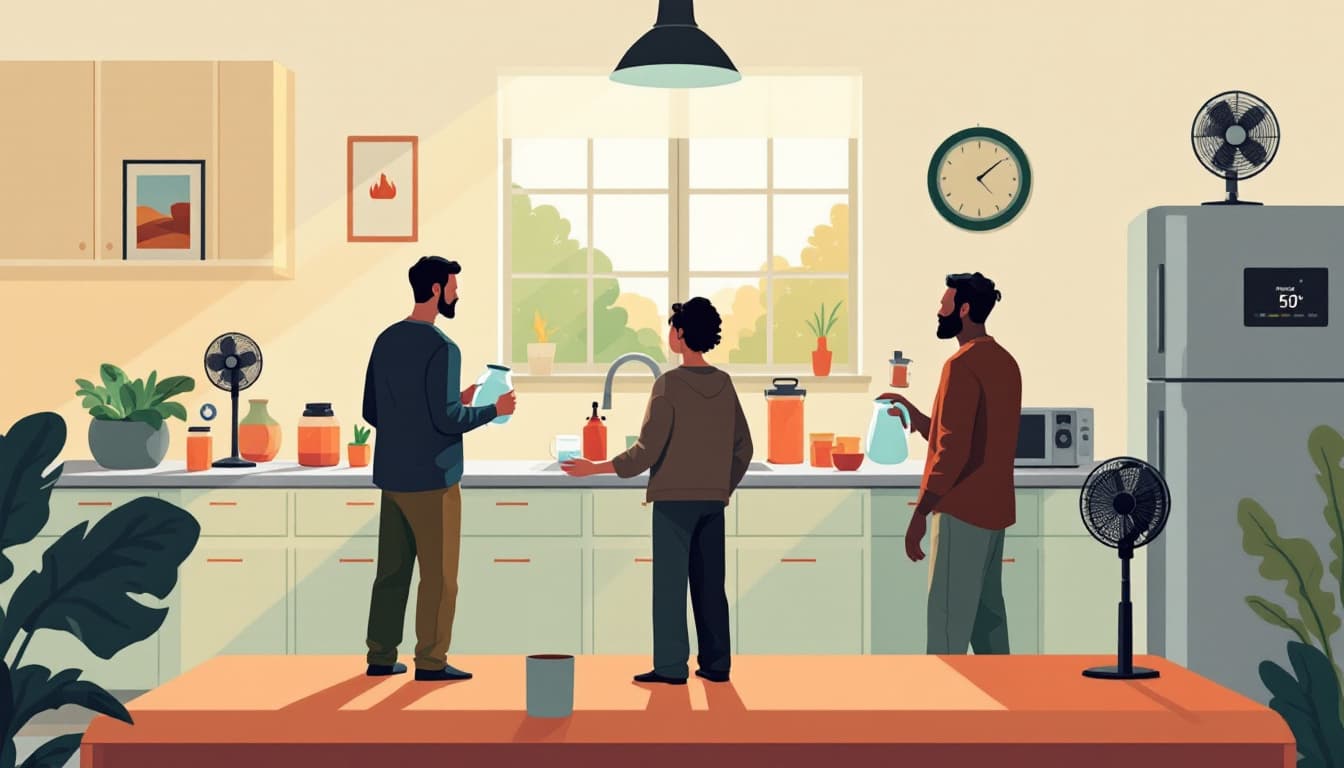
Identify one room you can make into a cool refuge, then prep it now. The goal isn't to air-condition the whole house without power; that's not achievable. The goal is one room — ideally north-facing, interior, lowest floor — that you can keep survivable. Weatherstrip the door, hang a moving blanket or blackout curtain on any window that gets direct sun, and keep a battery-powered fan and frozen gel packs staged there. This is a realistic 48-hour buffer, not a fantasy.
Map your nearest public cooling centers before you need them. Every major Texas county — Harris, Dallas, Bexar, Travis, Tarrant — maintains a list of air-conditioned public spaces that open during heat emergencies. Find yours now, note the hours, and download the address offline or write it down. During a grid event, your phone battery and cell service are both under strain. Knowing where to go without searching is not a small thing.
Add attic ventilation or a radiant barrier to your home improvement budget, not your wish list. A radiant barrier installed in an unshaded Texas attic can reduce attic temperatures by 20 to 30 degrees, which meaningfully reduces how hard your AC works and how fast your house heats if cooling fails. This is not a luxury upgrade — it is the single highest-ROI heat mitigation for most Texas homes built before 2000. Costs vary widely by home size, but basic DIY radiant barrier foil for a standard attic runs well under $500 in materials. Get a quote this month while contractors aren't yet slammed.
Check your elderly or medically vulnerable neighbors now, not when an alert goes out. Heat deaths in Texas are concentrated among people over 65 living alone and people with cardiovascular or respiratory conditions. If you know someone in that category within a block of you, a simple check-in agreement — a text or a knock by 10 a.m. on any day forecast above 103°F — is a meaningful intervention. Public health infrastructure is stretched thin during multi-day events. Neighbor-to-neighbor contact scales when systems don't.
The bigger picture
Texas is not going to retrofit its entire housing stock before next summer. That's the honest answer to the policy question the Houston Chronicle piece raises. What households can do is stop treating their home's thermal performance as someone else's problem to solve. The buildings aren't ready. You can be.
Durability means knowing your home's real limitations and working within them — not waiting for a perfect solution that doesn't exist yet.