A Yahoo report this week flagged what North Texas residents already felt coming: triple-digit temperatures bearing down on the Dallas-Fort Worth corridor and the surrounding region. ERCOT, the state's grid operator, has been issuing conservation appeals since early June. The pattern is familiar. What changes year to year is how prepared individual households are when it arrives.
This is not a catastrophe. It is a predictable seasonal event with predictable household consequences — and a short window to act before the worst days hit.
What's actually changing
The heat itself is not the surprise. What has shifted is the compounding pressure on Texas households. Electricity bills in many parts of the state have climbed alongside summer demand, meaning families on variable-rate retail electric plans may face bills 40–60% higher in July and August than in spring. ERCOT has added generation capacity since the February 2021 grid failure, but summer peak demand — driven by air conditioning load across the whole state simultaneously — remains the single largest stress on the system. A multi-day heat event above 105°F is not just uncomfortable; it creates real grid risk during afternoon peak hours, roughly 3–7 p.m.
The other thing worth naming: heat is the deadliest weather event in the U.S. by average annual fatalities, consistently more lethal than hurricanes or tornadoes. The risk concentrates in older adults, young children, people without reliable AC, and anyone doing outdoor work. If you have neighbors in any of those categories, that matters for what you do this week.
What we'd actually do
Lock in a fixed-rate electricity plan before your current contract ends. Call your retail electric provider today and ask when your contract expires. If it's before September, consider switching to a fixed rate now rather than rolling onto a variable plan during peak summer billing. The Public Utility Commission of Texas maintains a comparison tool at powertochoose.org where you can sort by rate and contract length. A fixed rate won't protect you from higher usage, but it removes the per-kilowatt-hour spike risk.
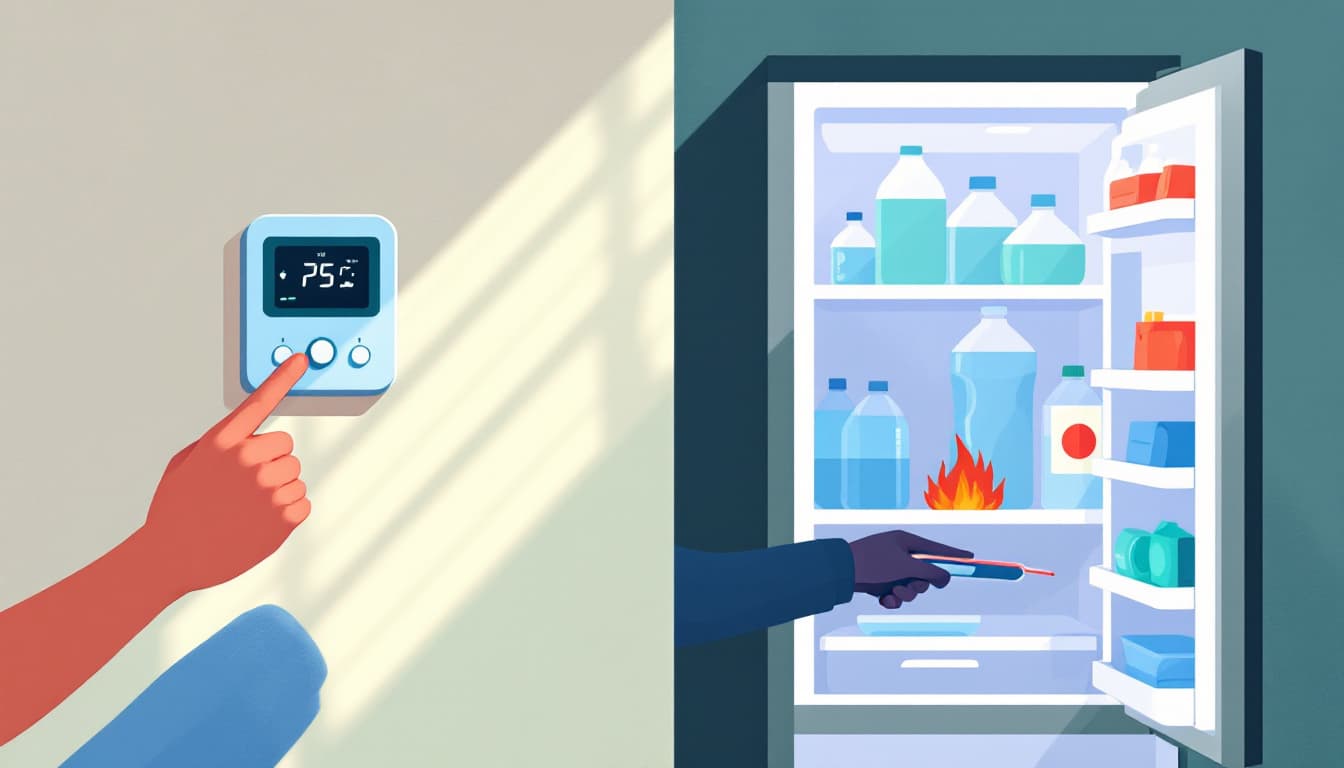
Set your thermostat to 78–80°F during peak hours and pre-cool the house before 3 p.m. This is not about sacrifice — it's about load-shifting. Running your AC hard from noon to 2:30 p.m. to get the house down to 74°F, then raising the setpoint to 78°F from 3–7 p.m., reduces your grid draw during the hours ERCOT is most vulnerable and trims your bill. A programmable or smart thermostat makes this automatic.
Identify one room in your home that stays coolest and treat it as your heat refuge. Not every Texas household can cool 2,000 square feet for 10 hours a day at a manageable cost. Pick the interior room — often a north-facing bedroom or bathroom — with the least sun exposure, and concentrate your cooling there if you need to reduce usage. Keep a battery fan in that room. If your AC fails, this buys time.
Check on one neighbor before Thursday. This is not a platitude. Heat death in Texas is disproportionately concentrated among people living alone, often elderly, whose deaths go unnoticed for days. A two-minute check on a neighbor who lives alone — knock on the door, ask if they're cool, offer a phone number — has a measurable impact. Dallas County and Tarrant County both operate cooling centers during heat emergencies; have those addresses ready to share.
Fill three days of water before the week peaks. This sounds redundant in a city water context, but extended heat waves increase the chance of localized infrastructure stress — pressure drops, boil-water notices, or simply your household needing more water than usual. One gallon per person per day for three days is the floor. Store it in a cool, dark spot and rotate it out after a few months.
The bigger picture
Texas summers are long and they're getting longer at the margins. That doesn't mean panic-buying a generator or retreating to a bunker. It means treating summer heat the way Texas households already treat hurricane season on the coast: as a known, recurring event that rewards modest preparation done in advance.
The households that come through heat waves in good shape aren't the ones with the most gear. They're the ones who made a few decisions before the thermometer hit 105 — about their electricity plan, their home's weak points, and the people around them who might need help.
That's the work. It's not dramatic. It's durable.