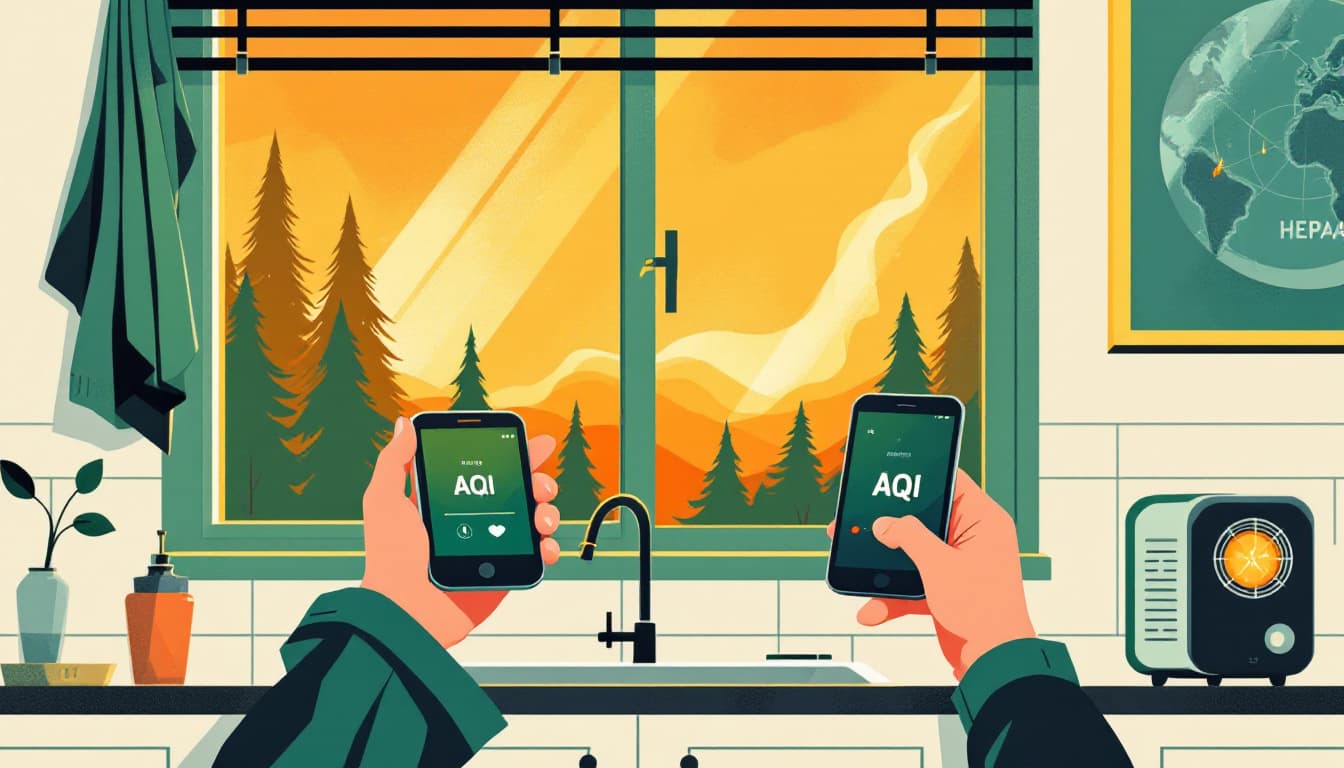
A Weather Channel report this week confirmed what Puget Sound residents already noticed out their windows: wildfire smoke from Northwest fires has pushed air quality into the unhealthy range across Seattle and surrounding communities. The Washington Department of Ecology's air monitoring network showed several western Washington stations hitting AQI readings above 150 — a threshold where sensitive groups face real respiratory risk and healthy adults begin to feel effects after a few hours outside.
This is August in Washington. It is not a surprise. It is, however, still a planning problem most households have not solved.
What's actually changing
The smoke pattern over the past several summers has shifted from occasional nuisance to a recurring multi-week condition. Western Washington used to be largely insulated — marine air pushed smoke east. That buffer still exists, but it is less reliable as fire seasons in eastern Washington, Oregon, and British Columbia start earlier and burn longer.
The practical consequence is that a home that worked fine for Seattle's mild climate — designed for cross-ventilation, not air sealing — is now a liability during smoke events. Older craftsman houses and apartments with window-unit AC or no AC at all pull outdoor air constantly. If you opened your windows last night because it was warm, you likely slept in degraded air.
The other thing that doesn't get covered in weather reports: indoor air quality degrades unevenly. Smoke particles accumulate over hours. A house that reads fine at 10 a.m. after a night of closed windows may be significantly worse by 3 p.m. if anyone has been opening doors, running exhaust fans, or using a gas range without ventilation. There is no single "safe" or "unsafe" state — it's a leaky system that gets worse the longer the outdoor event lasts.
What we'd actually do
Get a portable air purifier with a true HEPA filter into the room where you sleep. Bedroom air quality matters more than whole-house air quality during smoke events, because you're in that room for seven or eight hours. A portable HEPA unit in a small-to-medium bedroom can reduce fine particle concentrations significantly within an hour. The unit does not need to be expensive — basic, well-reviewed models run $60–$120. If you have one stored elsewhere in the house, move it to the bedroom tonight.
Seal your weakest leaks temporarily. This does not mean weatherproofing your entire house. It means identifying where outdoor air enters most easily — usually the gap under exterior doors, bathroom exhaust fans left on, kitchen range hoods, and window AC unit gaps — and addressing those during peak smoke hours (typically midday through early evening). A rolled towel at a door threshold costs nothing. Turning off exhaust fans during smoke hours is a behavioral change, not a purchase.
Check your HVAC filter and set your system to recirculate. If your home has forced-air heating or cooling, make sure the system is set to recirculate indoor air rather than draw fresh air from outside. Verify the setting — many thermostats default back to "auto" after a power flicker. If your filter is more than three months old, replace it. A MERV-13 filter is the practical ceiling for most residential systems; higher-rated filters can restrict airflow enough to damage the blower.
Buy a $10–$15 indoor air quality monitor and actually look at it. Washington residents living near I-5, SeaTac, or industrial corridors in Tacoma already have some baseline particulate load indoors. A basic PM2.5 monitor tells you what's happening in your specific home, not what the nearest Ecology monitoring station is reading a mile away. These are not precision instruments, but they give you directional information: is it getting better or worse? That's enough to make decisions about ventilation timing.
Have N95 masks accessible for outdoor tasks. If you need to commute, run errands, or do anything outside during an AQI-150-plus event, an N95 provides meaningful protection. Cloth masks and surgical masks do not filter fine smoke particles adequately. If your household used N95s during COVID and still has some, confirm they haven't degraded — check the nose wire and seal. If you're out, a two-pack runs about $10 at most hardware stores.
The bigger picture
Western Washington is not becoming unlivable. The air quality problems that hit the Central Valley of California or eastern Oregon on a routine basis are meaningfully worse than what Seattle faces in a typical smoke event. But the trajectory is toward more frequent disruption, not less, and the homes and habits that served Pacific Northwest families for decades weren't built with this in mind.
The goal isn't a bunker. It's a house that stays livable during a week of bad air without anyone getting sick, missing work, or making panicked decisions. The gap between where most Seattle-area households are and where they need to be is not large. A HEPA purifier, a better filter, a $15 monitor, and a few behavioral adjustments close most of it.
That's a Tuesday project, not a crisis.