On a still July afternoon in Baton Rouge or Shreveport, the sky can turn an unmistakable dull orange — not from a storm rolling in off the Gulf, but from wildfire smoke drifting hundreds of miles from fires burning in Texas, the Southeast, or even the Western states. It doesn't smell like Louisiana. That's the point.
A report this week from Louisiana First News flagged the growing practice of buying home air purifiers to reduce smoke exposure. The advice isn't wrong. But the framing — focused almost entirely on product selection — skips the harder questions: Why is smoke reaching Louisiana with increasing regularity? What do most households already have that can help? And when does an air purifier actually matter versus when is it a $200 placebo?
What's actually changing for Gulf Coast air quality
Louisiana sits at the receiving end of the continent's air patterns. When large fires burn to the west or north, the jet stream and prevailing winds deposit fine particulate matter (PM2.5) across the Gulf South within 24 to 72 hours. The Louisiana Department of Environmental Quality publishes air quality index readings daily at deq.louisiana.gov — and in recent summers, Code Orange and Code Red days from smoke events have become a measurable, recurring pattern, not a once-a-decade anomaly.
The specific danger is PM2.5, particles small enough to bypass your nose and throat and lodge in lung tissue. A standard MERV-8 filter — the kind most Louisiana homes run in their central air systems — stops dust and pollen reasonably well. It stops very little PM2.5. The filter in your system right now is probably not doing what you hope it does during a smoke event.
Children with asthma, adults over 65, and anyone with an underlying respiratory condition face the sharpest risk. But even healthy adults absorb meaningful particulate load during sustained exposure over a full day indoors with a leaky or under-filtered system.
What we'd actually do
Check your HVAC filter's MERV rating this week. Pull the filter out and look for the MERV number printed on the cardboard frame. If it reads MERV-8 or below, swap it for a MERV-13 before the next smoke advisory. MERV-13 filters cost roughly $15–25 at any hardware store in Louisiana, fit most standard residential systems, and capture a meaningful share of fine particles. One caveat: some older or lower-powered air handlers can't move air efficiently against a denser MERV-13 filter — check your system's documentation or call your HVAC tech if you're unsure.
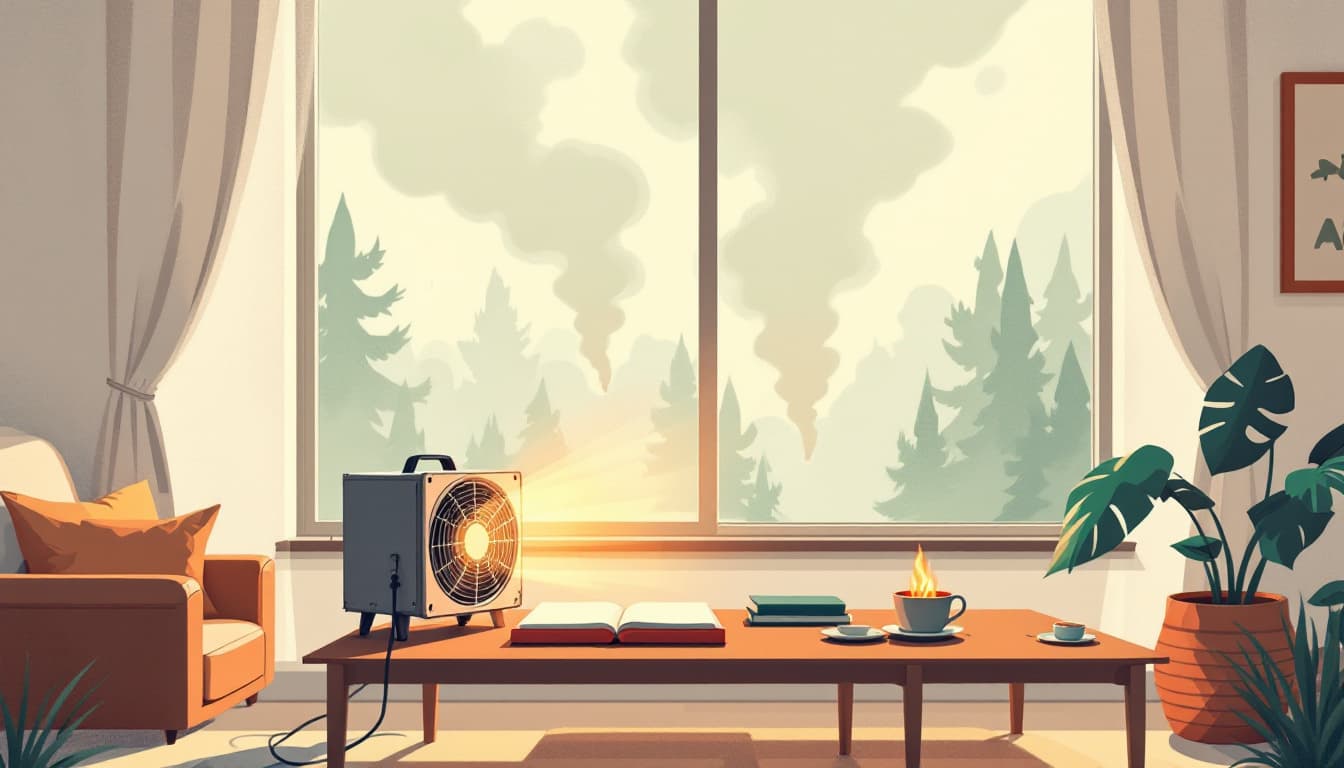
Build a box-fan filter for under $30. A 20x20 box fan paired with a MERV-13 furnace filter and basic box tape functions as a surprisingly effective room-level air cleaner. Research from multiple university engineering departments has confirmed the approach works for PM2.5 reduction in a single room. During a Code Red air quality day, running one in a bedroom with the door closed is a practical, low-cost way to protect the room where your family sleeps — without buying a dedicated purifier at all.
Seal the obvious gaps before the next event. Louisiana homes are not built for air-tightness — they're built for heat and humidity management. During a smoke event, that design works against you. Weather-stripping around exterior doors and a bead of caulk around window AC unit gaps are the two highest-leverage places to spend 90 minutes. Neither requires a contractor.
Know the LDEQ air quality alert system. Sign up for air quality alerts directly through the Louisiana DEQ website. The AirNow app (run by the EPA) provides parish-level PM2.5 readings updated hourly. When the index hits 101 or above, that's the practical threshold to close the house, switch your HVAC to recirculation mode, and keep the box-fan filter running in high-use rooms.
If you do buy a dedicated purifier, buy for room size, not brand. Any unit with a true HEPA filter rated for the square footage of your specific room will perform. A unit sized for 200 square feet will underperform in a 500-square-foot open-plan living area regardless of its price. The CADR (Clean Air Delivery Rate) number on the box is the figure to match against your room — not the marketing copy.
The bigger picture
Louisiana households already manage one of the more demanding environmental footprints in the country — hurricane season, extreme heat, flooding, and now recurring smoke advisories layered on top. None of these require doomsday-level preparation. They require knowing which tool applies to which threat.
Smoke events are a filtration problem. Filtration problems are among the cheapest household problems to address, if you do it before the sky turns orange and the hardware store sells out of MERV-13 filters by noon.
Durability isn't about having the perfect equipment. It's about taking the cheap, unsexy steps when the calendar says July and the air is still clear.