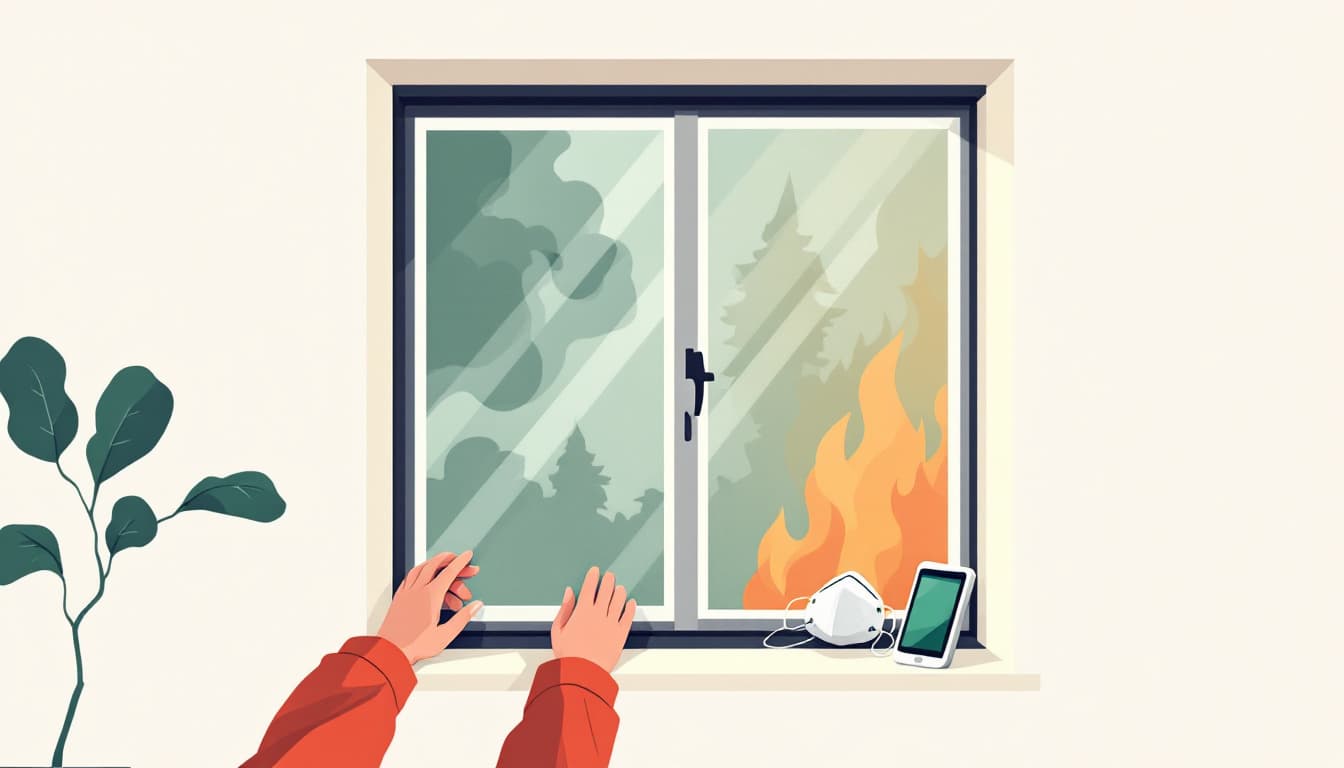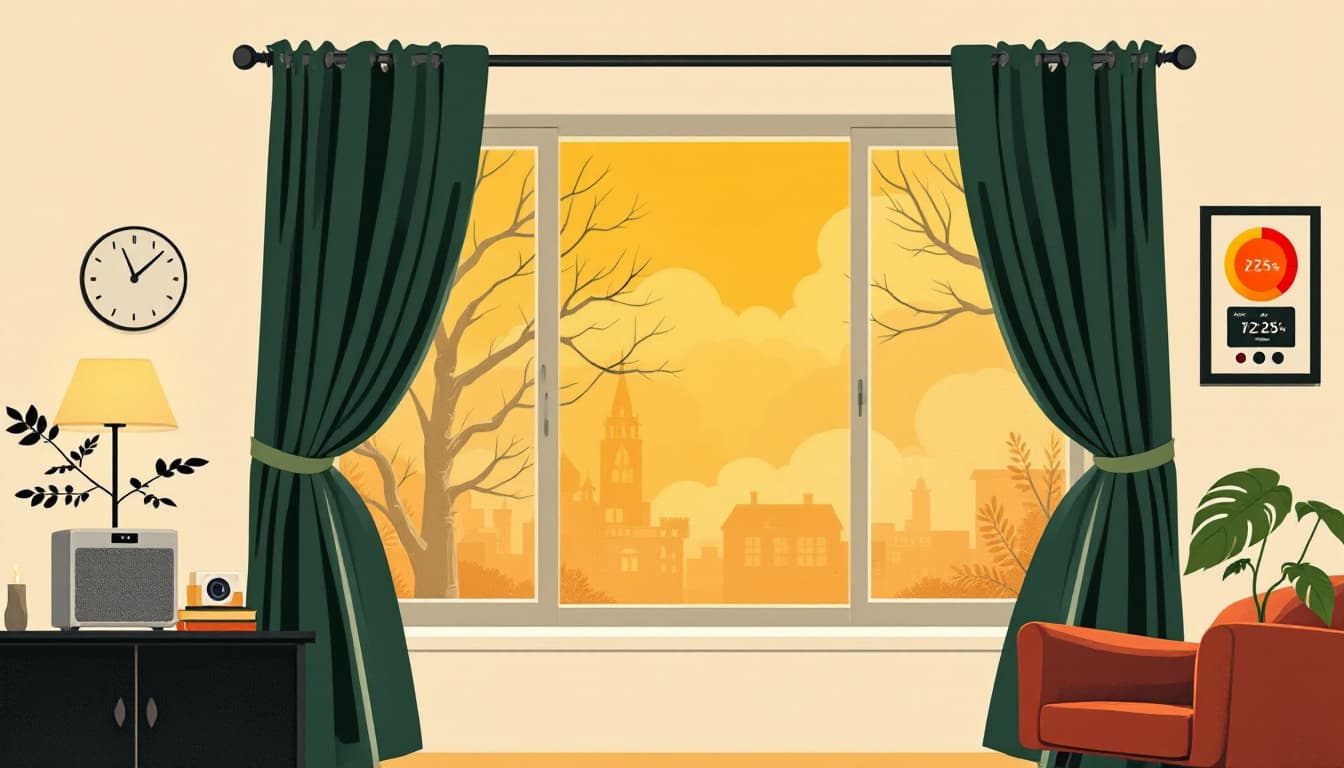
Delaware sits at the edge of the mid-Atlantic corridor — not the Pacific Northwest, not the Mountain West. When Delawareonline.com reported this week that the state was simultaneously under excessive heat warnings and blanketed by wildfire smoke, it confirmed something households in that region had not fully absorbed: smoke events are no longer a Western problem you watch on cable news. They arrive in Delaware, Pennsylvania, and New Jersey with less warning than a hurricane and with damage that's harder to see.
The compound problem — smoke plus heat — is the part most emergency planning skips. They tend to be treated as separate events, with separate checklists. They are not separate when they land on the same afternoon.
What's actually changing
The sequence matters. Wildfire smoke suppresses your instinct to cool down by staying outside, which is exactly what you'd normally do during a heat advisory: open windows, run a fan, take a walk in the evening. Smoke closes that option. You seal the house, which raises indoor temperatures. If you're running central air, you're recirculating some outdoor particulates depending on your filter grade. If you don't have central air — and a substantial share of older mid-Atlantic housing stock does not — you face a direct trade-off: heat stress indoors or particulate exposure outdoors.
EPA AQI readings above 150 (the "Unhealthy" threshold) put particulate matter at levels where short-term exposure causes measurable respiratory stress in healthy adults, not just in vulnerable groups. Children, the elderly, and anyone with asthma or a cardiovascular condition reach dangerous territory at AQI levels well below that. Wildfire smoke is dominated by fine particulate matter (PM2.5), which penetrates deeper into lung tissue than coarser particles.
Heat and smoke together tax the cardiovascular system from two directions at once. The body works harder to cool itself in high heat; simultaneously, reduced lung efficiency means less oxygen is reaching the bloodstream efficiently. This is not theoretical. Emergency department visits for respiratory and heat-related complaints spike measurably during these compound events.
Most household emergency plans don't reflect this. They address heat in summer and smoke when it comes up, but not both at once, and not as a recurring pattern rather than a freak occurrence.
What we'd actually do
Check your HVAC filter rating and replace it before the next event, not during it. A standard fiberglass HVAC filter does essentially nothing against PM2.5 smoke particles. MERV-13 filters (the rating system used for residential and commercial HVAC) capture a meaningful fraction of fine particles and fit most standard forced-air systems. They cost $15–$30 at most hardware stores. Check that your system can handle the slight airflow restriction — most modern systems can — and swap it in now. During a smoke event, it is not the time to be sourcing filters.
Identify your one coolest interior room and know its baseline temperature. Pick the room in your home that holds heat least — usually lowest floor, north or east facing, smallest window area — and check its temperature on a normal hot day. That number is your reference point. During a compound heat-smoke event, if outdoor air is closed off, that room becomes your refuge. Know it ahead of time. If you have a window AC unit that hasn't been used, test it this week.
Buy two N95 respirators per household member and store them with your go-bag, not your pandemic supplies. N95s filter PM2.5 effectively. A surgical mask does not. You need these when you must go outside during a smoke event — to get a vulnerable family member to a car, to walk a dog that won't wait, to assess property. Two per person is enough for short-duration events. IQAir and PurpleAir both offer real-time neighborhood-level AQI maps; bookmark one on your phone and check it before deciding whether outdoor exposure is worth it.
Set up a text alert for your county's AQI. AirNow.gov (operated by EPA) sends free air quality alerts by zip code. Sign up takes under two minutes. Most people in Delaware this week learned about the smoke event from general weather apps, which often lag dedicated air quality monitoring by hours. An AQI alert tied to your specific zip code gives you a shorter lead time to close windows and make decisions.
Know where your nearest cooling center is before you need it. Every county in Delaware and most mid-Atlantic jurisdictions operates designated cooling centers during heat emergencies — typically libraries, community centers, and senior facilities. These also offer a filtered, air-conditioned environment when smoke is a factor. Look up the address now. The time you spend finding it during an event is time your household is exposed.
The bigger picture
What happened in Delaware this week is not anomalous bad luck. The geographic footprint of wildfire smoke has expanded steadily over the past decade, and the mid-Atlantic corridor has appeared on smoke-impact maps in multiple recent summers. At the same time, urban heat island effects mean that dense residential neighborhoods accumulate heat faster than rural areas, amplifying advisories that were originally calibrated for different conditions.
None of this requires catastrophizing. Households that have thought through the compound event — sealed room, correct filter, N95s accessible, cooling center address noted — are not dramatically better equipped than their neighbors in normal years. They're specifically better equipped in the 72-hour windows that increasingly characterize summer in the eastern U.S. That's the kind of durable readiness worth building.