The Atlantic hurricane season officially opened June 1. By mid-June, The New York Times was already publishing live tracking maps for Potential Tropical Cyclone One. That gap — fifteen days between the season's start and the first organized system — is not a catastrophe. It is a clock.
Most households on the Gulf and Atlantic coasts treat June 1 as a reminder to think about preparation sometime before August. A system forming in the second week of June collapses that assumption. The question is not whether your area will be affected by this particular storm. The question is whether your household is actually ready, or whether you have been meaning to get ready.
What is actually changing
The early-season signal here is not the storm itself. Pre-season and early-season tropical development has shown up more frequently over the past decade as Gulf and Atlantic surface temperatures have remained elevated into spring. NOAA's seasonal outlooks in recent years have repeatedly flagged above-normal activity, and 2026 is no exception to that pattern.
What changes for families is the preparation window. A September storm gives most households two to three months of ambient anxiety that eventually produces action. A June storm compresses that window to days. Emergency managers in coastal counties have noted for years that the first storm of any season causes a run on supplies — water, batteries, plywood — because people assumed they had more time.
There is also a supply-chain dimension. Post-pandemic restocking cycles mean that big-box retailers in hurricane corridors carry leaner pre-season inventory than they did a decade ago. A storm threat in mid-June hits shelves before most regional distribution centers have pushed in their summer emergency-goods replenishment. That is not alarmism; it is logistics.
What we would actually do
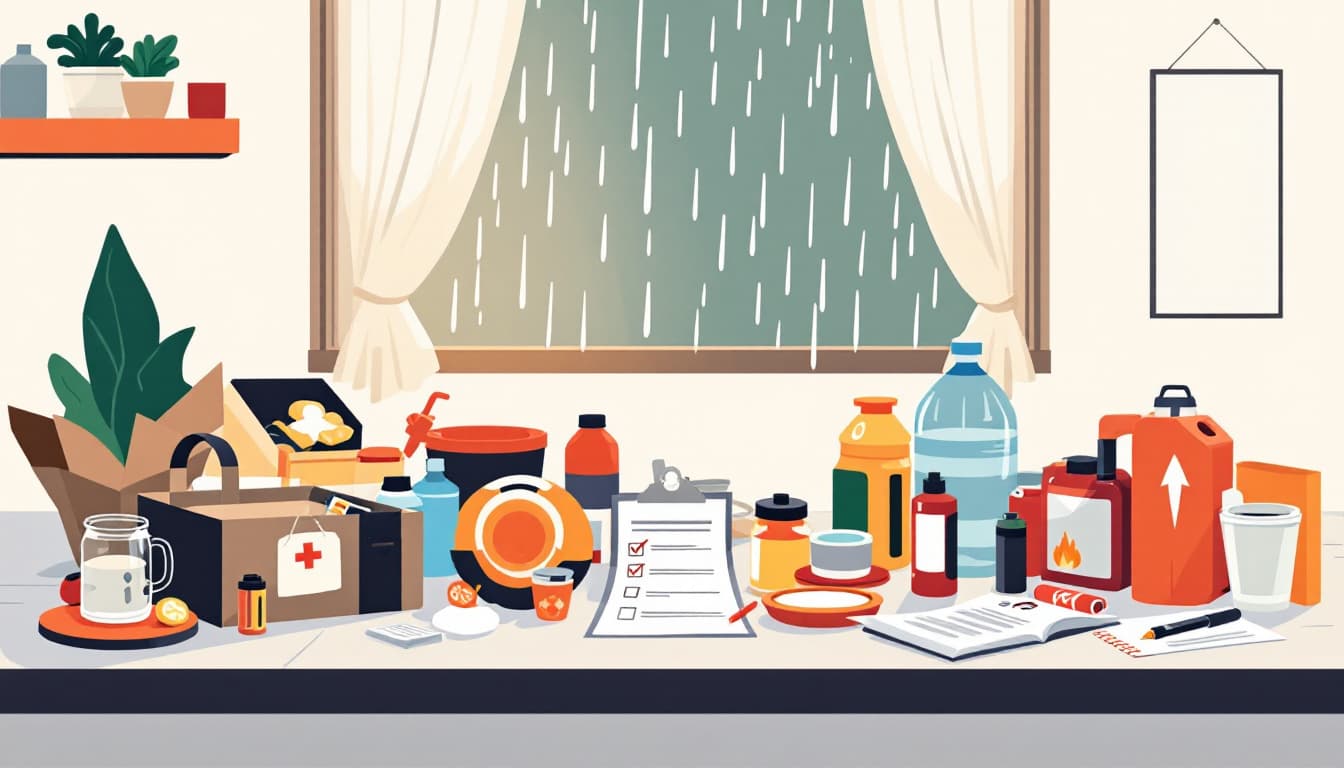
Verify your water supply this week, not this month. FEMA's baseline guidance is one gallon per person per day for at least three days; most preparedness analysts consider seven days more realistic for a serious storm. A family of four needs 28 gallons stored to hit that threshold. Tap water in food-grade containers costs almost nothing. Do it before a watch is issued, when stores are still calm.
The mental trick that works: schedule it like a bill payment. Thirty minutes on a weekday evening. Fill containers, label them with today's date, put them somewhere accessible. Done.
Pull your documents out of wherever you last put them. Driver's licenses, insurance policies, passports, mortgage or lease documents — know where they are and photograph them to a cloud folder. A storm that requires evacuation gives you minutes, not hours, to gather what matters. Physical documents destroyed by flooding are a weeks-long administrative nightmare to replace.
This is not exotic preparation. It takes twenty minutes. It is the single most-neglected item in household readiness surveys.
Check your evacuation route, not just your kit. Most coastal families have a vague sense that they would "head north" or "go to family." That is not a plan. Look up your county's official evacuation zones — they are posted on county emergency management websites — confirm which zone you are in, and identify two routes out. One of them will be gridlocked. Know the other one.
Test your communications backup. If your household relies entirely on smartphones and home internet during a storm, a power outage leaves you without weather updates at the moment you need them most. A battery-powered or hand-crank NOAA weather radio costs under $30 and requires no network. Buy one before a watch is posted, when Amazon delivery times are still normal.
Talk to the people you would actually call. Who is your out-of-area contact if local lines are jammed? Where would you stay if you evacuate? Do the elderly or mobility-limited people in your family or neighborhood have a plan? These conversations feel unnecessary right up until they are urgent.
The bigger picture
A tropical cyclone forming in the second week of June is not a sign that everything is broken. It is a sign that the Atlantic basin behaves on its own schedule, not ours. The families who handle storms well are not the ones with the most gear. They are the ones who did the boring, low-cost work during the quiet weeks — water stored, documents photographed, routes confirmed, radios charged — so that when a track shifts toward their coast, the decision tree is already built.
Durability is not about surviving one catastrophic event. It is about not being caught unprepared by the ordinary ones.