The marine layer is still hugging the California coast this morning. By next week, it may be gone.
A report this week from edhat, drawing on the Weather West forecast blog, describes an unusually energetic June jet stream currently driving low pressure over California. The relevant detail is what comes after: meteorologists are tracking a strong ridging pattern expected to build by mid-June, with the potential for a significant heatwave. In California, "significant" ridging events in June are not routine. The marine layer collapses, overnight lows stay elevated, and the grid gets hit hard before anyone has mentally shifted from spring into summer mode.
That transition window — the days between now and when the ridge locks in — is the only preparation window you have.
What's actually changing
Early-June heatwaves in California are more disruptive than their August counterparts for one specific reason: households and utilities alike are not calibrated for them. Air conditioning hasn't been serviced. The body hasn't acclimatized. The California Independent System Operator (CAISO), which manages the state's grid, typically sees its highest demand alerts in late summer. An aggressive mid-June ridge can catch load-balancing reserves in a suboptimal position.
The other factor here is the sequence. Weather West's analysis describes low pressure being replaced by a strong ridge — a pattern that tends to produce rapid temperature swings rather than a gradual warm-up. Inland valleys, the Sacramento and San Joaquin regions, foothill communities, and the Inland Empire absorb these swings the hardest. Coastal residents, especially in the Bay Area and Los Angeles Basin, often get a delayed but compounding effect when the marine layer finally clears.
None of this is certainty. Forecast confidence degrades past about five days, and ridge timing can shift. But the meteorological setup is credible enough to act on.
What we'd actually do
Sign up for CAISO's demand-response alerts or your utility's flex alerts right now. PG&E, SCE, and SDG&E all allow customers to enroll in Flex Alert notifications — typically a text or email — that arrive a day before a grid stress event. Most households haven't enrolled because they've never needed to. Do it before Friday. During a Flex Alert (generally 4–9 p.m.), running the dishwasher, charging an EV, or running a dryer adds real load. Shifting those tasks to before 4 p.m. costs nothing and reduces the chance of rolling outages in your neighborhood.
Identify your household's one most vulnerable person and build a specific plan around them, not a general plan. Heat preparedness advice almost always defaults to "check on elderly neighbors." That's not wrong, but it's too abstract. If you have someone in your home — a toddler, a person over 75, or someone on medications that impair heat tolerance (diuretics, beta blockers, antipsychotics) — write down the three nearest cooling centers in your city and confirm their June hours. California's extreme heat website, maintained by the state's Office of Emergency Services, lists cooling centers by county. Confirm now, before the phone lines are jammed.
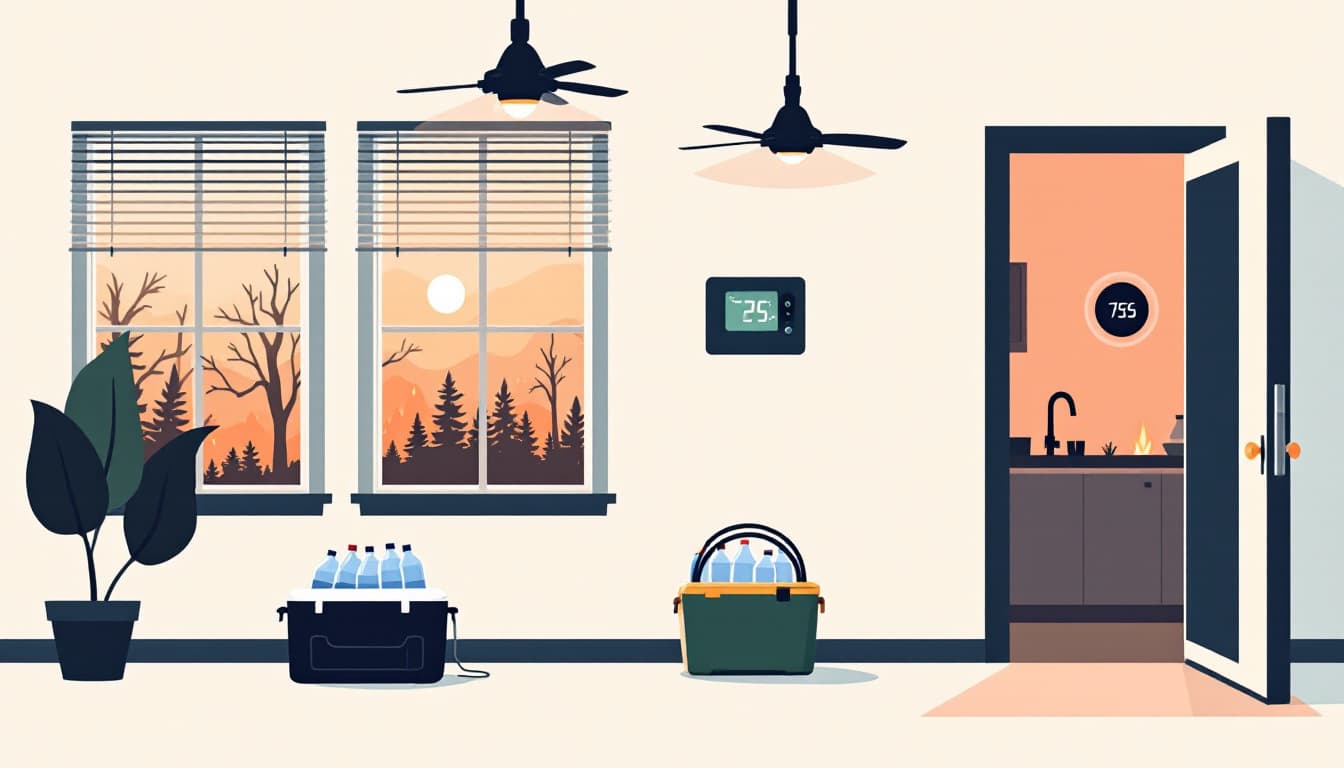
Pre-cool your home before the hottest window each day, not during it. This is the single most effective low-cost action for households without efficient central air. Open windows fully from 10 p.m. to 7 a.m. and use fans to flush in cool air. Close everything — windows, blinds, interior doors — by mid-morning and keep them closed. A house that starts a 105-degree day at 68°F interior temperature stays livable far longer than one that starts at 78°F and runs AC reactively. Blackout curtains on west-facing windows make a measurable difference; they cost $25–$40 at most hardware stores.
Check your emergency water baseline before the heat arrives, not during it. A three-day supply for a California household is one gallon per person per day, per FEMA's standard guidance. That's the floor, not the ceiling. During a heatwave, the practical need is closer to two gallons per person per day when you account for activity and cooling. Fill what you have. If you rely on a well, note the pump's power dependency. If you're on municipal water, there is no supply concern in most heatwave scenarios — but a simultaneous outage changes that.
If you're planning to be away from home for any extended period next week, tell someone your household's status. This sounds basic. It is not practiced. Heatwave fatalities in California are disproportionately people who were alone and not checked on. A quick text thread with a neighbor or family member that simply says "we're home" or "we're out" creates a minimal safety net.
The bigger picture
California's heat seasons are not lengthening gradually — they are becoming less predictable at the margins, which is actually the harder problem. A household that has practiced summer resilience since April is prepared for a mid-June ridge. A household waiting for the traditional "heat season" to begin is not.
The goal here is not a bunker. It is a household that functions — stays cool enough, has water, knows where to go, and doesn't add to the emergency call volume — when the grid and the forecast both become inconvenient at the same time. That is an achievable standard. The window to build toward it is open right now.