A KVUE report from Tuesday night documented power outages rolling across Austin as severe storms pushed through Central Texas. Tens of thousands of customers lost power. Some came back online within hours. Others didn't.
This is not a rare event. It is the pattern. Texas enters meteorological summer — already hot, already humid — with a grid that has weathered criticism since the February 2021 freeze and faces fresh pressure every time a derecho or a heat dome settles over the state. The storms this week were not historic. They were ordinary. That's the point.
What's actually changing
The ERCOT grid has added significant generation capacity since 2021, and the Public Utility Commission of Texas has pushed through weatherization rules for generators. Those changes are real. But the distribution infrastructure — the poles, lines, and transformers that carry power from the grid to your house — is owned by local utilities like Austin Energy, and it ages and fails under high winds and falling trees the same way it always has. Grid-level reform doesn't prevent your neighborhood from going dark when a mature live oak drops onto a service line at 10 p.m.
What is changing: summers are starting earlier and the storms that precede heat waves are becoming more intense on average, according to National Weather Service climatological data for Central Texas. The gap between "storm knocks out power" and "dangerous indoor heat" is shorter in June than it is in April. An Austin home without power on a June night can hit uncomfortable temperatures in four to six hours and genuinely hazardous temperatures within twelve to eighteen hours for elderly residents, young children, or anyone on heat-sensitive medication.
The other pressure point is timing. Storm outages often hit in the evening, when utility crews are transitioning shifts and restoration estimates are unreliable. Families make bad decisions — staying in a hot house too long, running generators indoors, driving on flooded roads to find a hotel — in that information vacuum.
What we'd actually do
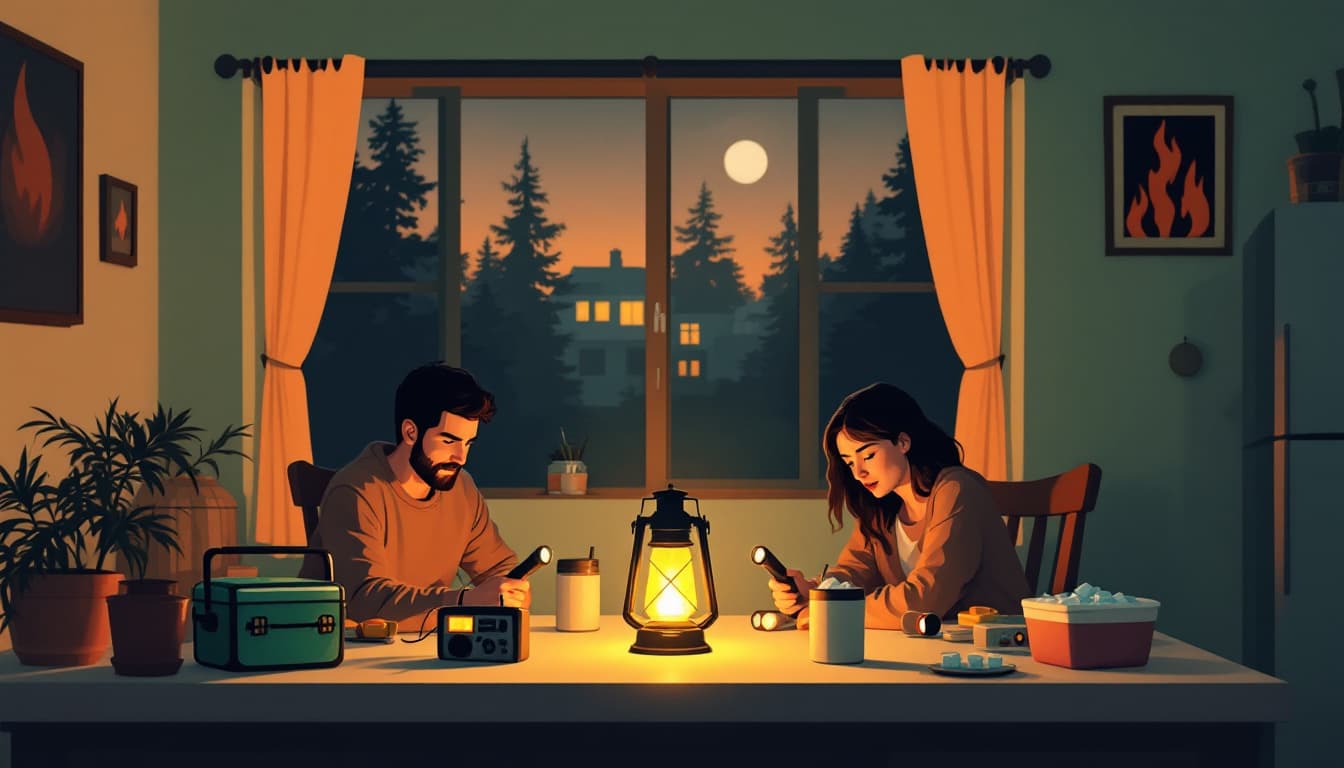
Build a 48-hour no-power kit before the next storm, not after. This is not a two-week survival cache. It's a box or a shelf: two gallons of water per person per day for two days, a battery-powered or hand-crank fan, a manual can opener, food that doesn't require cooking, and a power bank charged to full. Austin Energy's historical restoration data suggests most residential outages resolve within 48 hours; build for that window first.
Get your car's gas tank above half before storm season, not during. When the grid goes down, gas stations with underground pumps lose power too. Austin has enough stations with backup generators that you won't be stranded, but lines form fast. A standing rule — refill at a quarter tank from June through September — costs nothing and removes a decision point during a chaotic evening.
Know your household's medical heat threshold now. If anyone in your home takes beta-blockers, diuretics, antipsychotics, or certain antihistamines, heat tolerance is reduced. Talk to a pharmacist — not a prepper forum — about what a prolonged high-heat environment means for that person specifically. Have a plan that doesn't rely on improvising at midnight.
Program 211 Texas into your phone. Dialing 211 in Texas connects to a statewide information line that can locate the nearest cooling center, shelter, or social service. Austin Public Health and Travis County both activate cooling centers during extended outages. Knowing this before you need it means you're making a calm call, not a panicked search.
Test your smoke and CO detectors this week. Generator misuse kills people in Texas every storm season. A working carbon monoxide detector is a $25 decision that matters most when your neighbors are running generators in garages. If you don't own one, buy one before the next storm watch appears on your phone.
The bigger picture
Texas households are not helpless, and the grid is not as fragile as the loudest voices on either side insist. What is true is that the distribution layer — your street, your transformer, your service drop — will fail during severe weather, and it will do so unpredictably. The goal isn't to build a bunker. It's to make sure a 36-hour outage in June is a sweaty inconvenience rather than a medical emergency or a financial crisis. That gap is closable with one afternoon of preparation and about $60.
The storms this week were ordinary. The next ones will be too.