A major logistics company doesn't build an AI system to monitor supply chain disruptions because things are going smoothly. Yusen Logistics — a global freight and warehousing operator with deep roots in automotive and retail supply chains — recently launched what it calls an AI-powered disruption radar, as reported by Love Business East Midlands. The tool is designed to give Yusen's operations team early warning when port congestion, geopolitical friction, or weather events are about to tighten the lines between a factory in Southeast Asia and a shelf in Birmingham or Baltimore.
That's a significant investment. It's also an admission.
What's actually changing
Corporate logistics has always had risk analysts. What's new is the speed and complexity of the signals they're trying to read. A single container ship rerouting around a conflict zone can cascade into delayed semiconductor deliveries, which delays appliance production, which delays retail restocking — all within six to eight weeks. The humans tracking this can't keep up. Hence the AI.
The household implication isn't dramatic. Nobody is predicting empty supermarkets. What the Yusen announcement reflects, alongside similar moves at other large 3PLs over the past 18 months, is that the professionals managing global freight now treat disruption as a baseline condition, not an aberration. They're building permanent early-warning infrastructure because they expect to need it continuously.
Families don't have access to a disruption radar. But the same logic applies at kitchen scale: the households that fare best during supply tightening are the ones who made low-cost decisions before the shortage, not during it.
Recent BLS consumer price data continues to show food-at-home costs outpacing overall inflation in specific categories — cooking oils, canned proteins, certain grains — that are disproportionately affected by shipping lane disruptions and single-origin sourcing. When a logistics giant invests in predicting exactly those disruptions, it's worth asking what your household's equivalent looks like.
What we'd actually do
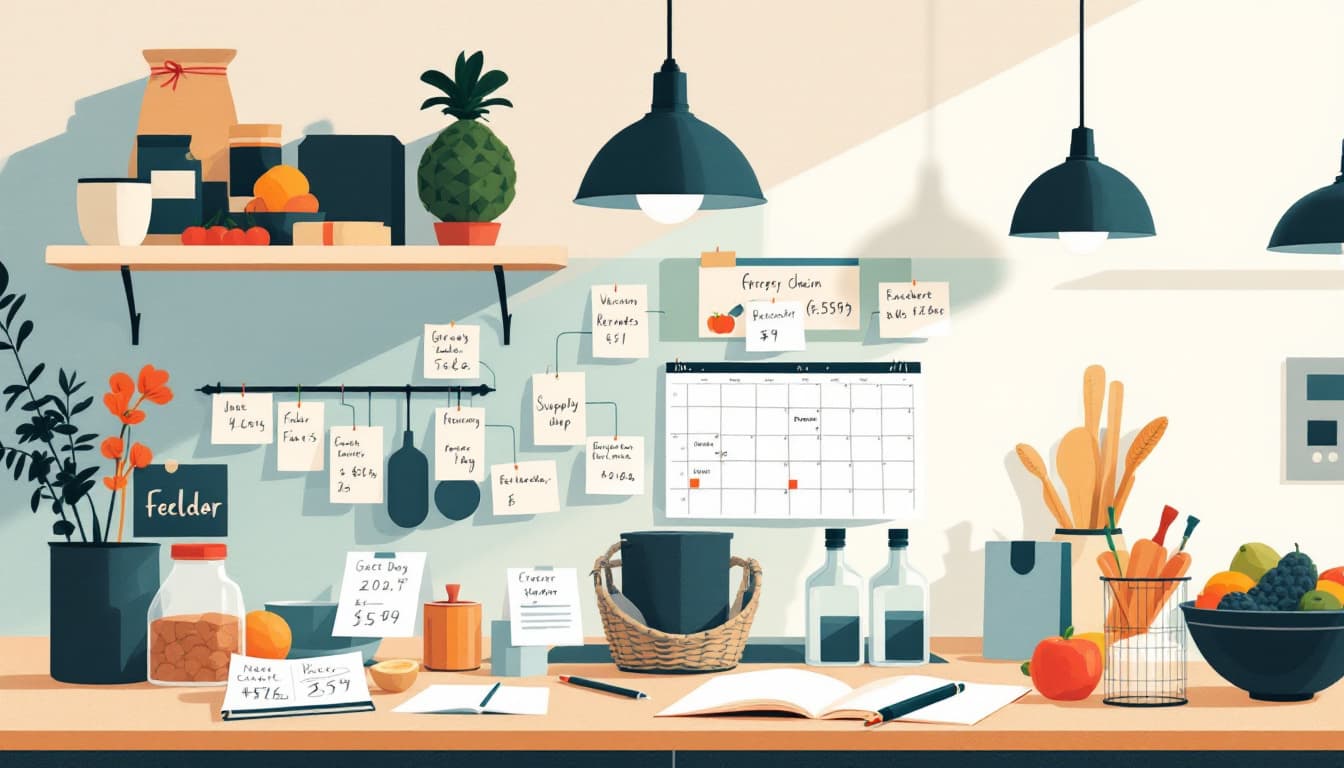
Start a simple pantry inventory, right now, in a spreadsheet or notes app. Most households genuinely don't know how many days of food they hold at any moment. A realistic audit — not a fantasy bunker count, just what's actually in the cupboards — is the foundation for every other decision. Aim to know your number: most urban families find it's somewhere between four and twelve days. That's your baseline.
Identify your three highest-use shelf-stable items and keep a one-month buffer of each. Not forty categories. Three. For most families this is something like rice or pasta, a canned protein, and cooking oil. Buy one extra unit each grocery run until you're sitting on a four-to-six week supply, then rotate. The cost is distributed over weeks and the benefit is real: when a category tightens on shelves, you're buying ahead of the spike, not into it.
Build a short list of what you actually can't substitute. Infant formula, specific medications, specialty dietary items — these are the categories where supply chain disruption hits hardest and where standard "just buy more pasta" advice breaks down. For each item on that list, identify a second supplier or format you've actually tested. Generic advice to "diversify suppliers" is useless; knowing that your child will accept Brand B formula because you've tried it is actionable.
Track one leading indicator monthly. You don't need an AI radar. The Freightos Baltic Index tracks container shipping rates in near-real-time and is publicly available. A sustained spike in spot rates often precedes retail shelf tightening by six to ten weeks in affected categories. Ten minutes a month looking at that number gives you more signal than most households have.
Normalize buying on trend, not on fear. The worst pantry decisions happen in the first 48 hours of a news event. If you've already rotated a reasonable buffer, you have the option to do nothing when headlines get loud — which is almost always the right move.
The bigger picture
What Yusen is building at enterprise scale, families can approximate at household scale — not with AI, but with a small amount of sustained attention and a willingness to make boring, incremental decisions before they're urgent. The goal isn't to be ready for the end of the world. It's to absorb a six-week disruption without a crisis. That gap — between a household that has two days of food and one that has six weeks — is where most of the real resilience lives.
The logistics industry is telling us, clearly and with investment dollars, that disruption is the new normal. The sane response is a slightly deeper pantry and a little more attention, not a bunker.