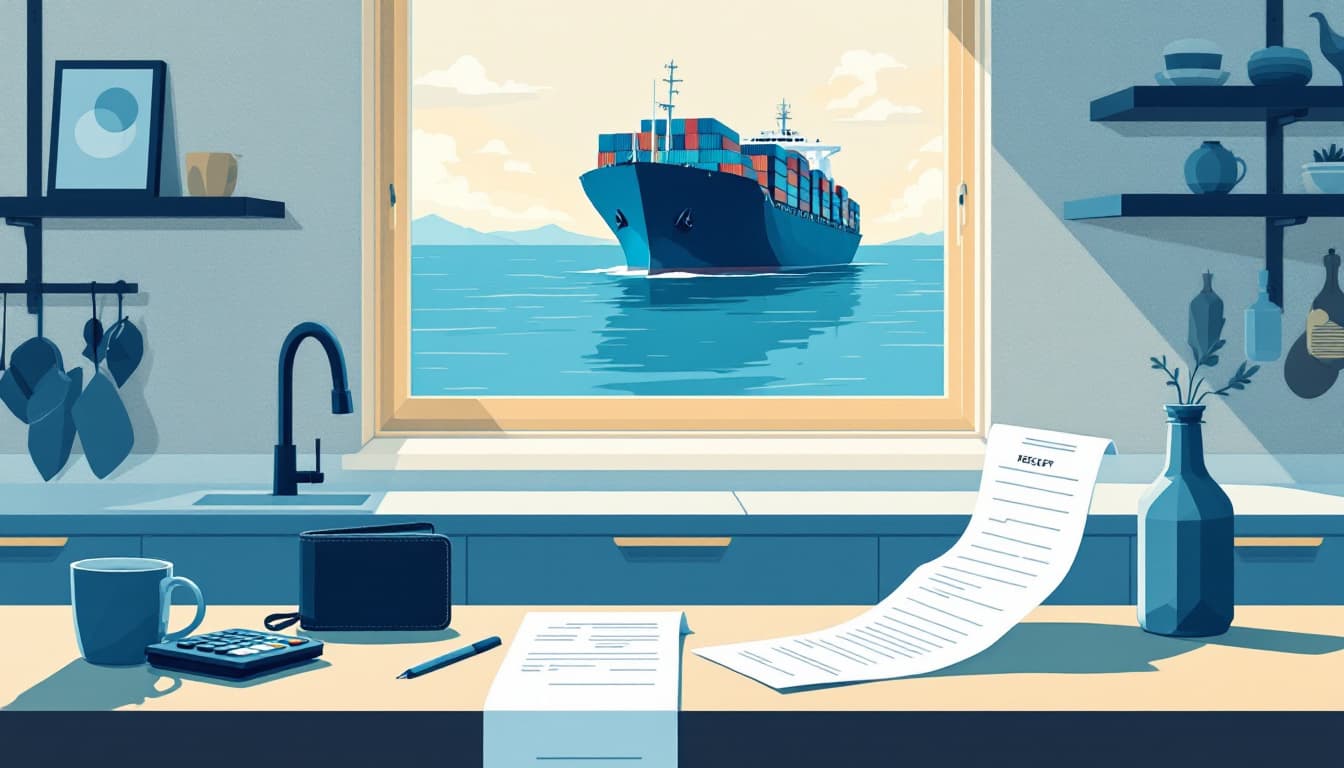
Roughly 40 percent of the world's seaborne oil passes through the Strait of Hormuz. A significant share of global container traffic flows through the Strait of Malacca. Both corridors are under strain at the same time — and a recent Firstpost analysis lays out how overlapping geopolitical pressures across the Middle East and Southeast Asia are converging into something shippers, insurers, and eventually consumers cannot ignore.
Most households won't track this story until a specific product disappears from a shelf or a price jumps with no obvious cause. That lag is the problem.
What's actually changing
Shipping disruptions don't announce themselves on grocery receipts. They arrive as a quiet arithmetic: higher insurance premiums for vessels transiting contested waters, rerouting costs when carriers avoid a strait entirely, and slower transit times that cascade into inventory gaps weeks later.
The pattern from the 2024 Red Sea disruptions — when Houthi attacks rerouted a significant share of Asia-Europe container traffic around the Cape of Good Hope — is the clearest recent template. Freight rates spiked sharply in the months that followed. Consumer goods categories most exposed were electronics, apparel, and certain processed foods with long supply chains.
Two simultaneous chokepoint stresses are categorically harder to route around than one. The Cape of Good Hope workaround added days and cost to Red Sea disruptions, but there is no clean geographic alternative when both Hormuz and Malacca face uncertainty. Energy prices respond first, because oil tankers have fewer routing options than container ships. Consumer goods prices follow, because almost everything manufactured in Asia and consumed in North America or Europe transits one of these straits.
The timeline between a shipping disruption and a household noticing it at checkout is typically six to twelve weeks for manufactured goods, and faster for energy-linked products. That lag is actually useful. It gives prepared families a window to act.
What we'd actually do
Audit your pantry for goods with long Asian supply chains — electronics, appliances, and shelf-stable processed foods — and note what you're running low on. The household items most exposed to strait disruptions are those manufactured in East or Southeast Asia. A replacement laptop power supply, a specific kitchen appliance part, vitamins manufactured overseas — these are the categories where a 30-60 day supply buffer costs little to build now and avoids paying a disruption premium later. You don't need to stockpile. You need to not be caught flat-footed when the item is suddenly backordered.
Check your home's energy cost exposure and consider locking in rates if your utility or fuel supplier offers it. Hormuz stress means oil price volatility. Heating oil customers, households in regions with gas-linked electricity pricing, and anyone with a propane contract approaching renewal should look at whether fixed-rate options are available and whether the current pricing makes them worth considering. This is a normal financial hedge, not a survivalist move.
Build a one-month cash buffer specifically earmarked for unexpected price increases. Disruption-driven inflation hits unevenly and fast. A separate cash cushion — even $200 to $400 — lets you absorb a sudden spike in a staple category without pulling from other budget lines. Think of it as a price-volatility fund, not an emergency fund.
Take stock of any medications or medical supplies manufactured in Asia. A meaningful share of pharmaceutical active ingredients and generic drug supply chains run through Southeast Asian manufacturing hubs. If a household member depends on a generic medication, a 60-90 day supply on hand is a reasonable baseline. Check with your insurer or pharmacist about early refill policies now, not during a shortage.
Watch freight rate indices as a leading indicator. The Freightos Baltic Index and similar public trackers update weekly and show container shipping costs before those costs reach retail prices. A sharp, sustained move upward in those numbers is a 6-8 week warning for goods-price pressure. Bookmark one. Check it monthly.
The bigger picture
Global shipping has always had chokepoints. What's different about the current period is the combination: multiple straits under stress simultaneously, insurance markets already sensitized by recent disruptions, and carrier fleets that haven't fully recovered their routing flexibility from earlier shocks.
None of this means a collapse is coming. Most disruptions resolve, reroute, or get absorbed by the market at a cost that spreads across many product categories in amounts too small to notice individually. But for households carrying no inventory buffer and no financial cushion, even moderate disruption lands harder than it should.
Durability isn't about predicting which strait closes next. It's about building enough margin into your household that you're choosing how to respond, not scrambling because you have no choice.