In the high desert outside Phoenix, the summer groundwater table has been declining for years. Farmers have sold water rights. Some subdivisions are on notice. And now, according to reporting from The Guardian this week, a large share of the next generation of U.S. AI datacenters is slated for land in exactly these kinds of drought-stressed corridors — the Southwest, parts of the Southeast, and the interior West.
This is not a technology story. It's a resource allocation story, and households in affected regions are a quiet stakeholder in it.
What's actually changing
Large language models and the infrastructure running them are computationally intensive in a way that earlier internet infrastructure wasn't. Cooling that infrastructure requires water — a lot of it. Estimates vary, but a single large datacenter can consume millions of gallons per day. The industry has made real efficiency gains, but the scale of buildout is outpacing those gains.
The location choices aren't random. Land is cheaper in the Sun Belt and interior West. Power infrastructure is being expanded there. Tax incentives follow. So does construction. The result is a clustering of high water-demand facilities in watersheds that are already under stress from population growth, agricultural draw, and years of below-average precipitation.
For most households, the mechanism of impact isn't dramatic. It's incremental: municipal water systems that draw from the same aquifers face higher competing demand. Utilities in some markets are already signaling rate increases tied to supply constraints. In a handful of fast-growing metros, water availability has become a quiet constraint on new residential development — which feeds into housing costs.
There's also a less-discussed angle: grid stress. Datacenters don't just use water; they're large, continuous power draws. Several of the same regions seeing this buildout have summer grids that already strain under air conditioning load. Adding large industrial consumers tightens reserve margins, which raises the odds of managed outages on peak days.
None of this is certain, and the timeline is diffuse. But the direction is clear enough to factor into household planning.
What we'd actually do
Know your water source. Look up whether your municipality draws primarily from surface water (reservoirs, rivers) or groundwater (wells, aquifers). Your utility's annual Consumer Confidence Report, required by the EPA and mailed or posted online each year, will say. Surface systems and aquifer-dependent systems face different risks on different timelines.
This matters because drought policy and rationing triggers differ by source type. If you're on a groundwater-dependent system in a fast-developing area, you're in a higher-risk category. That's not a reason to panic — it's a reason to have a number in your head: how many days of water do you have stored if your tap pressure drops?
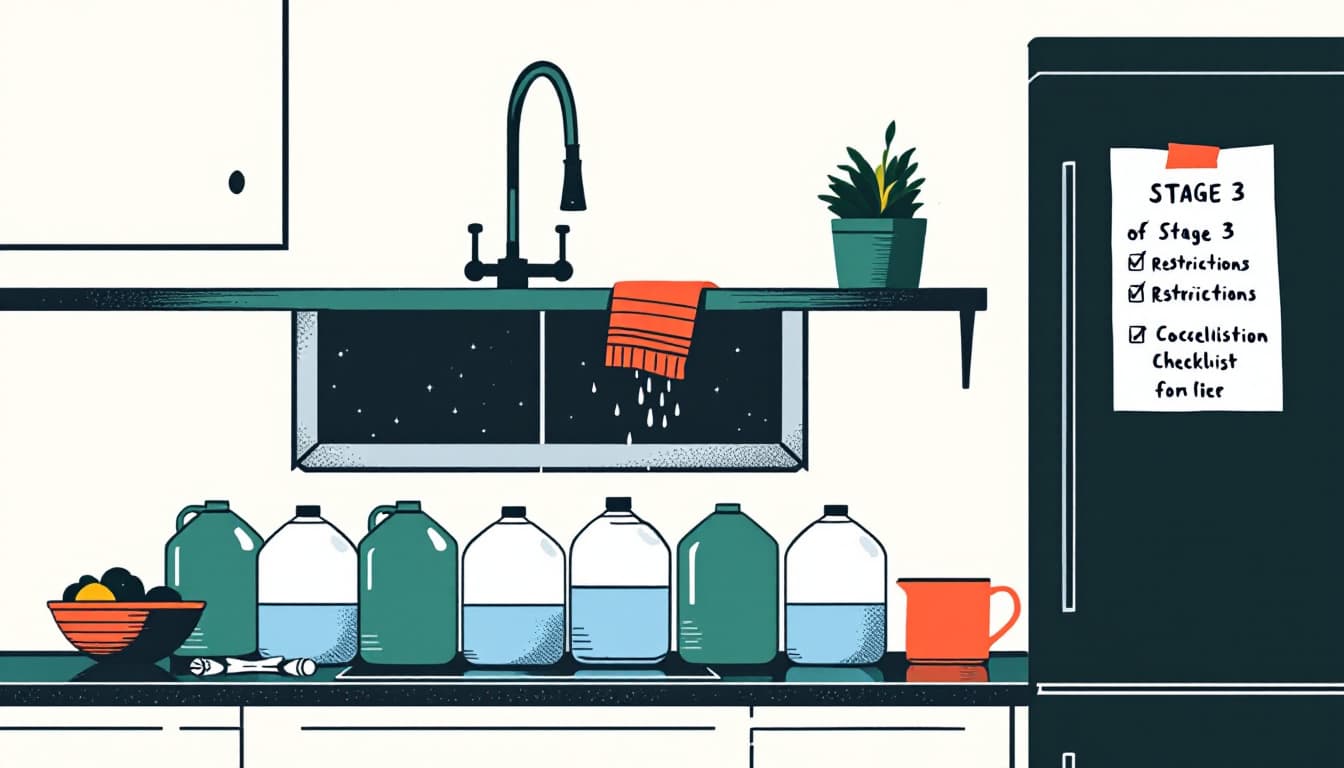
Store a meaningful water buffer. The standard FEMA guidance of 72 hours is fine for a hurricane evacuation; it's not designed for a two-week summer restriction order. A more useful target for households in drought-zone metros is 14 days of drinking and sanitation water per person. At roughly one gallon per person per day for drinking and another gallon for sanitation, a family of four needs about 112 gallons. That's six or seven 20-gallon stackable containers — a one-time cost under $150 at most hardware stores.
Read your utility's demand forecast. Most large municipal utilities publish 10- or 20-year water supply plans, and many now include sections on industrial demand projections. They're public documents and they're often surprisingly readable. If a new datacenter campus is in the planning pipeline near you, it will show up in those documents before it shows up in the news.
Take summer grid warnings seriously. If you're in a region where your utility sends Flex Alerts or demand-response notifications in summer, sign up for them now — before peak season. Households that pre-cool, run dishwashers off-peak, and reduce load during alerts aren't just doing a civic good; they're also less likely to lose refrigerated food when rolling outages hit hardest.
Track your actual water bill. Not the total, but the rate per unit. A rate increase buried in a bill can be the first signal that your system is under financial stress from supply costs. If you see it, that's a good time to accelerate your storage buffer — before neighbors do.
The bigger picture
The AI buildout is real, it's fast, and the infrastructure decisions being made right now will shape resource competition in certain regions for decades. That's not catastrophe. It's ordinary industrial geography working its way through water tables and transmission lines.
Durable households aren't the ones with the most gear. They're the ones who understand the systems they depend on well enough to see pressure building before it becomes a crisis. Water is the most local of those systems. The questions are answerable, the preparations are modest, and this week's Guardian report is a reasonable prompt to go find your utility's Consumer Confidence Report and actually read it.