
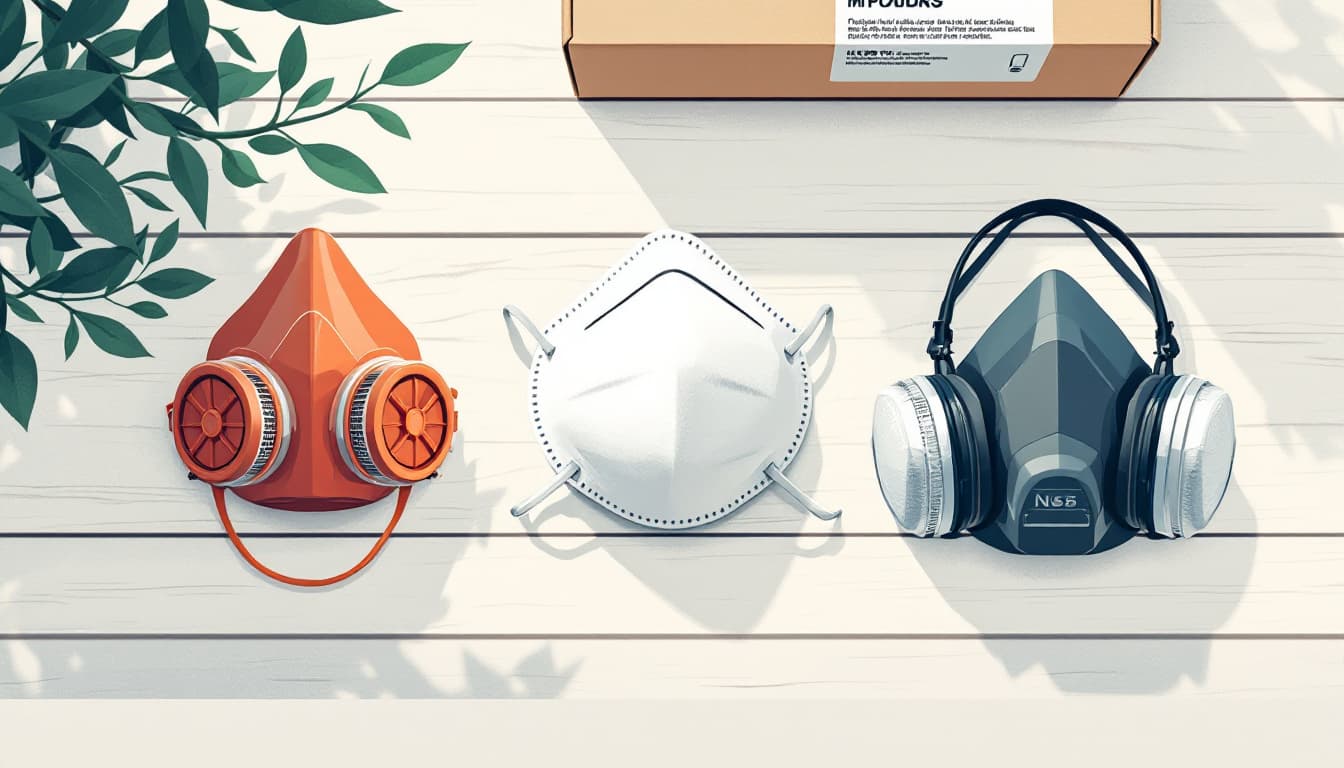
Why the mask category is different from everything else we review
Most gear categories have a wide band of "good enough." This one doesn't. Wildfire smoke is dominated by PM2.5 — particulate under 2.5 microns, small enough to pass deep into the lungs and into the bloodstream. A cloth mask does essentially nothing against it. A surgical mask does very little, because it is designed to block droplets moving outward, not to seal against a face. An earloop "KN95" does not seal reliably either.
What works is a respirator that forms a seal and filters to a certified standard. That's it. Everything else in this category is comfort theater, and in a smoke week the difference is measurable in how your household feels by evening.
This review pairs with our household air purifier picks — and the pairing is the actual strategy. Purifiers handle the air inside your house, which is where you should be during a smoke event. Respirators handle the twenty minutes you spend outside moving the car, walking the dog, or clearing a gutter. Neither substitutes for the other.
The counterfeit problem, and how to not get caught by it
This is the central editorial question in the category, so we'll be blunt about it.
NIOSH does not approve KN95 or KF94 masks. KN95 is a Chinese standard; KF94 is South Korean. Both describe real products, some of which perform well. But NIOSH — the US National Institute for Occupational Safety and Health — has never certified a mask under either standard. Any listing that puts the word "NIOSH" next to "KN95" is, by definition, mislabeled. That single test rules out a large share of what a marketplace search returns.
Look for a TC number. A genuine NIOSH-approved respirator carries an approval number in the form TC-84A-XXXX, printed on the mask itself or on the box. You can check that number, along with the manufacturer's name, against the NIOSH Certified Equipment List published by the CDC. If the number is missing, or the number is real but the manufacturer name doesn't match, walk away.
Prefer listings shipped and sold by Amazon or the manufacturer's own storefront. Marketplace listings for masks are a known counterfeit vector, and commingled inventory means a legitimate-looking listing can still ship a counterfeit unit. This is one of the few categories where we'd pay a few dollars more to buy from the brand's storefront directly.
A respirator that doesn't seal is not a respirator. All three picks here use headbands rather than earloops, which is not a style preference — earloops cannot generate enough tension to seal an N95. Facial hair along the seal line defeats any of them. If someone in your household has a beard they won't shave, the honest answer is a powered or elastomeric full-face option, not a better disposable.
What actually matters when you're choosing
Fit beats filtration rating. A P100 that leaks at the cheekbones protects less than a well-sealed N95. If you can only optimize one thing, optimize for a shape that matches the faces in your household — which usually means buying a small sample of two shapes and seeing which one seals, before you stock twenty.
Valved versus non-valved is a real tradeoff. An exhalation valve makes long wear dramatically more comfortable and cuts fogging, which is why the premium pick has one. It also vents your unfiltered breath outward, so a valved respirator provides no source control — irrelevant for smoke, relevant if anyone is ill. Households that want one mask for both jobs should choose non-valved.
Reusable versus disposable is a math problem, not a philosophy. If your region gets a few smoky days a year, a box of disposables is cheaper and simpler. If you're in a place where smoke season now runs for weeks — much of the West at this point — the reusable P100 stops being the expensive option somewhere around the second season.
Kids are the unsolved problem. There is no NIOSH-approved respirator sized for children, because NIOSH certifies for occupational use and children don't work in those settings. This is a genuine gap, not an oversight on our part. For households with young kids, the practical answer is to treat indoor air as the primary control — a well-sized purifier, windows closed, and limiting outdoor time — rather than expecting a mask to do the work.
Who each tier is actually for
Premium — GVS Elipse P100 (~$55): Right for households in high-smoke regions, anyone who does yard or property work during smoke season, and people who wear glasses and have given up on disposables because of fogging. At roughly $55 it costs more up front than a box of disposables, but the per-season cost drops below them once you're wearing it regularly. Its valve makes it a smoke-and-dust tool specifically, not a general-purpose mask.
Value — 3M Aura 9205+ (~$40 a box): The default recommendation. The flat-fold design is the reason: it seals on more faces than any cup-style mask we looked at, packs flat enough to keep a few in a glovebox and a go-bag, and is comfortable enough that people keep it on instead of pulling it down. No valve means it doubles as source control.
Budget — 3M 8210 (~$18 for 20): The stocking option. At under a dollar a mask, this is how you make sure every adult in the house has protection during a smoke event or a dusty cleanup, without thinking hard about it. It's less comfortable and bulkier than the Aura, and it seals poorly on smaller faces — but it is a real NIOSH N95 with a verifiable approval number, which puts it in a different category from most of what a marketplace search will show you.

