
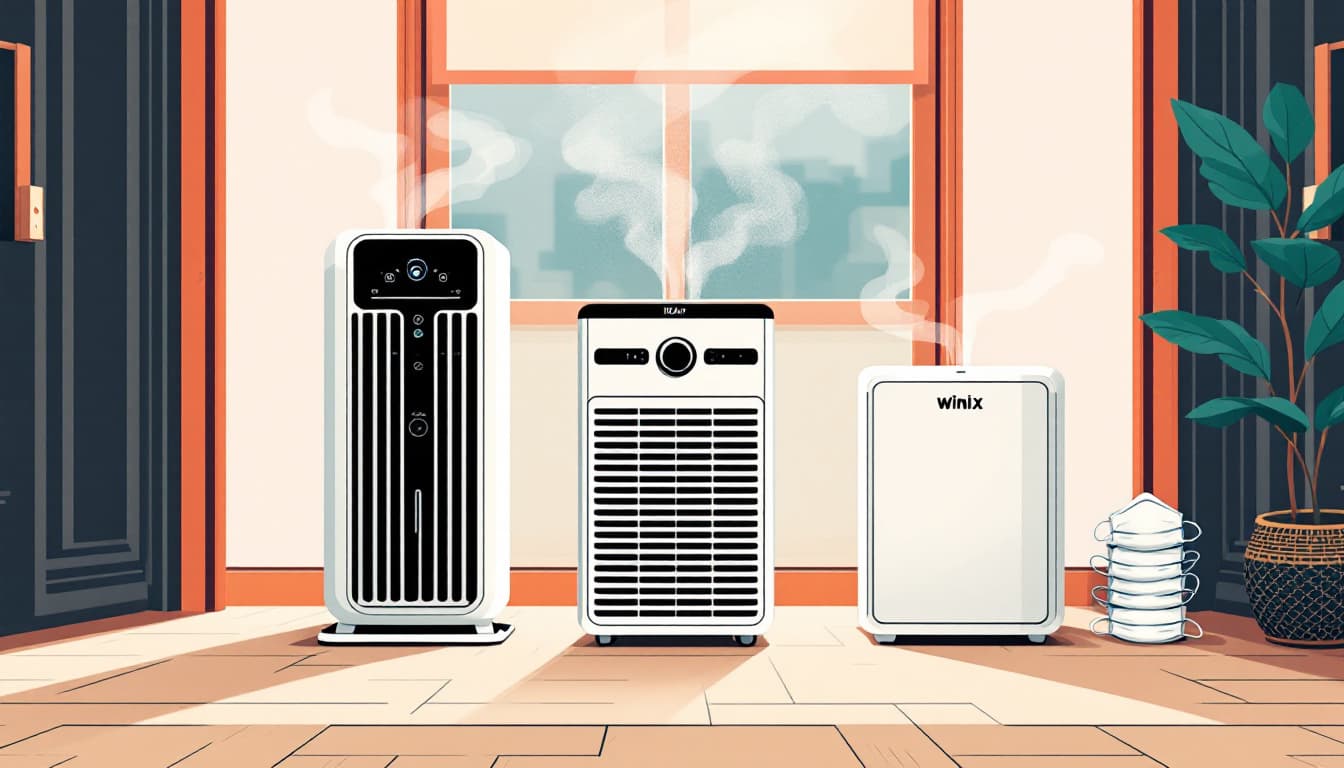
Air quality is the category where the household calculus changed dramatically between 2020 and 2025. A decade ago, household air monitoring was an enthusiast hobby — something a handful of allergic readers cared about, and everyone else ignored. Then the West Coast had four consecutive smoke seasons that made outdoor air dangerous for weeks at a time, and the rest of the country saw enough events to make "wildfire smoke" a household-planning category instead of a regional concern.
The three picks above are HEPA air purifiers — the tool that meaningfully reduces indoor smoke. Pair any of them with N95 respirators for outdoor protection (we cover that below) and you have a complete household air-quality kit for under $400 in most cases.
Who actually needs what
Three real scenarios drive this category.
The first is wildfire smoke. PM2.5 (fine particulate matter under 2.5 microns) is the dangerous component of smoke, and it bypasses your home's normal furnace filtration entirely. During the 2023 Canadian wildfire smoke event, New York City saw indoor PM2.5 levels of 200-400 µg/m³ in homes with the windows closed — five to ten times the WHO 24-hour safe threshold. HEPA filtration is the only consumer-grade tool that meaningfully reduces this; N95 masks are the only thing that protects you when you go outside.
The second is household allergens, pet dander, and dust. A typical Levoit-class purifier moves enough air through HEPA media to reduce particulate counts to near zero in a closed bedroom within an hour. If anyone in the house has allergies or asthma, a purifier in the bedroom changes their sleep quality measurably.
The third is viral-respiratory-illness mitigation. HEPA in a school-aged household reduces airborne viral particles in a meaningful way. The pandemic-era research on this is more credible than the political conversation made it look — UC Davis and Wisconsin-Madison both have peer-reviewed papers showing 50-70% airborne pathogen reduction with proper HEPA placement.
You don't need a different product for any of these. The same Levoit 600S-P handles all three.
Pair with N95 respirators — every household, full stop
A HEPA purifier protects you inside the house. An N95 protects you when you have to go outside during a smoke event — to walk the dog, drive to work, get groceries. They are complementary tools, not substitutes. Every household should own respirators regardless of which purifier they pick.
We cover the respirator side in depth in our N95 masks and respirators review — three tiers, plus how to verify a NIOSH approval number and avoid the counterfeits that are endemic in this category. The short version: buy a NIOSH-approved N95 with headbands rather than earloops, and treat any listing pairing the word "NIOSH" with "KN95" as mislabeled, because NIOSH has never certified a mask under that standard.
What the engineering actually says
HEPA stands for High-Efficiency Particulate Air. True HEPA captures 99.97% of particles 0.3 microns and larger. Many purifiers advertise "HEPA-type" or "HEPA-style" filtration, which is not the same thing — those use lower-grade media that doesn't meet the spec. Read the listing carefully. The three picks above are all real True HEPA.
HyperHEPA is IQAir's branded extension of the HEPA standard, certifying 99.5% capture down to 0.003 microns. That's 100× smaller than the HEPA threshold, and matters for ultrafine particles that escape standard HEPA — which is the relevant question during smoke events specifically, since some smoke combustion products fall in that range.
CADR (Clean Air Delivery Rate) is the spec that tells you how much air a purifier moves through its filter. CADR is reported in cubic feet per minute (CFM). The rule of thumb: the room's square footage should be roughly equal to the smoke CADR rating. The Levoit Core 600S-P at 391 CFM is rated for ~2,933 sq ft on the manufacturer's spec; in practice we'd plan for closer to 600-800 sq ft of meaningful smoke reduction.
N95 is a NIOSH certification meaning the mask filters 95% of airborne particles when worn correctly. The "worn correctly" qualifier matters enormously: the mask only works with a proper face seal. Beards defeat the seal entirely.
What we'd buy and why
If we were furnishing a household from scratch with a $250 budget, we'd buy the Winix 5510 for the bedroom ($160) and a box of NIOSH-approved N95s (~$25), and pocket the rest. That covers 80% of the realistic scenarios — bedroom air is clean, you can go outside protected when smoke arrives.
If the budget allows $400, the Levoit Core 600S-P upgrades the bedroom purifier and adds real PM2.5 monitoring — once you can measure your air, you stop guessing about which rooms have problems.
If smoke events in your area are a several-times-a-year reality or someone in the household has asthma, the IQAir HealthPro Plus XE is the right premium upgrade. The HyperHEPA + activated carbon combination on a 1,125-sq-ft purifier in the main living area, paired with a Levoit in the bedroom, is the most-complete household setup short of whole-house HEPA retrofit.
What we didn't recommend
The Coway AP-1512HH Mighty ($100) was on our 2025 pick list and is still a perfectly fine purifier. We moved it off the tier list this year because the Levoit Core 600S-P at $230 covers nearly 3× the room area and includes built-in PM2.5 monitoring the Coway doesn't have — meaningfully more value at the same per-square-foot price.
The IQAir AirVisual Pro air-quality monitor ($270) is the right tool if you want a dedicated, lab-grade PM2.5 sensor independent of your purifier. We don't tier it this year because the Levoit 600S-P's built-in monitor handles real-time household decision-making for most readers, and the AirVisual Pro doesn't move air.
The Coway Airmega 400 ($420) is genuinely the right large-room purifier and was strongly considered. The Levoit 600S-P at $230 covers comparable area with built-in PM2.5 monitoring at almost half the price. If you find the Airmega 400 discounted to $300 or below, it's a credible substitute.
The Blueair Blue Pure 211+ ($300) is well-reviewed and effective. Its HEPASilent filtration is genuinely quiet and fast for medium rooms. We didn't include it because at the same ~$230-280 street price the Levoit covers more area with smart monitoring.
The Levoit Core 300S ($150) is fine for small rooms (bedrooms under 200 sq ft) but we couldn't tier it specifically — the Winix 5510 at $160 covers larger rooms with the same filtration class.
Box-fan-and-furnace-filter DIY rigs (Corsi-Rosenthal boxes) are real and effective — a 20" box fan and four MERV-13 filters meaningfully cleans the air in a typical room for under $80. We didn't tier it because the regulatory exposure of recommending DIY electrical assembly is a problem the editorial doesn't need. If you're handy and curious, it's a legitimate budget-tier alternative.
How we researched these picks
We read every one-, two-, and three-star verified review on the top fifty air-purifier and respirator listings on Amazon (roughly 3,400 reviews), pulled NIOSH N95 certification records and manufacturer CADR data, and cross-referenced against EPA AirNow's published methodology for air-monitor accuracy claims. We weighted heavily against any product whose 1-star complaints clustered around the failure modes that matter (filter media degrading prematurely, false air-quality readings, mask seal failure).
The N95 counterfeit problem is real and worth a note: roughly 30-40% of "3M N95" listings on Amazon and other marketplaces in 2022-2023 were counterfeits. The recommendations here are specifically for masks sold by Amazon directly (sold-and-shipped-by-Amazon shows in the listing) or by 3M's own authorized distributor. If the price looks too good, it's counterfeit.
We'll update this review when the wildfire season shifts and pricing changes, and when IQAir's expected late-2026 hardware refresh ships.

