A wng.org report this week confirmed what fire agencies across the Southwest have been tracking since early June: active wildfires are forcing evacuations in both Utah and Arizona, with residents in multiple communities ordered out on short notice. The fires themselves are news. What they reveal about household readiness is the longer story.
What's actually happening
The pattern here is not unusual for late June in the interior West. Low humidity, persistent wind, and landscapes that saw below-average precipitation through spring create conditions where a single ignition point can grow faster than local crews can contain it. The National Interagency Fire Center has documented this cycle for decades.
What has changed is the exposure. More households now sit in the wildland-urban interface — the zone where subdivisions meet undeveloped land — than at any point in recorded U.S. history. Recent U.S. Census data confirms continued population growth in Sun Belt and Mountain West counties that overlap heavily with high fire-risk terrain. That means more families receiving their first-ever evacuation order, with no practiced response, on a Tuesday afternoon.
The gap between "I know I should have a plan" and "I have a plan my family has actually rehearsed" is where people get hurt, lose irreplaceable documents, or leave pets behind.
What we'd actually do
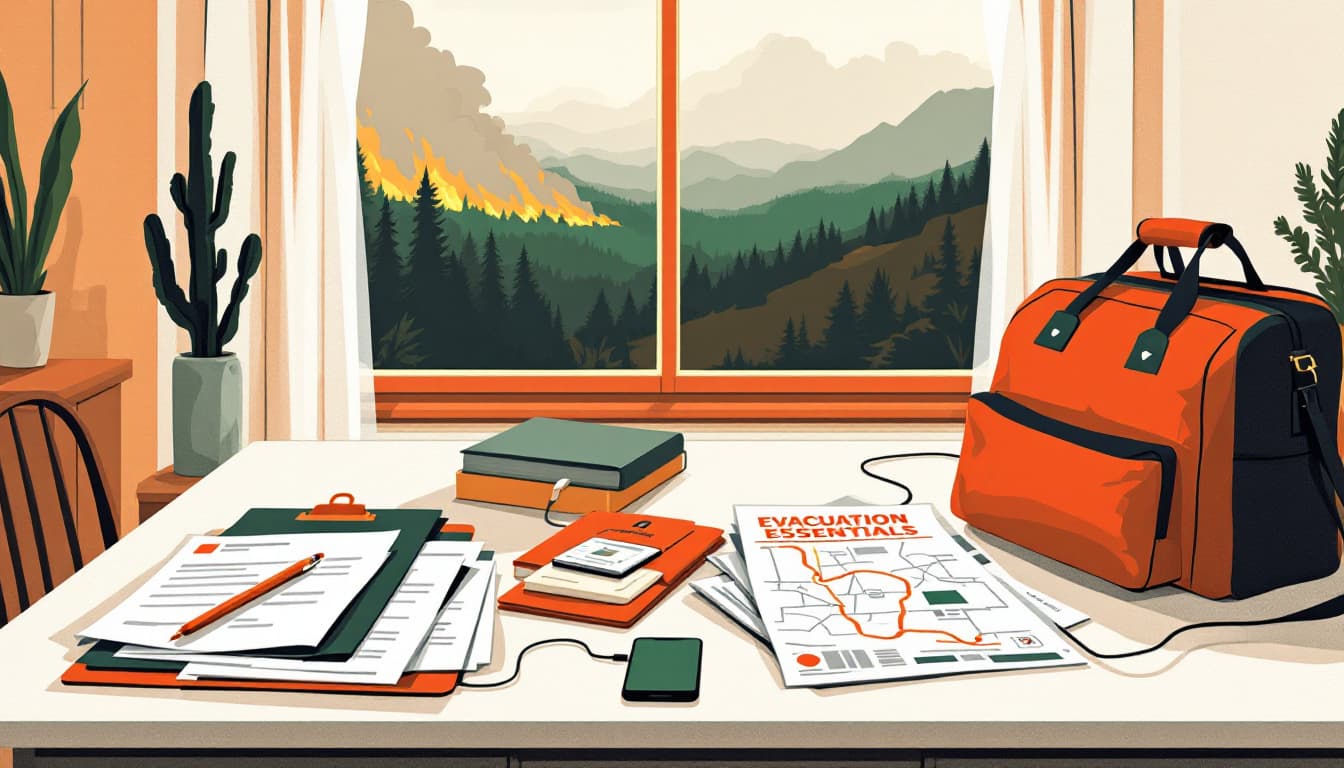
Build a go-bag that takes thirty minutes to pack, not three hours. A go-bag is only useful if you can grab it under stress. The version that works is pre-staged: physical copies of insurance documents, IDs, and financial account numbers sealed in a waterproof pouch; a three-day supply of any prescription medications rotated every six months; phone chargers; and a small amount of cash. Everything else is negotiable. Keep it near a door you'd actually exit through.
Decide your trigger point before the fire starts. Most evacuation injuries and fatalities happen because households wait for a mandatory order rather than leaving at a voluntary or warning stage. Pick a specific signal — a voluntary evacuation notice for your zone, visible smoke within a defined distance, or an alert on your county's emergency notification system — and commit to it as a household. Write it down. When that signal hits, the decision is already made.
Register for your county's emergency alert system today, not eventually. Every county in Utah and Arizona uses some form of opt-in or address-registered alert system. Federal Wireless Emergency Alerts reach cell phones automatically, but county-level systems often provide earlier, more granular notification by neighborhood or zone. Find yours through your county emergency management office website. Takes about four minutes.
Map two exit routes out of your neighborhood. A single road can become impassable from fire, smoke, or traffic gridlock within minutes of an order going out. Drive both routes with your family at least once so no one is navigating on a phone while panicking. Note where each route connects to a major highway.
Know what you cannot replace and where it lives. Hard drives fail. Cloud backups require power and internet. A small fireproof document bag costs under $40 at any hardware store. Put your birth certificates, Social Security cards, passports, and the deed or rental agreement in it. Put it somewhere you'll grab in under sixty seconds.
The bigger picture
Wildfire preparedness gets framed as a regional problem — something for people in California, or now Utah, or Arizona. That framing lets families in fire-adjacent zones stay comfortable until they're not. The actual question is simpler: if you had ninety minutes notice to leave your home and not return for a week, how would that go?
The goal of household preparedness is not to survive a worst-case scenario. It is to handle a disruption — a real, plausible, documented disruption like the one happening right now in the Southwest — without chaos. That's a low bar. Most families can clear it with one afternoon of focused work.
Start with the alert registration. Everything else follows.