A BBC report this week on Washington state wildfires describes what's become a reliable August pattern in the Pacific Northwest: dry conditions, fast-moving fire, and communities receiving evacuation orders with hours — sometimes minutes — to act. Some of those communities got out. Some didn't move fast enough.
The fire itself is the headline. The evacuation gap is the story that matters to your household.
What's actually changing
Wildfire behavior in the western United States has shifted measurably over the past two decades. Fire seasons are longer, and fires that reach residential areas tend to move faster than older models predicted. That's not alarmism — it's what fire behavior analysts and the National Interagency Fire Center have documented consistently.
What hasn't kept pace is household preparation. Most families in wildfire-adjacent areas have a rough mental plan: grab the dog, grab the kids, grab something important. That is not a plan. That's a starting point that collapses under stress.
The specific failure mode that evacuation researchers and emergency managers describe most often is decision paralysis. When an order comes, families spend 20 to 40 minutes deciding what to take. In a fast-moving wildfire, that window can be the entire margin you have.
Washington state uses a tiered evacuation system — Level 1 (be ready), Level 2 (be set to leave), Level 3 (leave now). Most people treat Level 1 as background noise and wait for Level 3. By Level 3, roads are congested and the window is closing.
There's a secondary issue that rarely gets covered: air quality degradation precedes visible flames by many miles. Families with infants, elderly members, or anyone with asthma or COPD face real medical risk from smoke exposure before fire is anywhere near their neighborhood. The decision to leave early is almost always the right one, and almost always made too late.
What we'd actually do
Map your two exit routes tonight, not during the next Level 2 alert. Wildfires can cut off a primary road within an hour of the alert. Pull up your county's road map, identify the two most likely evacuation corridors from your neighborhood, and note where they converge. If they share a single chokepoint, that is useful information to have before you're sitting in stopped traffic.
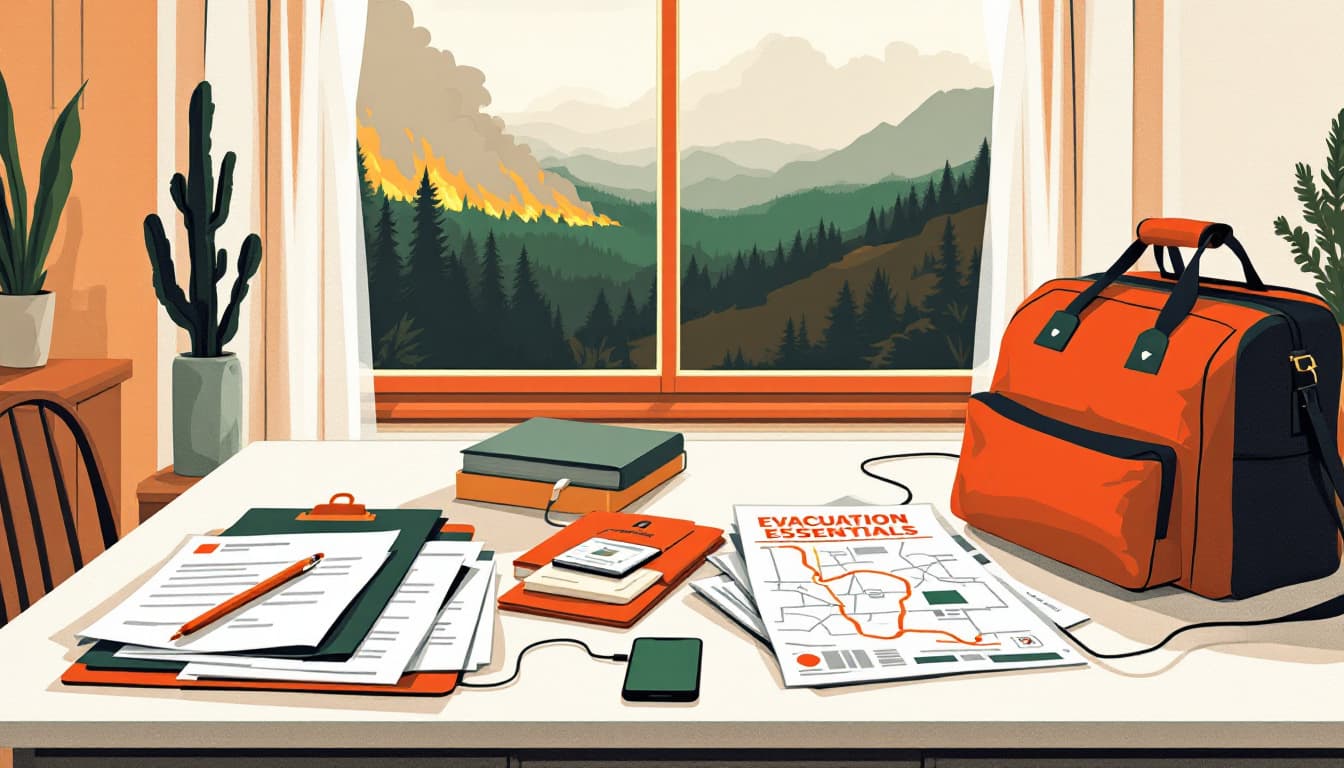
Build a 15-minute load list, not a go-bag. The prepper community has fetishized the go-bag for years. Most of them weigh 40 pounds and include gear that doesn't match the actual emergency. For wildfire evacuation, you need documents (or a thumb drive with scans), medications for every household member, a charger and backup battery, water for the car, and clothes for 72 hours. Write the list on paper and tape it inside a cabinet door. The list matters more than the bag.
Enroll in your county's emergency alert system and verify it works. Washington counties use varying systems — some use Wireless Emergency Alerts automatically, others require opt-in registration for phone and email notifications. Look up your county's emergency management office this week, find the registration link, and confirm your number is active. This takes under five minutes and is the single highest-leverage action on this list.
Make a care decision for animals before the next alert. Families with livestock, multiple pets, or large animals are statistically more likely to delay evacuation or return prematurely. If you have animals that require a trailer or a crate, locate that equipment and think through the logistics now. If a neighbor has a trailer and you don't, that conversation needs to happen on a Tuesday in July, not during a Level 2 alert.
Set a personal trigger that is earlier than Level 3. Decide now, in writing, what condition will make you leave without waiting for an official order. Something like: "If there is visible smoke on the horizon and a Level 2 is posted, we leave." Pre-committing to an early trigger eliminates the decision paralysis that costs families time when they can least afford it.
The bigger picture
Washington's fires this August are not an anomaly. They are a recurring feature of living in fire-adjacent terrain, and they will happen again next year and the year after. Emergency management agencies do their job; evacuation orders go out. The gap is almost always at the household level — families who didn't rehearse, didn't register, didn't decide in advance.
Durability doesn't mean owning the right gear. It means having already made the decisions that stress makes impossible to make clearly. An evacuation plan that lives in your head is not a plan. Fifteen minutes this week to write it down, map your routes, and verify your alerts is the actual work.