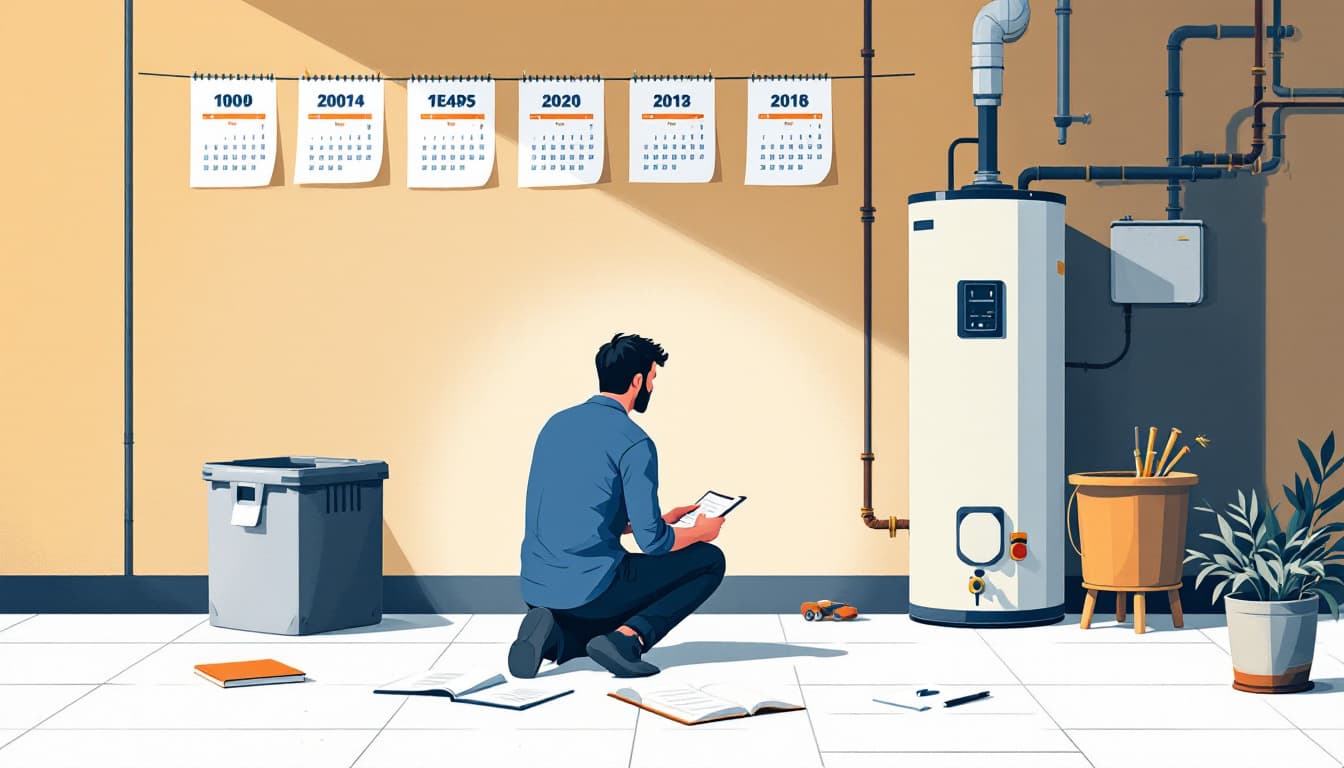
Walk into your basement, garage, or utility closet and look at the label near the top of your water heater. There's a sticker, or sometimes a stamped plate, that shows the manufacture date. If you bought your home more than eight years ago and can't remember the last time anyone looked at that label, there's a reasonable chance you're running a critical household system that is somewhere in the back half of its useful life — and you have no plan for when it stops working.
That's not a disaster. But it's a slow-leak risk that deserves a few minutes of honest arithmetic.
The math most households skip
A conventional tank water heater — the 40- or 50-gallon unit in most American homes — has a practical lifespan of eight to twelve years under normal conditions. Hard water, deferred anode rod maintenance, or a unit that was cheap to begin with can push that toward the low end. Well-maintained units on soft municipal water sometimes make it to fifteen.
The relevant question isn't "how old is it." The question is: what does failure actually cost a family that isn't ready for it?
Work through it. An emergency same-day or next-day water heater replacement — labor included — runs meaningfully higher than a planned replacement. The delta between a scheduled job and an emergency call-out can be $400 to $700 or more depending on your market, your plumber's availability, and whether it's a Friday afternoon. If you're in a rental market and paying a service call rate, that gap is wider. If the failure causes water damage — a slow seam leak that went unnoticed, a T&P valve that let go — you're now in insurance territory, and your deductible gets involved.
None of this is catastrophic. A $1,200 emergency replacement is not the end of the world. But it is a financial shock that hits a family without warning, often during a period when the household has no hot water, and it tends to happen at the worst possible time because families don't schedule failures.
More importantly, it's a risk that's almost entirely preventable with a few hours of attention.
Why people get this wrong
The preparedness community has a long history of focusing on low-probability, high-drama scenarios. The water heater is the opposite: a high-probability, low-drama event that is boring enough that almost nobody writes about it. FEMA doesn't publish a water heater readiness pamphlet. There's no preparedness subreddit thread that hits the front page about anode rods.
The other failure mode is the opposite one: people who bought into the "whole-house audit" approach and then did nothing because the scope felt overwhelming. The water heater is actually a perfect entry point for thinking about home infrastructure risk precisely because it's bounded. There's a predictable failure window. There's a known cost. There's a clear set of actions.
The actuarial principle here is simple: a risk you can put a number on and act on before it materializes is the best kind of risk to manage. It's the risks with no warning that do real damage.
What to do this week
1. Find the manufacture date. The sticker on the unit will have it, usually in the upper third of the tank. Some brands encode it in the serial number — your manufacturer's website will tell you how to read it.
2. If the unit is seven years or older, add a line item to your household budget for replacement within the next 18-24 months. Not an emergency fund draw — a sinking fund contribution. If you put aside $40-50 a month for 18 months, you have $720-900 toward a replacement before the failure happens, which covers most of the labor premium on a planned job.
3. Check the anode rod. This is the sacrificial magnesium or aluminum rod that protects the tank lining from corrosion. Most manufacturer guidance calls for inspection every three to five years; most households have never done it. A plumber can inspect it during a routine visit for minimal labor cost. Replacing a corroded anode rod can add years to an otherwise healthy tank.
4. Note the location relative to drains and drywall. If your water heater sits on concrete with a floor drain nearby, a failure is messy but contained. If it's on a platform above finished flooring with no drain pan, you have a secondary risk worth addressing before the primary one materializes.
5. Price a replacement now. Call two plumbers for a non-emergency quote on a comparable unit. That number, sitting in your household notes, is itself a preparedness asset — it means you won't be making a panicked decision at 9 p.m. on a Sunday.
The bigger picture
Household preparedness is often framed as protection against events that come from outside — storms, supply disruptions, job losses. But a meaningful share of the financial shocks that actually hit families originate inside the house, from systems that age quietly and fail at the worst possible moment.
The water heater is a useful mental model for an entire class of these risks. A furnace. A sump pump. An electrical panel that hasn't been looked at since the Clinton administration. None of these are glamorous. All of them have predictable failure windows. All of them cost more to fix as emergencies than as scheduled replacements.
The preparedness habit worth building isn't stockpiling for the apocalypse. It's knowing where you are in the lifecycle of every system you depend on, and having a number ready before the failure arrives.