Walk into a regional grocery distribution center and you will not find a warehouse full of food. You will find a sorting operation — pallets arriving on one dock, leaving from another, inventory measured in hours rather than days. The building is not storage. It is a pipe.
This is by design, and it has been for roughly forty years.
The management philosophy that produced it — lean manufacturing, just-in-time delivery, demand-signal optimization — was developed by Toyota in the 1970s and became the organizing logic of global retail and food distribution through the 1990s and 2000s. The efficiency gains were real and large. Carrying inventory costs money: capital tied up in product, warehouse space, labor, spoilage. By moving toward continuous-flow logistics, companies genuinely did lower prices and reduce waste. The model worked brilliantly until the moment it didn't.
What the model removed, quietly and over a long time, was buffer.
Buffer is not glamorous. Buffer is extra stock sitting on a shelf, a secondary supplier kept warm even though the primary is cheaper, a warehouse lease that looks like overhead on a quarterly report. Buffer is the thing a CFO identifies as slack and a procurement team identifies as cost. In a normal year, they are correct. Buffer is expensive, and in a normal year, disruption is rare enough that you never miss it.
The preparedness implication is not what most prepper literature suggests. The common framing is: "the grocery store only has three days of food." That is roughly accurate as a snapshot, but it misses the more important point. The issue is not inventory depth at a single point in the chain. It is that the entire chain, from raw material to retail shelf, has been stripped of the redundant relationships and stockpiles that used to absorb shocks at multiple layers simultaneously.
When COVID-era port congestion hit in 2021, the problem cascaded precisely because there was no give anywhere. A container ship delayed in Long Beach meant a warehouse in Dallas that was already running lean went to zero, which meant a store in Memphis that ordered daily went to empty shelves, which meant a consumer who bought weekly found nothing. Each node was optimized. None had reserves. The cascade had no friction to slow it down.
This is what "fragility" means in a structural sense, and it is worth being precise about it rather than alarming. The system does not fail catastrophically and permanently — it fails sharply and then recovers, often faster than people expect, because market incentives rush supply toward scarcity. The 2021 toilet paper shortage was resolved in a matter of months. Baby formula shortages in 2022, driven partly by a single-plant closure compounding a concentrated supplier market, lasted longer — close to a year in some categories — because the structural brittleness ran deeper in that supply chain.
Most households get this wrong in both directions.
The prepper response is to stockpile heavily and treat every supply disruption as a potential permanent collapse. That is the wrong lesson. The right lesson is narrower: sharp, short shortages in specific categories are now a normal feature of a just-in-time supply chain, not an anomaly. They happen more often than the system's architects planned for, and they tend to cluster around the categories where suppliers are most concentrated and substitution is hardest.
The non-prepper response is to assume that the system's generally-good performance is a sign of robustness. It is not. It is a sign that the disruptions have been manageable so far. The difference between a one-month shortage and a six-month shortage is often a single variable — a second supplier that does or does not exist, a stockpile that was or was not maintained somewhere upstream.
The household-level implication is this: the supply chain's buffer has been engineered out of the commercial system, and the only buffer that now exists at the retail end of the chain is the one individual households choose to maintain themselves. This is not a doom scenario. It is just a structural reality that shifted gradually over decades and that most consumer behavior has not caught up with.
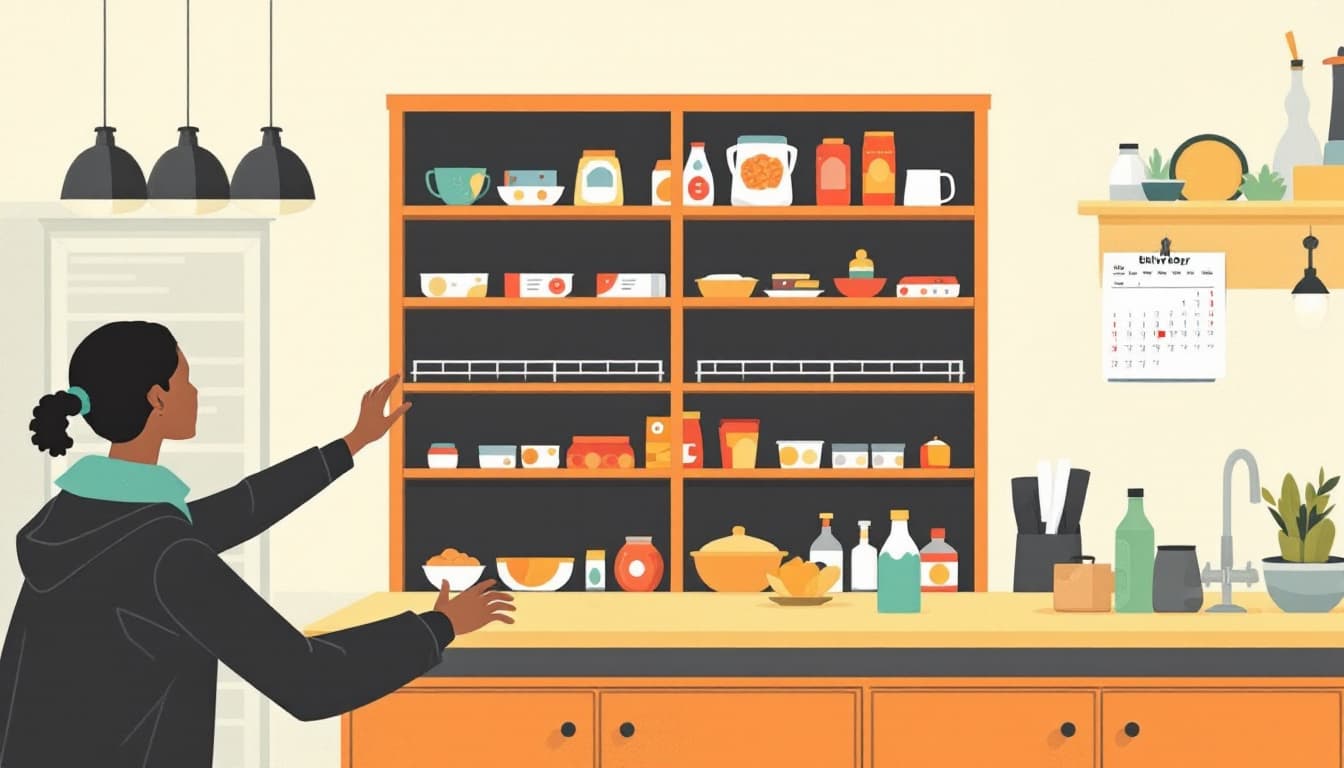
A modest, rotating pantry — enough to absorb a six-to-eight-week disruption in any single category — is not survivalism. It is what a reasonable household inventory policy looked like before just-in-time became universal. You are not building a bunker. You are restoring a margin that the supply chain used to carry for you and no longer does.
If you want a concrete starting point for thinking through what that actually looks like in calories and liters, our water and food calculator is built around exactly this kind of category-by-category assessment rather than a generic "three-month supply" rule of thumb.
The buffer did not disappear because of any single decision or any single administration. It was optimized away, incrementally, by thousands of rational choices that made sense at the time. Recognizing that is more useful than being angry about it — and a lot more useful than waiting for someone else to put it back.