Pull out a pen and write down what you paid for your water heater. If you don't remember, the answer is probably somewhere between $800 and $1,800 installed — more if it's a hybrid heat pump unit. Now write down when it was last flushed. If you can't answer that second question, you are almost certainly running a machine that is working harder than it should, wearing out faster than it should, and costing you more per month than it should.
This is not a crisis. It is a slow leak — the kind of slow leak that preparedness culture mostly ignores because it doesn't make for a dramatic headline.
The mechanism is simple
Water, especially in areas with moderate-to-hard mineral content, deposits calcium carbonate and magnesium at the bottom of a storage tank every time it heats. The layer is thin at first — millimeters per year — but it accumulates into an insulating blanket between the burner and the water. The heater compensates by running longer cycles. Efficiency drops. The bottom of the tank, now cycling between extreme heat and cold water contact, becomes the most likely failure point.
The industry rule of thumb — backed by manufacturer documentation and plumbing trade data — is that an unserviced tank loses somewhere between 10 and 15 percent of its heating efficiency within five years in a moderately hard-water area, and that sediment is the leading cause of premature tank failure. Water heaters are rated to last 8–12 years. Unserviced tanks in hard-water regions routinely fail at 6–8. That two-to-four-year gap, multiplied by replacement cost, is a $400–$700 hit.
Add the monthly energy drag. If your water heating represents roughly 18 percent of your home energy bill — which is consistent with recent EIA household surveys — and sediment is degrading efficiency by 10 percent, you are paying an extra 1.8 percent of your total bill every month for nothing. On a $200 monthly energy bill, that's $43 a year. Over five years of neglect, it's $215 in pure waste. Not ruinous. Not nothing.
Why households underweight this
The water heater lives in a closet or a basement corner. It does not announce its degradation. It heats water — maybe a little slower, maybe not quite as hot — and households adjust without noticing they've adjusted. The failure, when it finally comes, feels sudden: a leak, a cold shower, a puddle. But the failure was years in the making.
Preparedness thinking tends to focus on external shocks — storms, supply disruptions, power outages. The internal, slow-moving household infrastructure risks get almost no attention, even though they are statistically more likely to cost the average family money in any given year than a regional emergency is. A flooded water heater closet is its own small emergency: water damage to flooring, potential drywall involvement, and an urgent replacement purchase made under pressure, which is the worst condition under which to buy anything.
There is also a resilience angle that goes beyond the appliance itself. A household running tight on budget has less margin to absorb a $1,200 unplanned replacement. Building the maintenance habit is, in a small but real way, a form of financial preparedness.
What to do this week
You do not need a plumber for this. Annual tank flushing is a legitimate DIY task.
What you'll need: A garden hose long enough to reach a floor drain or exterior exit, and 20 minutes.
- Turn the water heater thermostat to "Pilot" or the lowest setting. Do not skip this — draining a tank that's actively heating is a burn risk.
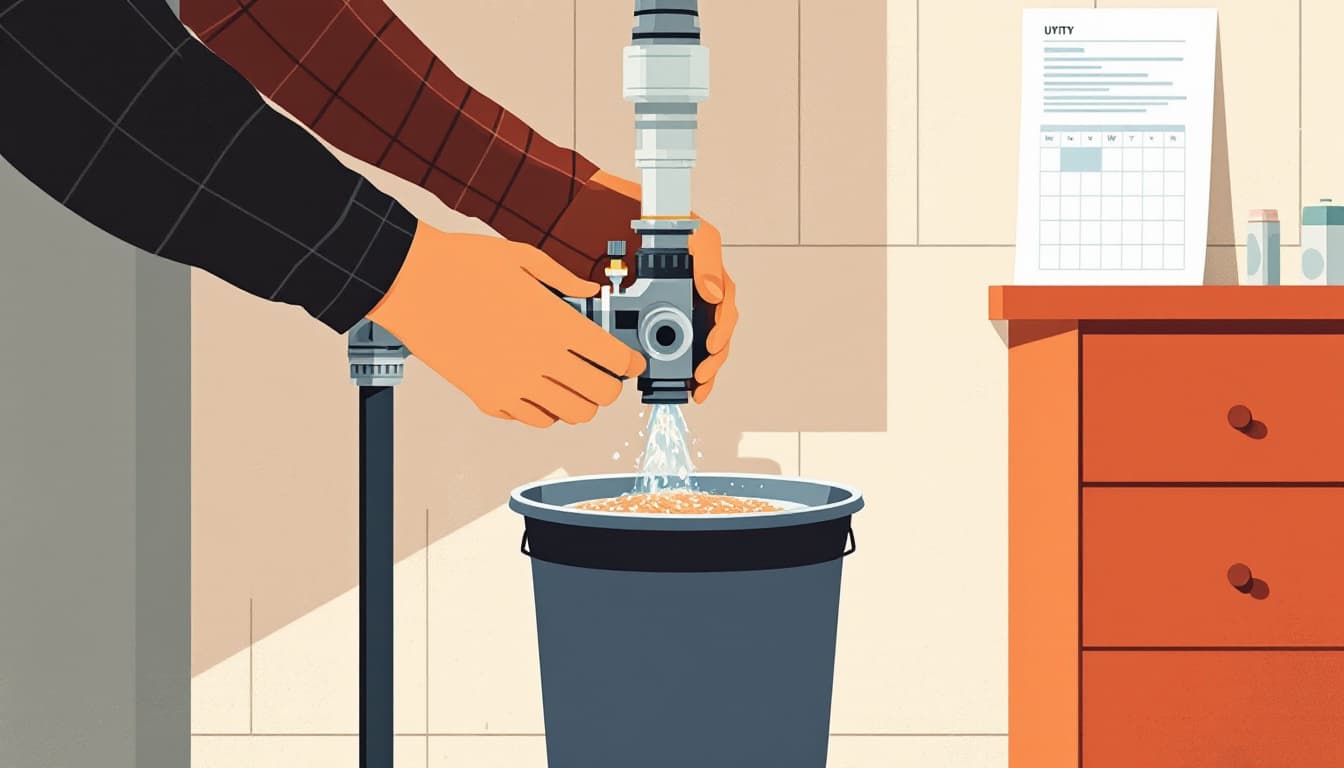
- Connect the garden hose to the drain valve near the base of the tank.
- Run the other end somewhere water can drain safely.
- Open a hot-water tap somewhere in the house to prevent a vacuum.
- Open the drain valve. Let it run until the water runs clear rather than cloudy or rust-tinged. This typically takes 5–15 minutes depending on sediment load.
- Close the valve, remove the hose, let the tank refill, then restore temperature.
If the drain valve leaks after you close it — a common finding on tanks that have never been serviced — a replacement valve costs under $10 and threads on without special tools.
Set a calendar reminder to do this every October. That timing catches the tank before winter heating loads increase and gives you a natural checkpoint on the tank's condition.
The bigger picture
A household that tracks its infrastructure the way it tracks its pantry stock is a household with fewer surprises. The water heater is one example; the principle extends to HVAC filters, sump pump float valves, pressure relief valves, and a dozen other components that degrade quietly and fail noisily. None of these are catastrophic risks. Together, they are the texture of a home that either supports or undermines your financial resilience over time.
The emergency preparedness movement spends enormous energy on scenarios that may never arrive. A water heater flushed annually will almost certainly save you money. That is a rarer thing than it sounds: a preparedness action with a near-certain return.