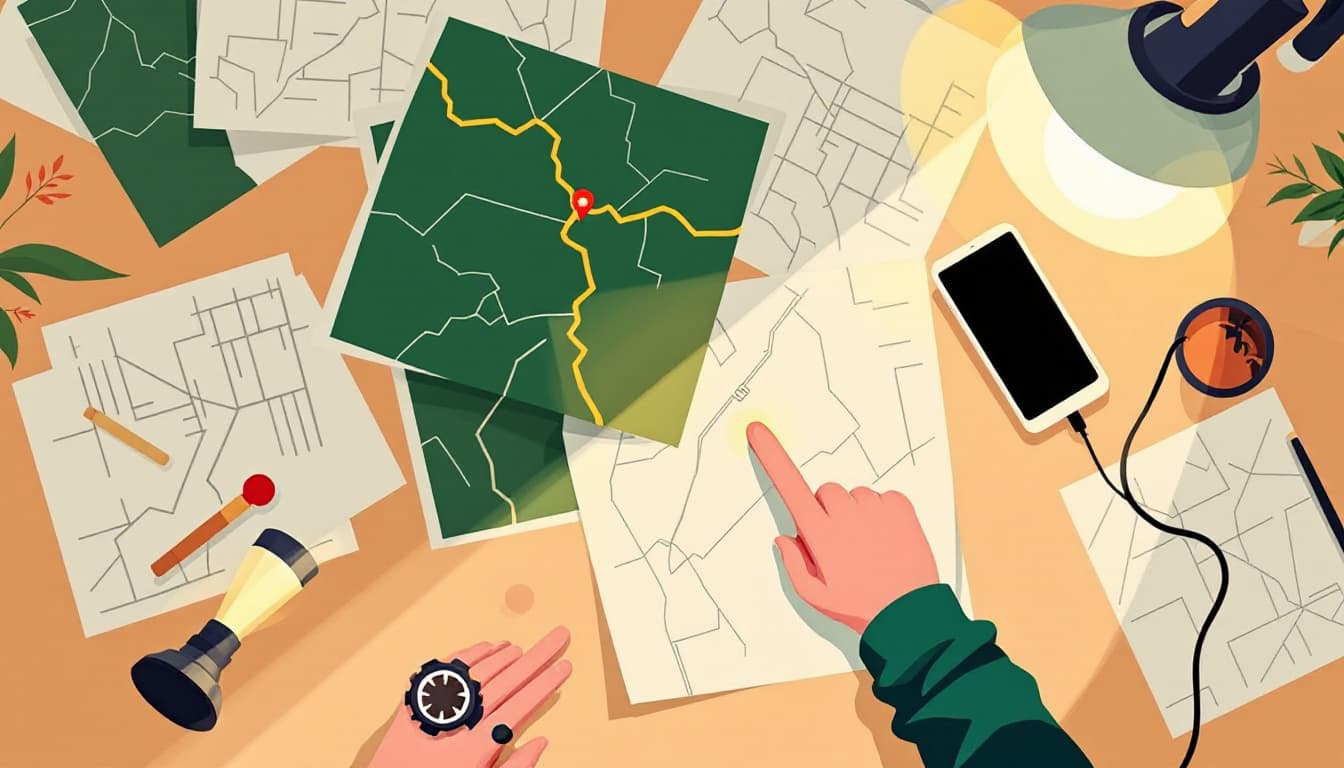
A friend mentioned recently that she couldn't remember how to read a paper map — not the broad strokes, but the actual skill of triangulating position from terrain features, matching contour lines to landscape, orienting without a compass rose in the corner of her phone screen. She'd done it confidently in her twenties, when she hiked regularly. She's 41 now. The skill didn't vanish. It attenuated.
This is worth thinking about carefully, because the preparedness conversation almost entirely focuses on acquisition — what to buy, what to stock, what plan to write down. Almost nobody talks about the atrophy curve: the rate at which capabilities your household once had degrade when they go unpracticed.
The mechanism is the same across skill categories
Skill atrophy isn't random. It follows a rough pattern that behavioral researchers have documented across domains: the most procedurally complex skills degrade fastest, the most conceptual skills survive longest, and motor skills tend to plateau at a floor rather than disappearing entirely. What this means practically is that the skills most relevant to emergency response — the ones with many sequential steps performed under stress — are exactly the ones that erode most quickly and most silently.
Consider the difference between knowing that you should shut off your home's gas main versus knowing how to do it without fumbling: locating the shutoff, understanding which direction is closed, having the right wrench in hand, and executing the motion without second-guessing yourself. The factual knowledge survives. The procedural fluency doesn't, not without occasional practice.
The same dynamic shows up across a range of household-level competencies: wound management, manual food preservation, navigating without digital infrastructure, operating on a cash-only basis when payment systems are degraded. Most middle-class families acquired fragments of these skills during the disruptions of the early 2020s. Most have not maintained them.
Why the standard preparedness frame misses this
The conventional approach treats preparedness as a state — a condition you either have or don't have, typically measured by days of food storage or the contents of a go-bag. This framing is comfortable because it converts readiness into a checklist that can be completed and then set aside.
But readiness is better understood as a maintenance problem, not an installation problem. The gear doesn't degrade much (with some exceptions). The knowledge degrades constantly. A household that practiced pressure canning in 2021 and hasn't touched the equipment since has the hardware but not the fluency. A family that navigated an extended power outage five years ago has the memory of competence, which is not the same thing as the competence itself.
There's an additional wrinkle that makes this counterintuitive: people consistently overestimate retained skill. The psychological literature on this is fairly robust — we tend to recall that we can do something more vividly than we recall how to do it. This is particularly true for skills that once felt effortless, because effortlessness is itself a memory that persists even after the underlying fluency has degraded.
What atrophy implies about household planning
The implication isn't that families need to run monthly drills or treat their home like a training facility — that way lies the identity-capture problem we've written about before. The more useful reframe is to treat skill maintenance as a design constraint rather than a scheduled activity.
Design constraint means asking: does our household's normal life create low-stakes repetitions of high-stakes skills? A family that occasionally cooks over a camp stove isn't doing disaster training — they're maintaining a procedural baseline. A household that uses paper maps on road trips is doing the same. The skill stays warm because the practice is embedded in ordinary life, not siloed into a preparedness ritual.
The harder question is about the skills with no obvious peacetime analog — the ones that only make sense in degraded conditions. For those, occasional deliberate practice really is the right answer, and the honest acknowledgment is that most families won't do it often enough. Knowing that, the better strategy may be to design toward simpler procedures in the first place: fewer steps, less specialized equipment, more overlap with everyday competencies.
The map-reading friend, for what it's worth, printed out a road atlas a few weeks after that conversation. Not because she expects GPS to fail catastrophically, but because she recognized that a capability she valued had quietly left her. That's a more honest accounting than most preparedness frameworks encourage — and probably a more durable one.