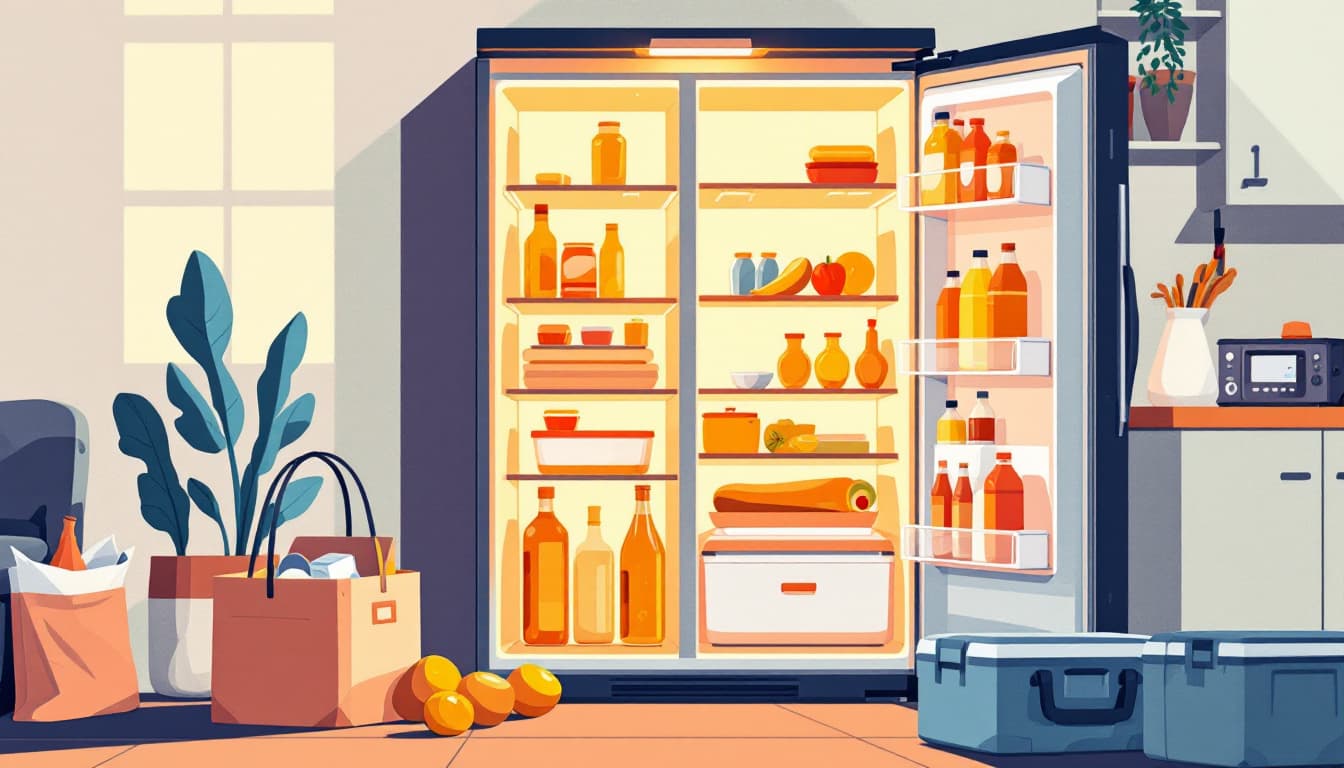
Walk into almost any suburban garage in America and you'll find one: the second refrigerator. It's usually a hand-me-down, slightly humming, running warmer than the display says. It holds overflow sodas, a few frozen pizzas, some bulk meat from the last warehouse run, and a stack of condiments nobody has touched since 2023.
The preparedness community loves this appliance. "Extra cold storage = resilience" is essentially an article of faith in prepper culture. And on the surface, it sounds logical — more food on hand means more buffer against disruption.
The problem is that under the exact conditions that create a disruption, the second refrigerator becomes one of the first things that fails you.
The specific way the logic breaks down
Second refrigerators in garages are almost always older units — the average age of a garage overflow fridge is well over a decade, based on the simple fact that households move a fridge to the garage when they upgrade the kitchen. Older compressors are less efficient and less reliable. They're also running in an environment — a garage — that is neither climate-controlled nor monitored closely.
During a summer power outage, the garage heats up faster than the main living space. A chest freezer in a 95-degree garage is fighting significantly harder than one sitting in a 72-degree kitchen. It loses the battle sooner.
And here's the practical kicker: when an outage hits and people start checking on their food, the garage fridge is usually checked last. By the time someone opens it, the safe window — roughly four hours for a refrigerator section, 24–48 for a full freezer — may already be closing.
Recent BLS data on household appliance usage consistently shows that secondary refrigerators run at higher ambient temperatures and are opened more frequently for casual use (every guest grabbing a drink adds a heat event), which means their actual internal temperature is less stable than owners assume.
What most households are actually doing wrong
The standard preparedness advice is to stock more. Buy a chest freezer. Fill it with meat. Run two or three refrigerators if you can. This advice treats cold storage as a pure quantity problem.
But cold storage is really a management and monitoring problem. You cannot prepare your way out of a monitoring gap.
Here's the pattern we've been thinking about: households that invest in more cold storage tend to invest less attention per unit of storage. A single well-monitored refrigerator with a cheap wireless thermometer and a practiced rotation schedule outperforms a garage fridge full of bulk meat that nobody is watching closely.
The same logic applies to freezers. A chest freezer that is 80% full, kept in a conditioned space, with a $15 appliance thermometer on the shelf, is more resilient than a 95%-full garage unit that you're mostly hoping is fine.
There's also a financial dimension. A second refrigerator running in a hot garage year-round can consume twice the energy of a modern kitchen unit — which means you're paying a steady, ongoing cost for resilience that may evaporate exactly when you need it.
What to do this week
1. Find out what your garage fridge is actually doing. Buy a standalone appliance thermometer (not the built-in display — those are notoriously inaccurate on older units). Tape it to a shelf, check it tomorrow. If the fridge section is consistently above 40°F, the unit is already failing its basic job.
2. Audit what's actually in the overflow unit. Pull everything out and look at dates. If more than a third of it is expired, forgotten, or something you'd honestly throw away in a normal kitchen cleanout, the unit isn't functioning as resilience — it's functioning as a delay mechanism for food waste.
3. Decide: upgrade the location or downsize the inventory. If you have a conditioned basement or interior utility room, moving a chest freezer there dramatically improves its reliability and efficiency. If the only option is the garage, size down to what you can realistically rotate and monitor.
4. Add a power-outage protocol to your household plan. Write down, literally on a sticky note inside the garage fridge door: what temperature, what time limit, what to prioritize saving. The decision-making overhead during an outage is higher than people expect. Reducing it to a pre-made checklist is worth more than an extra appliance.
The bigger picture
Preparedness culture has a well-documented tendency to treat acquisition as an end in itself — more gear, more storage, more supplies. But the households that actually come through disruptions well are usually the ones that have invested in systems rather than inventory.
The second refrigerator is a good symbol of the acquisition trap: it feels like resilience, it looks like resilience on a spreadsheet of household assets, but it requires active management to be resilience in practice.
The goal isn't to have more cold storage than you can monitor. It's to have cold storage you can actually vouch for when the power goes out and the clock starts running.