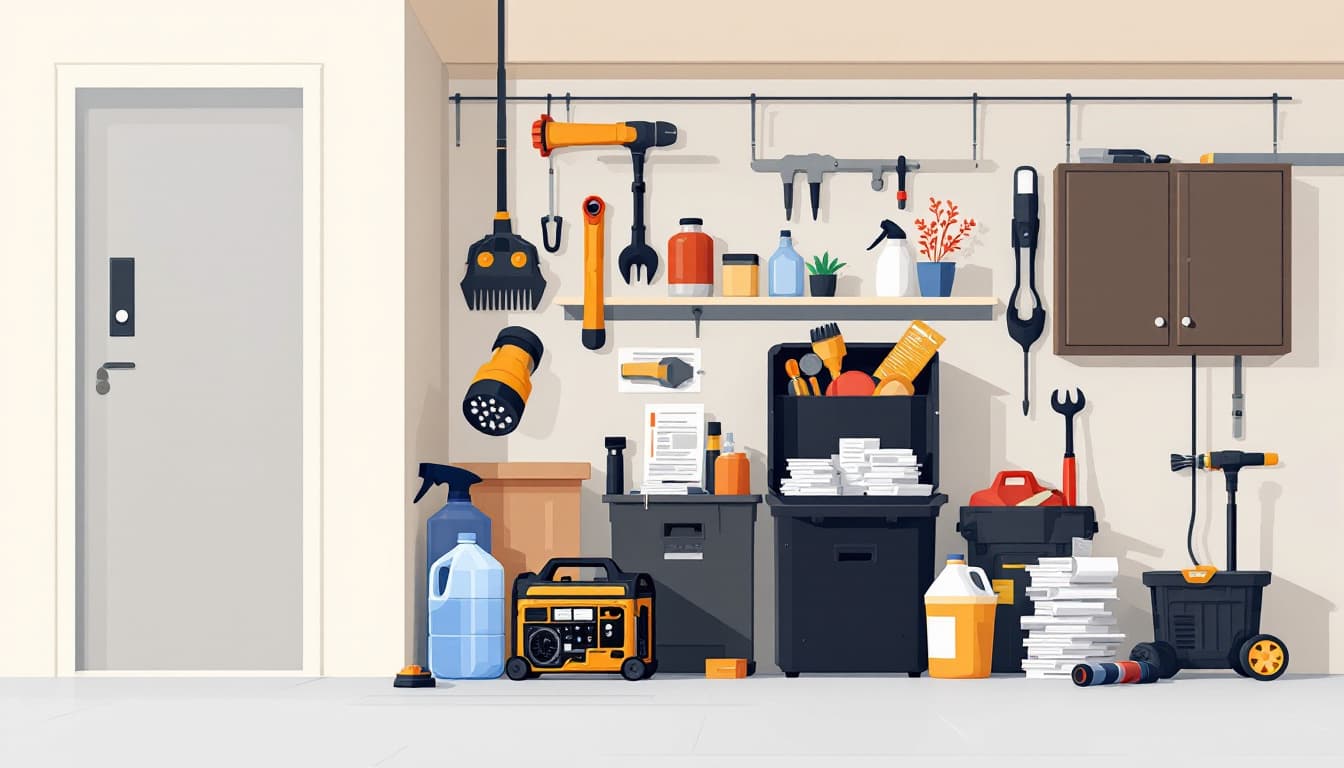
Somewhere in the past five years, a generator stopped being a prepper purchase and started showing up in the same shopping cart as a new dishwasher. Walk through any big-box home improvement store on a weekend and you'll find portable power stations shelved between the patio furniture and the shop vacs — not in a survivalist annex, but in the main floor plan, next to the seasonal merchandise. The store knows its customer. The customer is you.
This is not a story about doomsday. It's a story about a cost that has quietly been transferred onto household balance sheets without much discussion, and what it means to carry that cost thoughtfully rather than reflexively.
What's actually happening
Infrastructure economists have a useful concept: the difference between reliability and resilience. A reliable system rarely fails. A resilient system recovers quickly when it does. For most of the 20th century, American households could reasonably assume that the grid, the water system, the supply chain, and the banking system were reliable enough that personal resilience measures were optional — the province of rural homesteaders, hurricane-prone coastal residents, and a subculture of enthusiasts who took things perhaps a bit far.
That assumption has been eroding. Power outages measured in hours have become power outages measured in days. Municipal water advisories have grown more common. Supply chain "temporarily out of stock" notices have become routine enough to alter purchasing behavior permanently. None of these shifts represent collapse — they represent a ratcheting-down of the baseline reliability that households once could borrow against for free.
The cost of that reliability used to be socialized. Utilities built in excess capacity. Retailers held buffer inventory. Governments maintained strategic reserves. Recent decades of efficiency optimization — just-in-time logistics, deregulated grid management, lean municipal budgets — transferred a portion of that buffer cost to the edge of the network. Which is to say: to your house.
Why households haven't noticed
The shift has been gradual enough to feel like a series of individual decisions rather than a systemic change. You bought a battery backup for your router because the internet is essential for work. You keep a few extra cases of water because your area had a boil notice two years ago. You printed out your insurance documents after the app failed during a claim. Each of these felt like a personal choice. Together, they constitute a reliability tax — money and mental overhead spent maintaining redundancies that the system used to provide.
Recent labor market data suggests that households in the $60,000–$120,000 income range are spending meaningfully more on these categories than they were a decade ago, even when adjusted for inflation. The line items show up under "home improvement," "emergency supplies," and "electronics," which obscures the pattern. No one writes "reliability tax" in their budget spreadsheet.
The preparedness industry, to its credit, noticed this shift early. To its discredit, it monetized the anxiety around it rather than helping people calibrate a rational response. The result is a market full of $400 freeze-dried meal kits and $800 tactical flashlights aimed at people who genuinely just need a $35 battery lantern and a few weeks of pantry depth.
The calibration problem
Here's the counterintuitive part: spending more on redundancy is not always more rational. There's a crossover point at which additional preparedness spending produces diminishing returns relative to the risks you actually face, and a household that overshoots that point has made a poor financial decision dressed up as prudence.
The useful question isn't "how much redundancy can I afford?" It's "what is the realistic failure mode I'm buffering against, and how long does it typically last?" For most households in most American cities, the answer is a power outage lasting one to four days, a supply disruption lasting one to three weeks, and occasional access problems with digital financial records. Those are finite, bounded risks — and they require finite, bounded responses.
A household that has mapped its actual risks and bought against them specifically has done something genuinely different from a household that has accumulated gear in response to ambient anxiety. The first household has transferred the reliability tax into productive assets. The second has mostly donated to the preparedness industry's margin.
The shift in who bears the cost of resilience is structural and probably permanent. Utility infrastructure investment timelines are measured in decades; supply chain lean-ness is now baked into shareholder expectations. What's optional is whether your household's response to that shift is calibrated or reflexive. If you want a starting point for thinking about the actual scope of what your household needs, our water and food calculator is built around realistic failure durations — not worst-case fantasies.
The generator in the home improvement aisle is real. The question is whether you buy the right one for the right reason, or whether you buy it because the culture of mild ambient dread has become very good at spending your money.