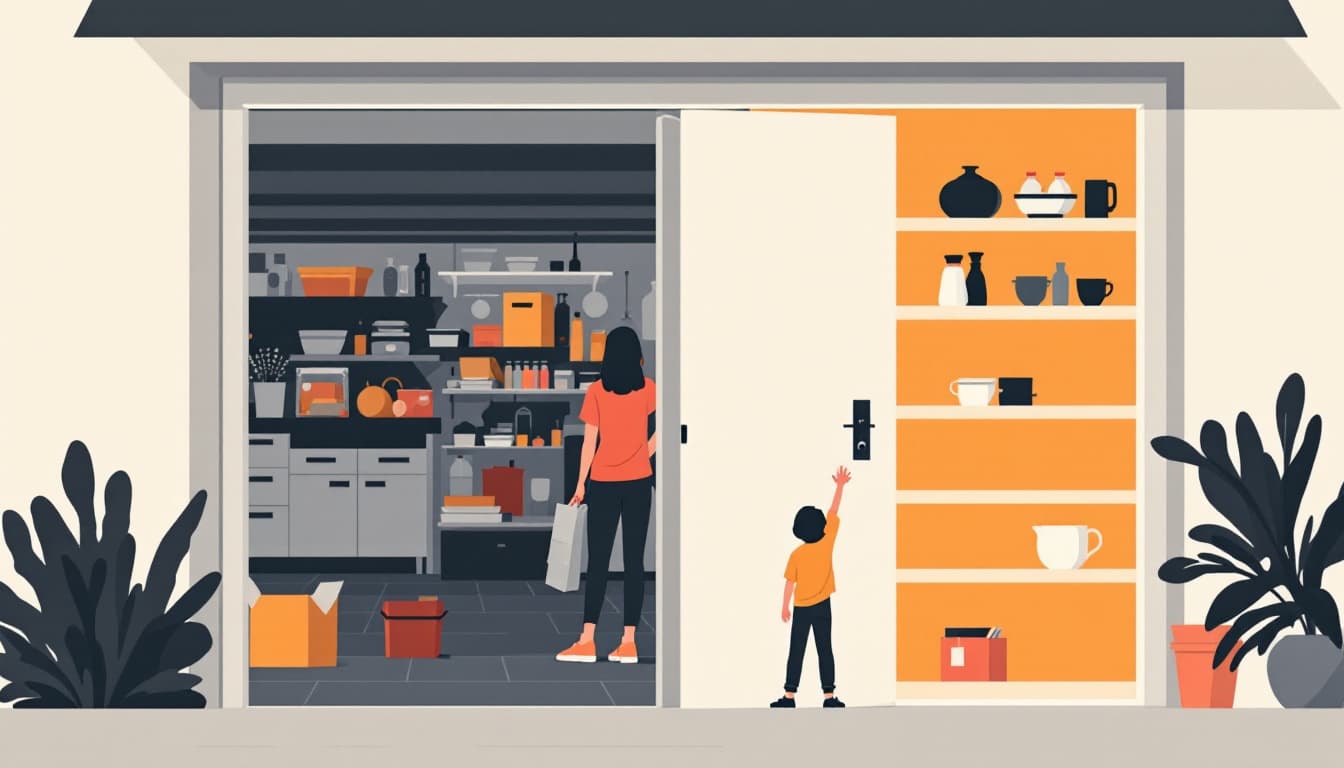
Somewhere in a suburban garage in the American intermountain West, there are enough freeze-dried calories to feed a family of four for two years. The same garage also has a leaking roof, no earthquake insurance, and a single family member who knows how to drive the generator. The family is, in every meaningful sense, less prepared than a neighbor with three weeks of food, a solid savings buffer, and two adults who have each handled a real emergency before.
This is the preparedness plateau problem — and it is more common than the prepper community will ever acknowledge, because acknowledging it would threaten a core belief: that more is always better.
What the plateau actually looks like
Resilience, treated honestly, behaves like most things subject to diminishing returns. The first meaningful gains come fast. Moving from zero food storage to two weeks of shelf-stable supplies dramatically changes a household's exposure to short disruptions — the category that covers roughly 95 percent of actual emergencies most families will face. A job interruption. A regional storm. A temporary illness that keeps you from the store. Two weeks of runway transforms these from crises into inconveniences.
The gains from moving to one month of storage are still real, but smaller. Three months is a reasonable ceiling for most households in most regions, with meaningful edge cases above that for people with medical dependencies or genuinely remote geography. Beyond that, the marginal safety returned by each additional pound of storage begins to approach zero — while the marginal cost, including the opportunity cost of that money and mental energy, stays stubbornly real.
The plateau is not a bug in preparedness thinking. It is the honest shape of the risk curve.
Why the prepper community gets this wrong
Two things conspire to keep the plateau invisible. The first is that preparedness media — including, frankly, much of what passes for analysis in this space — is structurally incentivized to expand the scope of what counts as necessary. A household that is genuinely, durably prepared for the realistic range of disruptions it will face does not need to read much more. Extending the threat horizon keeps the audience engaged.
The second force is psychological. Accumulation feels like progress in a way that skill-building, relationship maintenance, and financial flexibility do not. You can see and touch the supplies. The pantry is a legible scoreboard. Knowing how to talk to a neighbor after a disaster, or having a flexible enough budget to absorb a three-month income shock, produces no visible artifact. It does not photograph well.
This asymmetry pushes anxious people toward material accumulation and away from the things that actually produce resilience: skills, relationships, and liquidity. The result is households that are well-stocked and brittle — a combination that is worse, in some failure modes, than being simply under-prepared, because it carries the psychological cost of false confidence.
The durable household is not the best-stocked one
What distinguishes genuinely resilient families, across the pattern of real disruptions that emergency management researchers have documented over decades, is not depth of storage. It is optionality. These households have multiple ways to solve the same problem. They can buy food, grow a little food, ask a neighbor, or draw on savings. They can navigate a power outage, a job loss, a health crisis, or a supply disruption using different combinations of the same underlying resources. No single failure closes all exits.
That optionality does not come from stockpiling. It comes from keeping the household system — financial, physical, social, practical — diverse and in good repair. It comes from resisting the pull toward any single axis of preparedness.
There is a word for a system that has optimized heavily along one dimension at the expense of others: fragile. The household with two years of food and a leaky roof is fragile in a different direction than the household with nothing. But it is still fragile.
The right question is not "how much?"
The more useful frame is: what kinds of disruptions is this household actually exposed to, and what is the cheapest way to build meaningful buffer against each of them? That question leads most families to a different portfolio than either the three-day-kit minimalists or the multi-year-storage maximalists would suggest. It leads to something more boring, more balanced, and — the data consistently suggest — more durable.
If you want to run those numbers on food and water specifically, our water and food calculator will walk you through a household-level baseline without any hidden assumption that more is always better.
The plateau is real. Knowing where it sits for your family is one of the more useful things this kind of analysis can give you.