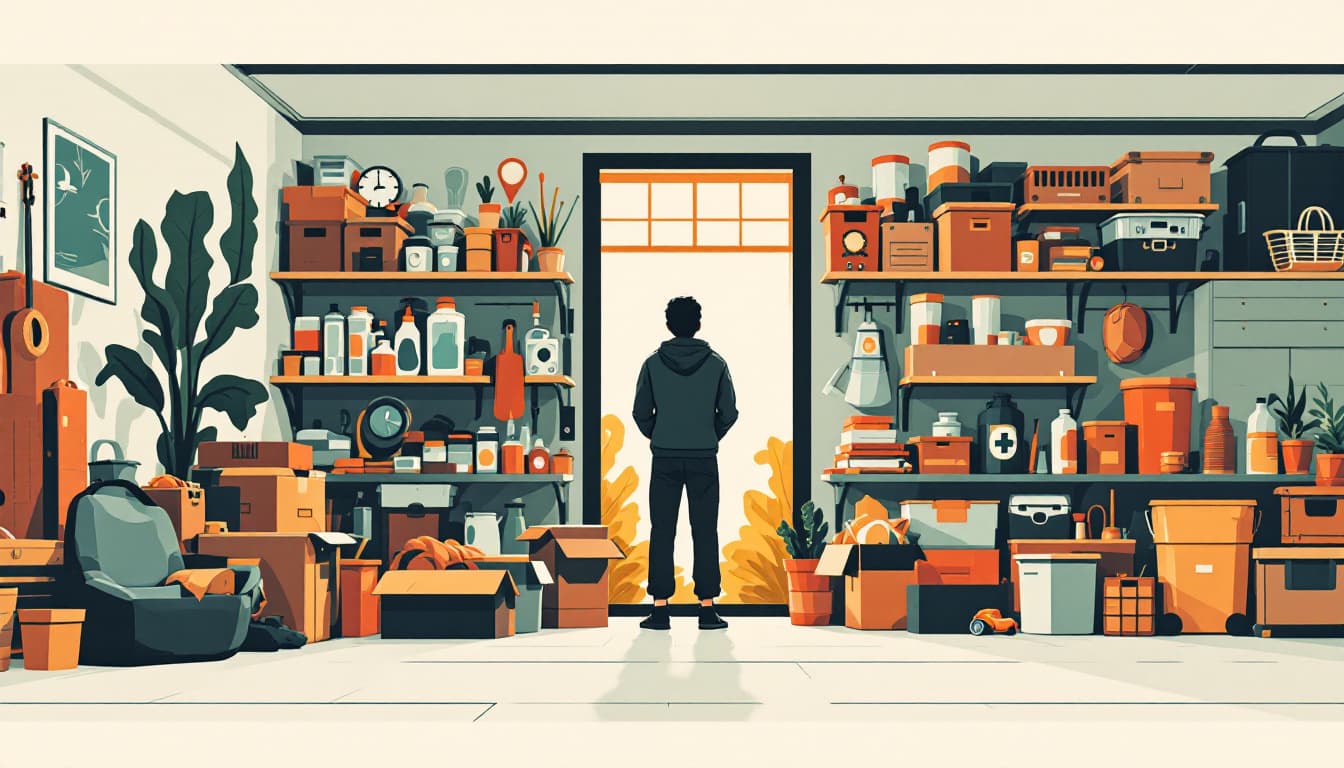
A few years back, an acquaintance showed off his preparedness setup: a basement with floor-to-ceiling shelves, oxygen absorbers in every bucket, a printed binder cross-referencing expiration dates. He was proud of it. He'd also, he mentioned almost in passing, let his homeowner's insurance lapse — the premiums felt wasteful compared to what he was doing "for real" protection. His roof had no attic ventilation worth mentioning, his water heater was original to the house, and his car ran on fumes more often than not.
He had done a lot of preparedness theater. He had not built a resilient household.
There is a shape to effective household resiledness that most people never consciously think about. It is not linear. It is not a matter of doing more until you feel safe. It looks more like a learning curve run backward: early effort pays enormous dividends; effort beyond a certain point yields almost nothing; and effort far beyond that point actively degrades the household by consuming money, time, and attention that would have served better elsewhere.
Call it the preparedness plateau.
The first ten percent of preparedness effort — a week's worth of water, a modest pantry buffer, a household communication plan, solid insurance coverage, a charged fire extinguisher — accounts for something like eighty percent of real-world risk reduction for the vast majority of households. The events that actually affect middle-class families in the United States are not collapse scenarios. They are three-day power outages, job gaps of two or three months, a sick kid during a busy travel week, or a car that dies on a Wednesday. A household that has addressed those vulnerabilities is genuinely, measurably more durable than one that has not.
The next tier — a month's supplies, a modest generator, a more deliberate financial cushion, a first-aid kit that goes beyond Band-Aids — handles a meaningful but rarer set of disruptions. Hurricanes. Regional grid failures. Extended illness. These payoffs are real, though smaller relative to the effort invested.
After that, the curve flattens. A six-month food stockpile does not make a household six times more resilient than a one-month stockpile; the disruptions that require the sixth month of food are rare enough, and statistically peculiar enough, that the probability-weighted benefit is tiny. Meanwhile, that stockpile requires rotation, space, capital, and attention. It has a real cost.
Why do people miss this? Two reasons, mostly.
The first is that preparedness culture is dominated by its most extreme practitioners — the people who have thought about very-low-probability, high-consequence scenarios so long that those scenarios feel normal. Online forums, YouTube channels, and gear communities self-select for depth and intensity. A person who keeps a three-day kit and sound insurance doesn't post much about it. Someone with a bunker does. This creates a skewed picture of what "serious" preparedness looks like.
The second is that preparedness, done past the plateau, starts to feel like control over an uncontrollable world. That feeling is its own reward, independent of actual risk reduction. It is psychologically coherent — uncertainty is genuinely uncomfortable — but it means people will keep doing more even when more stops helping. The marginal bucket of freeze-dried calories serves anxiety more than it serves survival.
The households that handle disruptions well — really well, consistently, across different kinds of disruptions — tend to look pretty boring from the outside. They have some savings. They know their neighbors. Their cars and appliances are reasonably maintained. They have thought through what they'd do if the power went out for a week. They are not impressive. They are just durable.
The deeper insight here is that preparedness is a form of portfolio allocation. Every dollar and hour spent on freeze-dried potatoes past month two is a dollar and hour not spent on financial liquidity, health maintenance, professional skill-building, or relationships — all of which are more likely to actually matter. The best-prepared households are not the ones with the most stuff. They are the ones that have made honest tradeoffs: enough material buffer, enough institutional coverage (insurance is preparedness), and enough slack in their lives to adapt when things go sideways.
The goal is not to be ready for everything. That's a fantasy that costs a fortune and delivers anxiety. The goal is to have handled the likely things so well that you have real capacity left — mental, financial, physical — when the unlikely things arrive.
Knowing where your plateau is turns out to be the most underrated preparedness skill of all.