Think about the last time you had a power outage that lasted more than four hours. If you're being honest about how you got through it, some part of the story probably involves another person — a neighbor who told you the pizza place three blocks over still had power, a friend who texted that the outage was isolated and the utility's app had a restoration estimate, a relative who offered their driveway generator for your refrigerator.
That informal network did something your headlamp and three-day food supply could not do on its own: it collapsed your uncertainty.
This is the variable almost no preparedness framework accounts for, and it's the one with the highest return on investment of anything you could spend time on this month.
Why resilience research keeps finding the same thing
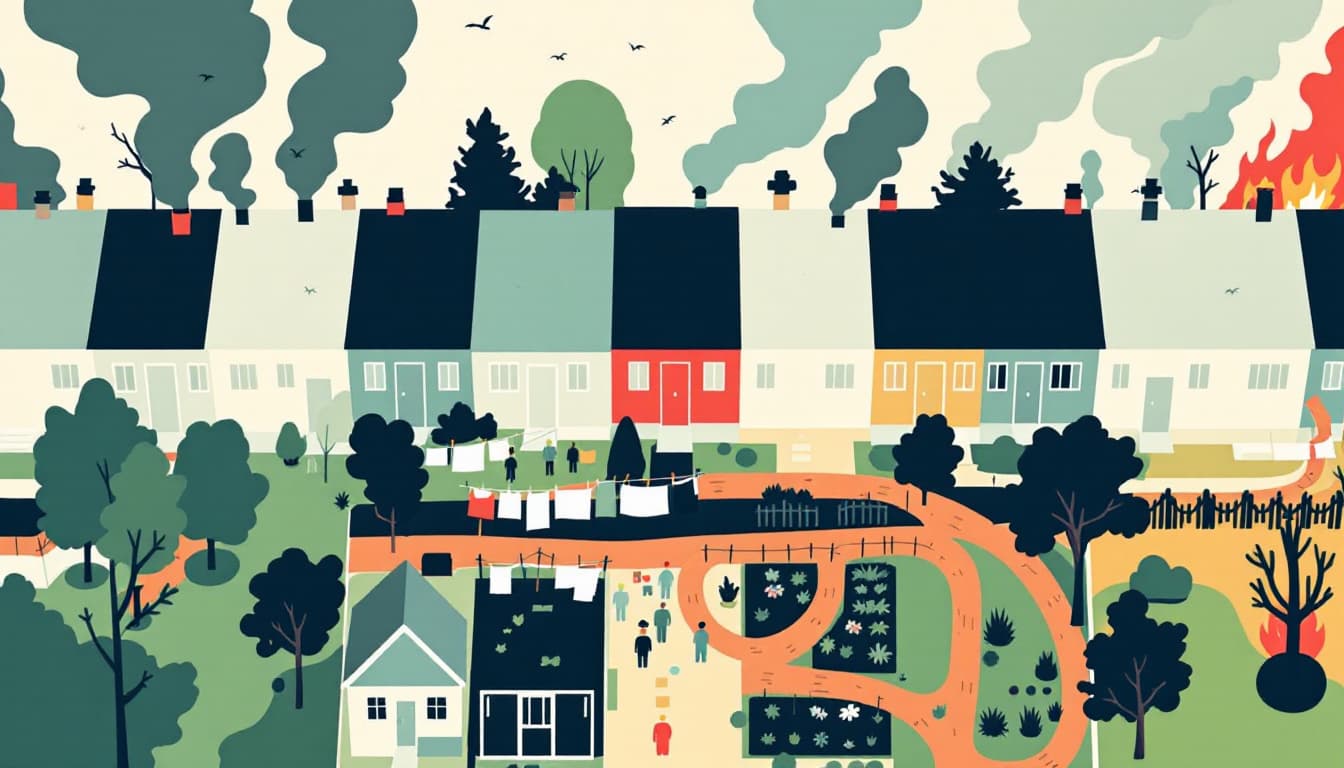
Sociologists who study disaster recovery have been pointing at the same pattern for decades. The households and communities that recover fastest from disruption — whether it's a regional storm, a localized economic shock, or a prolonged utility outage — tend to share one trait that isn't gear or savings. They know their neighbors. Not in a sentimental way. In a logistical way.
They know who has a truck. Who is a nurse. Who has a basement. Who has a generator. Who is elderly and lives alone. Who works the night shift and is home during the day. This knowledge turns out to be more useful, more often, than most of the items on a standard preparedness checklist.
Researchers studying post-disaster housing recovery have found that social cohesion — measured by things as simple as whether people report knowing their neighbors' names — is one of the strongest predictors of how quickly a neighborhood stabilizes after a major disruption. This isn't a soft finding. It shows up repeatedly across different hazard types and different income levels.
Why the prepper industry has almost nothing to say about this
The preparedness market is built around products. That's not a criticism — it's just a structural fact. Gear, food, water filtration systems, solar chargers: these are things that can be manufactured, boxed, and sold. Social capital cannot. So the industry has very little incentive to tell you that the most leveraged thing you could do this week is introduce yourself to the household two doors down.
There's also a cultural current in preparedness thinking that runs against this. The image of the self-sufficient household — a closed system, prepared for anything, needing no one — is appealing precisely because it promises to eliminate dependency. The trouble is that dependency is not actually a problem to be solved. It's a feature of how humans survive disruption. The question is whether your dependencies are intentional and reciprocal or accidental and fragile.
A family that has quietly purchased six months of freeze-dried food, has no relationship with a single neighbor, and whose plan involves staying home and waiting it out is not more resilient than a family with a two-week pantry and four households nearby who know each other well. In most realistic scenarios, it is substantially less resilient.
The counterintuitive accounting here
Social capital has a compounding quality that gear does not. A generator is worth approximately one generator's worth of power. A neighbor who is an emergency medicine nurse is worth whatever you need a nurse for, whenever you need one, for as long as you maintain the relationship. The relationship also pays dividends in non-emergency life — which is most of life — whereas the generator sits in the garage.
Investing in neighbor relationships also gives you something no amount of solo preparation can: distributed early warning. Your network will know things before you do. They will see the flooded underpass. They will have spoken to the utility crew. They will know that the gas station on the corner still has fuel. That real-time, hyperlocal intelligence is one of the highest-value inputs during any disruption.
What to do this week
Audit your social geography. Make a rough mental map of the households within a two-block radius. How many adults can you name? How many occupations or skills do you know? If you can name fewer than three households in detail, that is your most significant preparedness gap right now.
Do one low-stakes introduction. Pick one household you've nodded at but never actually spoken to. A brief, non-weird introduction — no preparedness agenda required — is the starting point. You are not recruiting a survival team. You are beginning a relationship.
Find the existing structure. Many neighborhoods have a block association, a Nextdoor group, or an informal network already running. Joining an existing structure is faster than building one. If nothing exists, a single household survey left on a few doorsteps — just asking whether neighbors want to be on a contact list for local emergencies — is a proven starting point.
Know the one skill you'd offer. If you were going to be useful to your neighbors in a disruption, what would that be? First aid? A chainsaw? A vehicle that seats seven? Knowing your own contribution makes reciprocal relationships easier to build.
The bigger picture
Preparedness culture has spent a generation optimizing the household as a unit. That work matters — a financially stable, well-maintained, reasonably stocked home is genuinely more resilient than a fragile one. But the household is not the natural unit of disaster recovery. The neighborhood is. The street is. The cluster of people who know each other is.
The most durable households in any disruption are the ones that have figured this out and acted on it before anything went wrong — not by stockpiling more, but by investing in the social infrastructure that no catalog can sell them.