Walk into any mid-size grocery store on day three of a regional weather disruption and you will see something instructive: the bread aisle is bare, the bottled water is gone, and the canned goods are picked over — but your local news station is still running "storm preparation tips" as though the preparation window is open. It is not. It closed roughly 36 to 48 hours ago, when the distribution center upstream made its first re-routing decision.
That gap — between when logistics networks begin to strain and when most households recognize the strain — is the pattern worth sitting with this week.
How the timing actually works
Modern grocery supply chains run on what the industry calls "continuous replenishment." Stores carry, on average, a surprisingly small amount of on-hand inventory — often measured in days, not weeks, for perishables and fast-moving staples. That system is extraordinarily efficient under normal conditions. It is fragile under abnormal ones.
When a disruption signal enters the network — a port slowdown, a fuel price spike, a regional road closure, a labor shortage at a distribution hub — the first response happens at the logistics layer, not the retail layer. Trucking schedules get revised. Warehouse allocations shift. Stores in lower-priority zip codes get partial loads or skipped entirely. None of this is announced. It shows up as an empty shelf, usually without explanation.
By the time that shelf emptiness becomes newsworthy, the re-stocking timeline is already measured in days or weeks, not hours.
Why most households are positioned exactly wrong
The dominant mental model for emergency preparedness — even among people who take it seriously — is reactive and event-driven. Something happens, the news covers it, people go to the store. This model made more sense when supply chains had deeper local buffers. Regional warehouses used to hold more. Stores used to carry more back stock. That era is largely over.
The other failure mode is the opposite extreme: the prepper-culture response of building a year's worth of food storage in a dedicated bunker room. This creates its own problems — cost, spoilage, space, the psychological weight of maintaining a system that feels permanently on a war footing. Most families do not need that, and the framing discourages the much simpler middle path.
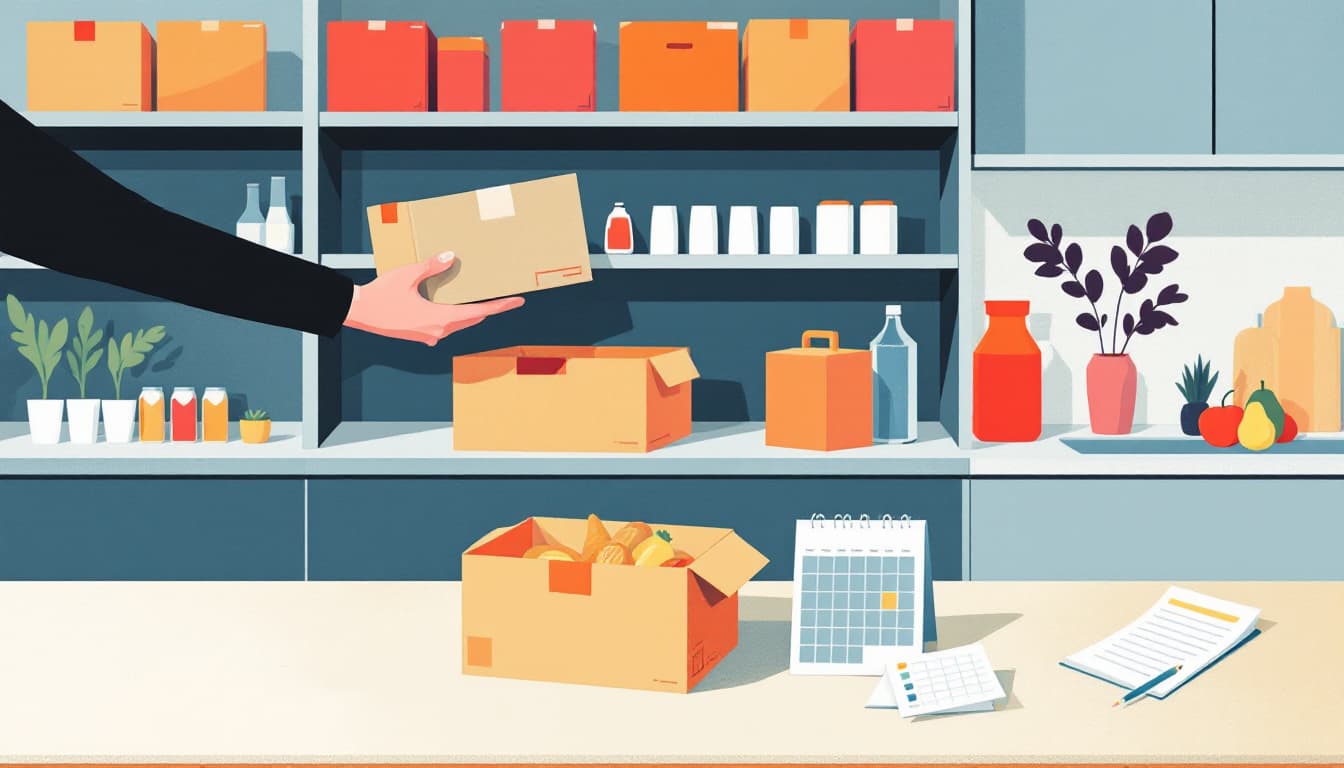
The middle path is what we'd call a rolling buffer: a modest, actively rotated household inventory calibrated to the specific disruption window that actually matters, which for most supply chain events is roughly two to four weeks. Not a bunker. Not bare shelves. A pantry that functions like a small, personal distribution center with its own replenishment logic.
What makes this counterintuitive
Here is the part that trips people up: building a rolling buffer feels like an act of anxiety. It can become one, if you do it wrong. But done correctly, it has the opposite psychological effect. When you know your household can absorb a two-week disruption in staples without a panic run to the store, you stop monitoring the news with dread. The buffer is not a response to fear — it is the thing that makes fear unnecessary.
There is also a cost dimension that runs counter to intuition. Buying staples at regular prices in modest rotating quantities almost always beats buying them at crisis-premium prices in desperate quantities. Recent Bureau of Labor Statistics data on grocery price volatility suggests that staple food prices can spike meaningfully in short windows during regional disruptions. A household that buys ahead of the disruption curve pays the baseline price. A household that buys into it pays the spike.
What to do this week
This is not a complicated project. It takes one hour.
Step one: Open your pantry and identify the five shelf-stable items your household consumes most reliably every two weeks. Not aspirational items — actual items. Pasta, canned tomatoes, rice, cooking oil, whatever applies to your household.
Step two: Note how much of each item you currently have on hand. Express it in days of consumption, not units.
Step three: Set a personal floor. A reasonable starting target is 14 days of your most-used items. If you are at four days, the gap is ten days' worth of purchasing. That is probably one grocery trip with a modest additional spend.
Step four: Write the floor number on a piece of tape inside the pantry door. When you drop below it, the next grocery run replenishes it. That is the whole system.
You are not building a bunker. You are installing a buffer.
The bigger picture
Supply chains are not going to become less complex. The logistics layer that sits between producers and your kitchen is going to remain opaque, efficient under calm conditions, and brittle under stressed ones. The news cycle will continue to lag the actual disruption by 48 hours or more.
None of that requires alarm. It just requires acknowledging that your household is the last node in a very long chain — and that last nodes need their own small reserves. The families who understand the timing gap are not the ones panic-buying. They are the ones already home, eating dinner, watching the coverage with detached calm.
That is a posture worth building toward.