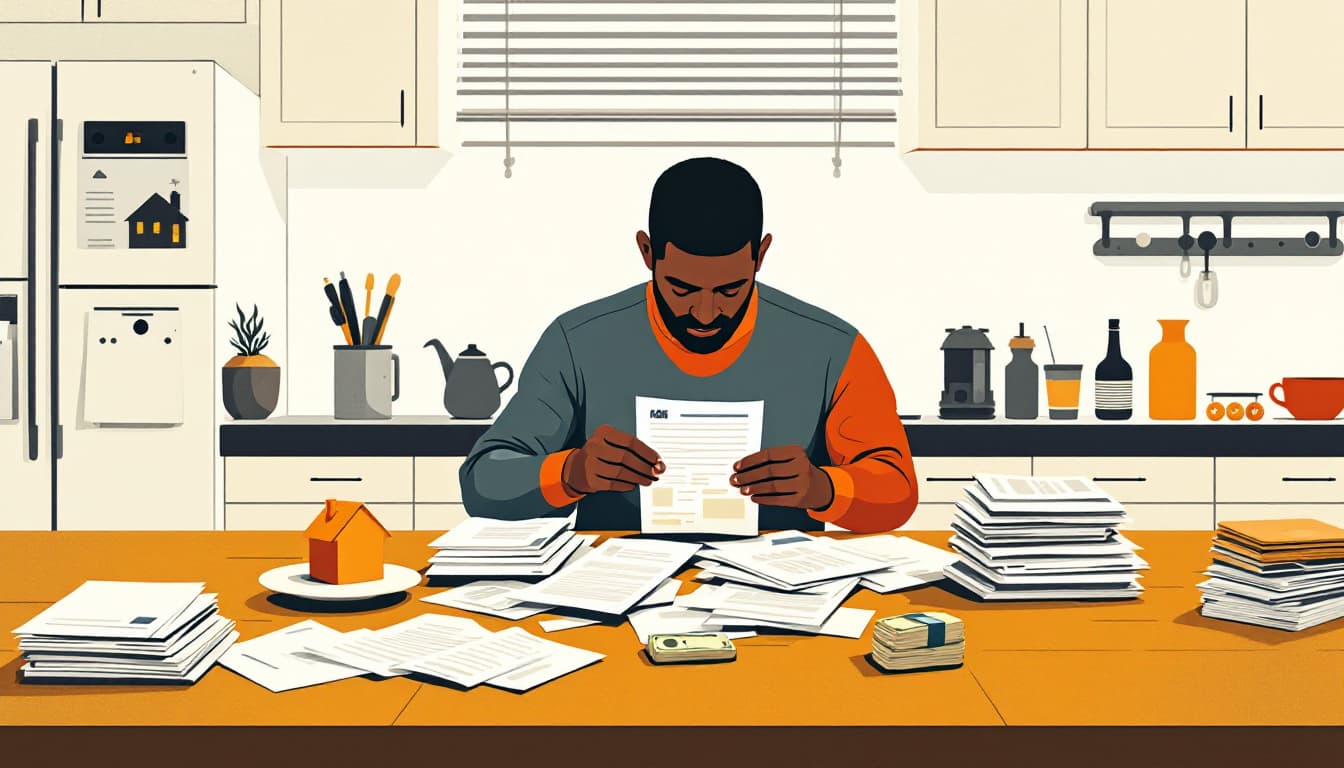
A family in suburban Columbus earns $140,000 combined. Both partners work. They have one car payment, a mortgage at a rate locked in several years ago, two kids in activities, and a Costco membership they use religiously. Their checking account balance is usually somewhere between $800 and $2,400 by the end of the month. They feel, on balance, like they are doing fine.
Then the furnace dies in January.
That family is not financially fragile in the conventional sense — their income is real, their credit is good, their jobs are stable. But their resilience is thin. And resilience, not income, is what determines how a household weathers disruption.
The preparedness conversation almost always gravitates toward physical inventory: water storage, food rotation, backup power, go-bags. These are the visible symbols of readiness, and they photograph well. But there's a quieter category of household vulnerability that matters more in the overwhelming majority of scenarios — the kind that show up not as disasters but as cascades of inconvenience that become crises.
A supply disruption, a prolonged illness, an extended power outage, or a job loss doesn't usually destroy households outright. It stresses them in a particular sequence: first the liquidity buffer, then the credit lines, then the relationships, then the routines. The household that runs with thin monthly cash balances hits the second stage — credit dependency — almost immediately.
The distinction worth drawing here is between liquidity and resilience. Liquidity is how much cash you can access in the next 30 days. Resilience is how long your household's functional quality of life holds before structural decisions have to be made — do we pull the kids from activities, do we defer the car repair, do we ask family for money.
High earners can have terrible resilience. Lower earners with stable routines, low fixed costs, and meaningful informal networks can have excellent resilience. Income is an input. Resilience is an output of how that income is configured.
Most preparedness orthodoxy gets this backwards. The standard advice assumes that physical supplies are the gap. Build your kit, rotate your pantry, store your water. But a household with $4,000 of emergency rations and $600 in checking is not prepared — they're just prepared for a different and much rarer kind of disruption.
Recent Federal Reserve survey data has consistently found that roughly four in ten American households would struggle to cover an unexpected $400 expense without borrowing. That figure actually understates the problem for middle-class households, because the expenses that break a prepared-but-illiquid household aren't $400. They're $3,000 HVAC jobs, $6,000 dental emergencies, $1,800 vet bills, and $5,000 income gaps during a job transition.
What makes this counterintuitive is that the households in question don't feel fragile. They have brand-name lives — good zip codes, newer cars, two incomes — and the cultural signals around them reinforce a sense of stability. The thin checking account is rationalized as "we always cover it," which is true until it isn't.
There's also an invisible tax on cash-poor households during disruptions that rarely gets discussed: the friction premium. When you can't pay for the emergency furnace repair immediately, you negotiate from weakness, you sometimes accept worse service, and you sometimes defer the repair and pay more for it later. Households with deep liquidity resolve the same problem faster, with better outcomes, and often for less money. Cash-poor resilience isn't just uncomfortable — it's literally more expensive.
None of this is an argument for financial perfectionism. The Columbus family in the opening isn't making bad decisions; they're making ordinary ones inside an economy where housing, healthcare, and childcare have all expanded their claims on household income simultaneously. The point isn't blame — it's category clarity.
For preparedness purposes, the most useful reframe is to think about household durability in terms of sustained function under moderate stress rather than survival under extreme stress. Extreme scenarios are real, but they are rare and largely beyond household control. Moderate disruptions — job gaps, medical bills, weather events, regional supply hiccups — happen to most families at least once per decade, often more.
If you want to pressure-test where your household actually sits, our water and food calculator can help you map the physical side of the equation. But the financial gap — the spread between your liquidity and the realistic cost of disruptions in your specific life — is a number worth calculating separately and sitting with for a while.
The prepper who worries most about grid collapse and least about their checking account balance has the risk hierarchy inverted. The furnace always dies in January.