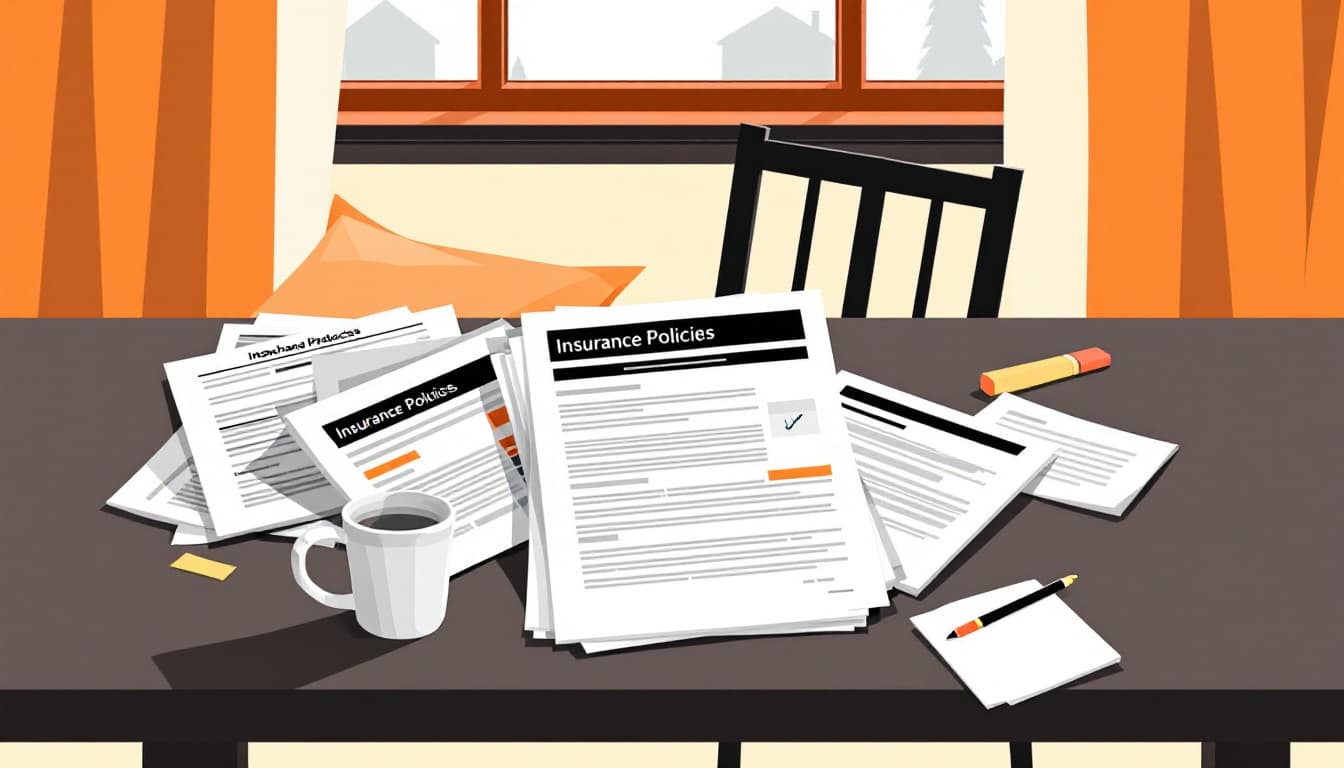
A family in the exurbs of Nashville spends eighteen months assembling what any reasonable person would call a serious preparedness kit — water storage, three weeks of food, a generator, a hand-crank radio, a modest supply of backup medications. They feel prepared. Then a hailstorm destroys their roof, mold establishes itself in the attic before they notice, and their homeowner's insurer denies the mold remediation claim because — buried in the exclusions section on page 31 — mold is a "long-term maintenance issue" rather than sudden-onset damage. The generator didn't help. The food stores didn't help. The thing that hurt them was the document in the filing cabinet they hadn't read in four years.
This is not a horror story about bad luck. It is a story about a category error that runs through middle-class preparedness thinking at almost every level.
The category error works like this: preparedness culture treats insurance as a background condition — the thing that handles financial losses so that preps can handle physical ones. Gear addresses the first 72 hours; insurance addresses the financial aftermath. Clean division of labor. The problem is that insurance is not a passive backstop. It is an active contract with dozens of conditions, sub-limits, and exclusions that erode its value in precisely the scenarios where you need it most.
A few patterns worth naming:
Replacement cost versus actual cash value is the most commonly misunderstood axis. A policy that reimburses actual cash value on a five-year-old HVAC system pays you what a five-year-old HVAC system is worth, not what a new one costs. That gap, on a major appliance or a roof, routinely runs into thousands of dollars. Most households do not know which version they have.
Sub-limits on contents mean that even a robust policy may cap reimbursement on electronics, jewelry, tools, or firearms at figures that were set when the policy was written — often years before inflation compounded. Recent BLS data on consumer goods pricing suggests that household contents have appreciated materially faster than most sub-limits have been updated.
Flood is not covered. This is technically common knowledge, but the practical implication — that a "standard" homeowner's policy covers zero water damage from external sources — is still functionally shocking to households who discover it after the fact. FEMA's National Flood Insurance Program is a separate purchase. Private flood coverage is a third distinct product. Neither is automatic.
Business-use exclusions have grown thornier as more households operate side businesses or store business inventory at home. A chest freezer full of a side business's product, or a home office with commercial-grade equipment, may fall into ambiguous territory that adjusters are not going to resolve in your favor.
Why does this gap persist? Partly because the preparedness community has a gear bias. Physical objects are satisfying to acquire, store, and audit. An insurance policy is a text document with no tactile presence. Nobody posts an Instagram photo of their updated home inventory spreadsheet next to their declarations page.
There's also a timing problem. Most households review their insurance the week after they buy a house and then again only when something goes wrong. The intervening years are when drift accumulates: home values appreciate, contents accumulate, coverage limits stagnate. A policy that was appropriate in 2019 may be meaningfully underinsured in 2026 without a single decision having been made to make it so.
The preparedness community's response to this, where it exists at all, tends toward cynicism — "insurance companies will find a way not to pay." That's too easy. Policies do pay, routinely and significantly, when claims fall within their actual scope. The households that get hurt are mostly the ones who never understood what that scope was.
The deeper pattern here is one we come back to often at this site: household resilience fails not at the dramatic moments that preparedness culture imagines, but at the slow, administrative, easy-to-defer edges of family financial life. The three-day emergency is the scenario everyone prepares for. The four-month financial recovery from an underinsured loss, without adequate savings to bridge the gap, is the scenario that actually reorganizes families.
An annual insurance audit — sitting down with your declarations page, your current home value, and an honest inventory of what has changed — is not a prepper activity in any recognizable sense. It doesn't feel like preparedness. It feels like paperwork. That's precisely why it doesn't get done.
The gear is downstream of the financial floor. If the financial floor has a hole in it, the gear sits on top of nothing.