Picture a Tuesday afternoon in September. A fast-moving windstorm knocks out power to roughly 200,000 households across a metro region — not a catastrophic event, a nuisance-scale outage that makes regional news for a day and a half. Schools dismiss early. One parent is across town at a client meeting. The other is trying to reach the kids' school to confirm pickup, and the school is trying to reach both parents simultaneously. The cell network, absorbing a modest surge in simultaneous voice calls, starts dropping connections. SMS messages queue and deliver twelve minutes later, out of order.
No one is in danger. But for about forty minutes, a functional household operates as four individuals who cannot coordinate.
This is the failure mode most emergency communication plans are not actually designed to survive.
The standard advice — "designate an out-of-state contact, agree on a meeting point" — is correct as far as it goes. The problem is that it addresses a scenario (regional infrastructure collapse) that is far rarer than the one that breaks most household plans: ordinary cell congestion during a localized, non-catastrophic event.
The math here is worth sitting with. The FCC has documented repeatedly that wireless networks are engineered for typical usage, not surge usage. During a significant regional event — even one that doesn't damage physical infrastructure — voice call attempts can spike four to six times above baseline within minutes. Networks prioritize certain traffic, but household voice calls are not near the top of that priority stack. The result is not a dramatic outage; it is a degraded, unreliable service window that can last anywhere from twenty minutes to several hours depending on network load and geography.
SMS text messages are substantially more resilient in congestion because they use lower-bandwidth signaling channels and tolerate delay natively. But "more resilient" is not the same as "reliable" — and messages that arrive out of sequence create their own coordination failures. A parent who receives "I'm at the school" followed by "I'm leaving the school" in the wrong order is now making decisions on bad data.
What most households experience, then, is not the clean failure their plan was written for. It is a degraded, intermittent, time-shifted communication environment that their plan was never tested against.
Here is a cruder version of the same arithmetic that is worth running on your own household.
Think about how many coordination touchpoints your family requires in the first ninety minutes of a disruptive event: school pickup confirmation, employer notification, checking on elderly relatives, confirming where everyone is sheltering. For most households with children and two working adults, that number is somewhere between eight and fifteen distinct communication acts — each of which depends on the other party being reachable and the message arriving intact and in sequence.
Now assume that roughly half of those attempts will fail or be significantly delayed during a moderate-congestion window. Which half? You don't get to choose. This is the gap that a plan built on the assumption of reliable cellular does not address.
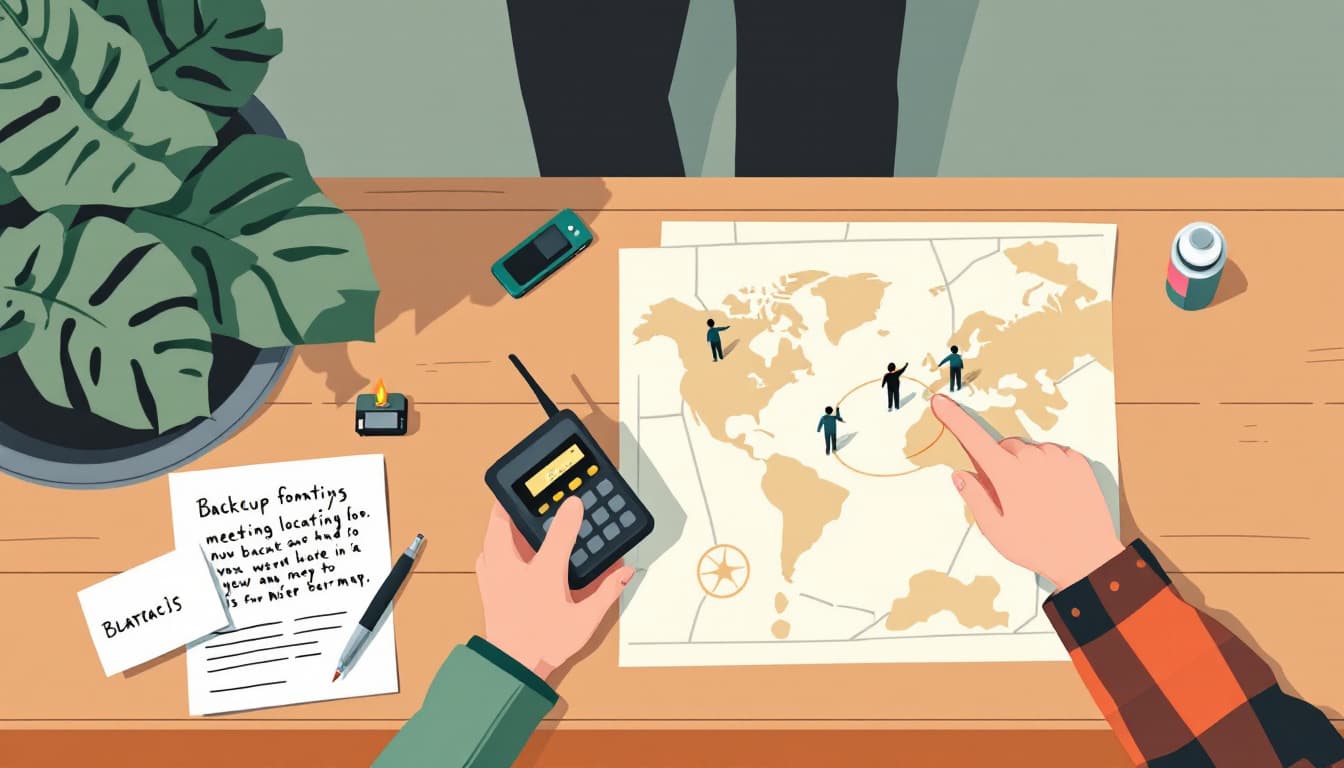
The counterintuitive conclusion is that the households best positioned here are not the ones with the most sophisticated communication technology. They are the ones who have done two simpler things: pre-committed to a physical fallback (a specific location where everyone goes if contact fails for more than thirty minutes, not just "the school"), and distributed that plan in written form to every family member old enough to read it. Paper does not experience network congestion.
The prepper internet is drawn to the dramatic version of this problem — solar flares, EMP events, grid-down scenarios that require ham radio licenses and Faraday cages. Those risks exist on some probability distribution, but they crowd out the mundane version of the same underlying vulnerability. Your household communication plan is most likely to be tested not by a catastrophe but by a Tuesday afternoon in September when too many people are trying to call their kids' school at the same time.
The households that handle that well share a trait: they made their plan legible enough that it works without real-time coordination. Everyone already knows where to be and when, without waiting for a confirmation text that may arrive twelve minutes late and out of order.
That is a different design target than what most households are aiming at — and closing the gap costs about an hour of planning and a sheet of paper.