Consider a family in a mid-sized Midwestern city that has done almost everything right. They carry three months of expenses in a high-yield savings account. They have a 72-hour kit. They rotate their pantry. On paper, they are prepared.
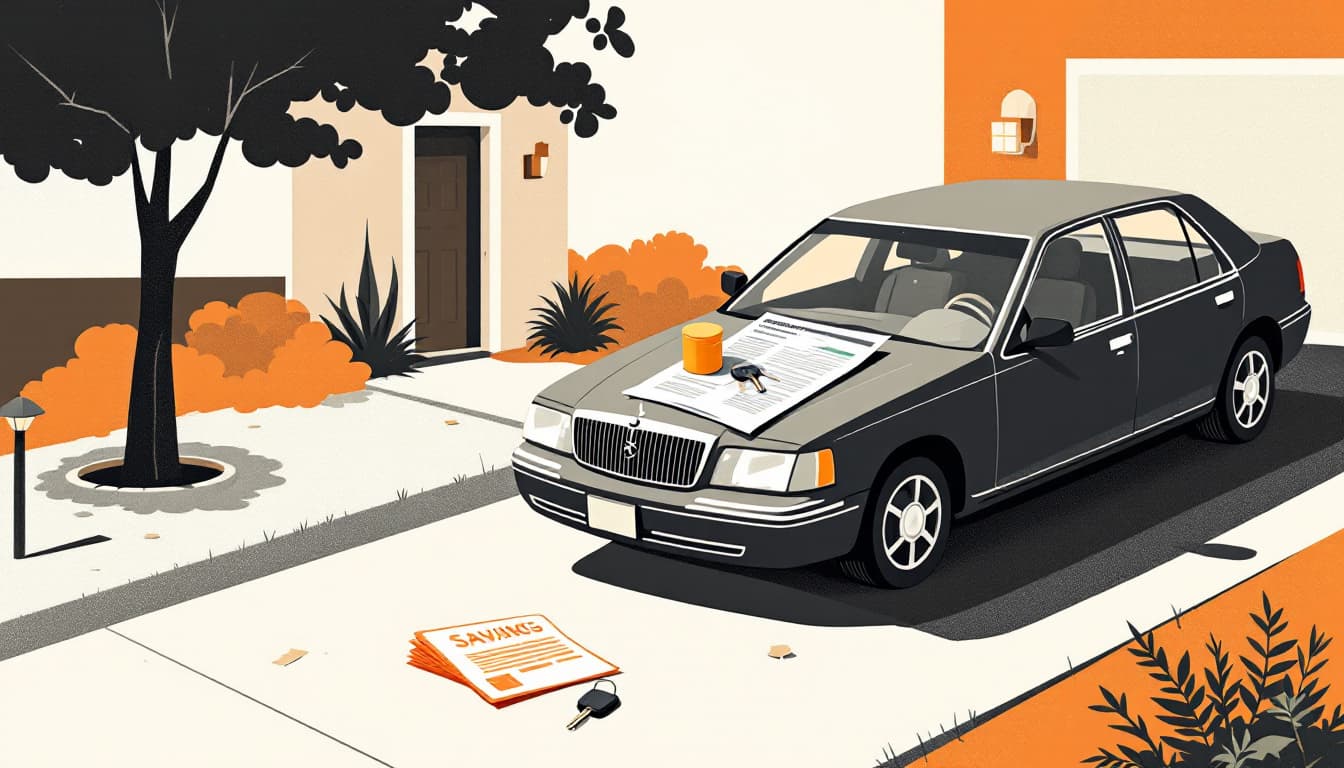
Their car payment is $687 a month.
That number is not unusual. Recent Federal Reserve data put the median monthly auto loan payment for new vehicles above $700, and the average loan term has stretched past six years. The preparedness community rarely talks about this because vehicle ownership feels like infrastructure rather than a financial decision — you need a car, so you have a car, and the conversation ends there. But that framing misses something important about how resilience actually works at the household level.
The buffer you build versus the buffer you bleed
Emergency funds are conventionally framed as a number — three months, six months, the Dave Ramsey tiers — and that framing trains people to think about resilience as a stock of cash rather than a flow of obligations. The problem is that a $15,000 emergency fund sitting next to a $30,000 car loan at 7% interest is not a $15,000 buffer. It is a $15,000 buffer that is being steadily drained by the carrying cost of a liability, even while the asset it finances depreciates.
A vehicle owned free and clear does something different. It converts a monthly cash obligation into a fixed asset that, yes, still costs money to maintain, but does not extract a predictable sum from your household every 30 days regardless of what else is happening. When income drops — a layoff, a medical disruption, a slow quarter for a self-employed household — the absence of a car payment is not nothing. At $687 a month, it is more than $8,000 a year of financial flexibility that either exists or does not.
Why the preparedness framework misses this
The standard preparedness inventory covers food, water, power, and communication. It is oriented toward physical disruption — the storm, the grid event, the supply chain hiccup. That orientation is not wrong; those risks are real and underprepared. But the statistical record is fairly clear that the most common household emergencies are economic, not physical. Job losses, medical bills, and unexpected major repairs dwarf natural disasters in frequency. And for economic emergencies, the most useful preparedness asset is not a Faraday cage — it is monthly cash flow.
This is where the car payment deserves more scrutiny than it typically gets. A household that finances a $42,000 SUV over 72 months has made a decision that will shape its economic resilience for six years. The vehicle itself may be fine — reliable, safe, appropriate for the family's actual needs. But the financing structure has converted what could have been a liquid buffer into an illiquid depreciating asset with a mandatory monthly draw on income.
The resilience question is not whether to own a car. It is whether the car you own is structured in a way that helps or hurts your household's ability to absorb a shock.
The counterintuitive position
There is a version of this argument that slides into austerity preaching — drive a beater, never finance anything, stockpile cash under the mattress. That is not the point, and it ignores the real tradeoffs involved in owning an older vehicle with higher maintenance volatility. A catastrophically unreliable car creates its own resilience problems.
The more useful frame is marginal. A household considering a vehicle replacement is not choosing between a $45,000 truck and a bicycle. It is choosing between a $45,000 truck at 72 months and a $26,000 sedan paid off in 36 — or a $14,000 three-year-old version of roughly the same sedan purchased with cash from existing savings. Each of those choices has a different monthly obligation profile, and that profile either compresses or expands the household's ability to absorb the economic emergencies that are, by far, the most likely ones they will face.
The preparedness community talks extensively about the three-day kit, the two-week food supply, the backup generator. It talks almost not at all about the single largest discretionary financial decision most households make every five to eight years, and whether that decision is being evaluated through a resilience lens or a monthly-payment lens.
Those are not the same lens. The monthly-payment lens asks: can we afford this payment right now? The resilience lens asks: what does this payment do to our ability to handle a bad year?
A paid-off car does not show up in any preparedness checklist. It probably should.