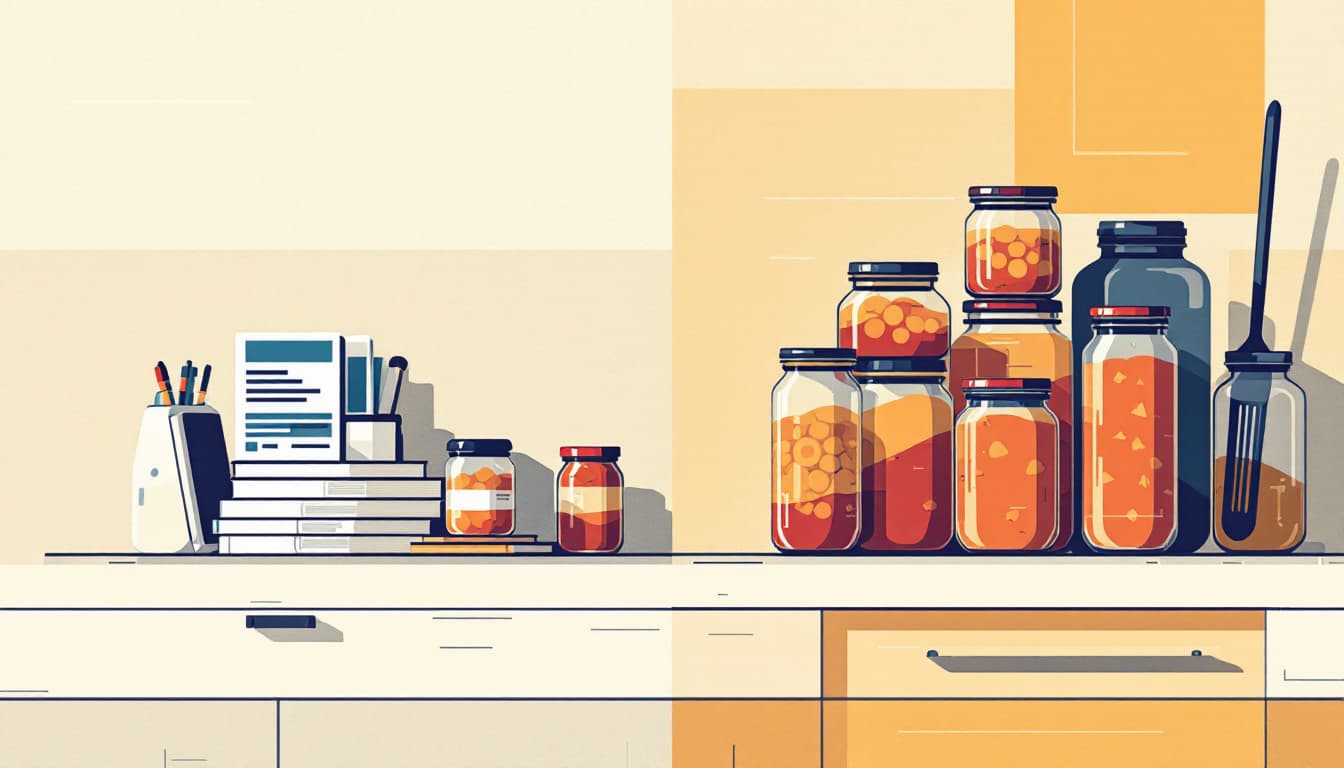
Picture two households facing the same scenario: a January ice storm knocks out power for six days. The first family has $4,000 in an emergency fund and almost nothing in the pantry. They spend the first night at a hotel, eat out for most of the week, and end the ordeal $800 poorer and significantly stressed. The second family has $800 in liquid savings but three weeks of food, two cases of water, a propane camp stove, and enough candles to stock a chapel. They're inconvenienced but intact, and their bank account looks almost identical on day seven as it did on day one.
Both households thought they had prepared. Only one of them had matched their buffer to the shape of the actual problem.
The category error most budgets make
Here's the framework that most household finance advice — even good household finance advice — tends to skip: cash and supplies are not substitutes for each other. They hedge against different failure modes.
Cash is a claim on a functioning supply chain. It works beautifully when stores are open, roads are passable, shelves are stocked, and card systems are processing. In every scenario where those four conditions hold, cash is the most efficient emergency buffer imaginable. You buy exactly what you need, when you need it, at that moment's prices.
Supplies are a claim on nothing. They're already yours. They work in scenarios where the supply chain has slowed, broken, or temporarily repriced everything upward. A case of canned beans in your basement does not care whether the highway is iced over or whether your regional distribution center just lost power for 72 hours. It just sits there, doing its job.
The mistake families make — the one that shows up clearly when you map actual disruptions against actual household resources — is treating these two buffers as a single pool. "We have $5,000 set aside, we're fine." That math works until the $5,000 can't buy what you need, or until the cost of buying it in an emergency is three times what it would have been in advance.
Why the intuition runs backward
The deprivation framing of prepping does real damage here. When the cultural image of "being prepared" involves bunkers and bulk pallets and survivalist identity, most sensible middle-class families quietly decide the whole enterprise isn't for them — and they park their resilience budget entirely in cash savings. That's a reasonable reaction to an unreasonable cultural signal, but it leaves the household exposed.
The opposite error is less common but worth naming: some households get so focused on physical supplies that they chronically underfund liquid savings, which means any emergency that does require cash — a medical copay, a car repair, a missed paycheck — lands with full force because the money is tied up in a three-year supply of freeze-dried potatoes.
Neither extreme is the point. The point is that these two resources have genuinely different liquidity profiles and genuinely different failure conditions, and a household budget that doesn't account for both has a gap in it.
A simple way to think about the split
You don't need elaborate spreadsheets. Think of it this way:
- Liquid savings cover disruptions that require money moving: medical, legal, income gaps, travel, repairs, unexpected professional services.
- Physical supplies cover disruptions that require goods existing: food insecurity, utility outages, access disruptions, supply-chain delays, localized price spikes.
Most financial planners recommend three to six months of expenses in liquid savings. That's reasonable. But that number was designed around income-replacement scenarios — job loss, disability, that kind of thing. It was not designed around the scenario where you have income but your grocery store is bare or your neighborhood is under a boil-water order for two weeks. Physical supplies are the buffer for that second category of event, and no dollar amount in a savings account adequately substitutes for them.
What to do this week
1. Map your last three disruptions against their resource type. Did they require money, or did they require goods already on hand? Most families find the list skews heavily toward "goods already on hand would have helped."
2. Audit the ratio. If your liquid savings are solid but your pantry has fewer than two weeks of food, your buffers are unbalanced. If your pantry is deep but you'd be in trouble with a $600 car repair, that's the gap.
3. Set a separate line item. Don't fund supplies from your emergency fund. Give physical preparedness its own small monthly budget — even $30–50/month, spent consistently on shelf-stable staples, builds meaningful depth over a year without touching your financial cushion.
4. Rotate, don't accumulate. Buy things your household actually eats. Canned tomatoes, dried pasta, oats, rice, peanut butter. The goal is a deep pantry you cycle through, not a warehouse you open during an apocalypse. This keeps costs low and waste near zero.
The bigger picture
Resilience isn't a single number in a savings account. It's a set of overlapping buffers, each covering failure modes the others can't. A household with strong liquid savings and a well-stocked pantry isn't twice as prepared as a household with one or the other — it's prepared for a fundamentally wider range of scenarios. That's a qualitative difference, not just a quantitative one.
The goal isn't to imagine the worst possible scenario and throw money at it. The goal is to make sure your household doesn't have a shape-of-problem mismatch: reaching for cash when you need goods, or reaching for goods when you need cash. Most disruptions are modest and temporary. That's exactly when matched buffers matter most.