A KTLA report this week documented multiple active wildfires pushing air quality readings into the unhealthy range across Southern California. The fires arrived in May — before June, before the traditional peak of fire season, before most households have thought once about smoke management.
That timing is the signal worth paying attention to.
What's actually changing
California's fire calendar has been shifting. Fires that once clustered in late summer and fall now ignite in spring, when humidity is already low and offshore wind patterns can move smoke rapidly into populated valleys and coastal corridors. The South Coast Air Quality Management District and Cal Fire both track this — and recent seasons have included significant smoke events in months that used to be considered off-season.
The practical consequence for households is that "I'll deal with it when it gets bad" no longer works as a plan. By the time an AQI reading crosses 150 on the SCAQMD's real-time map, the window to prepare your home has already closed. Stores sell out of N95s. Air purifiers ship in two weeks. Your family spends three days breathing particulate matter in what feels like a sealed house.
Smoke from wildfires carries fine particulate matter — PM2.5 — small enough to bypass the nose and throat entirely and reach deep lung tissue. Children, elderly adults, and anyone with asthma or cardiovascular conditions face elevated risk at exposure levels that feel only mildly uncomfortable to healthy adults. California's own OEHHA maintains guidance on this, and it is not alarmist: sustained exposure above AQI 150 is a real health concern, not an inconvenience to push through.
What we'd actually do
Check your home's actual filtration right now, before the next smoke event. Most central HVAC systems ship with MERV-8 filters, which catch large dust particles and do almost nothing for PM2.5. A MERV-13 filter fits the same slot in most systems, costs roughly the same, and captures fine particles far more effectively. Swap it before fire season advances. Run the fan on "on" rather than "auto" during smoke events so air is continuously circulated through the filter.
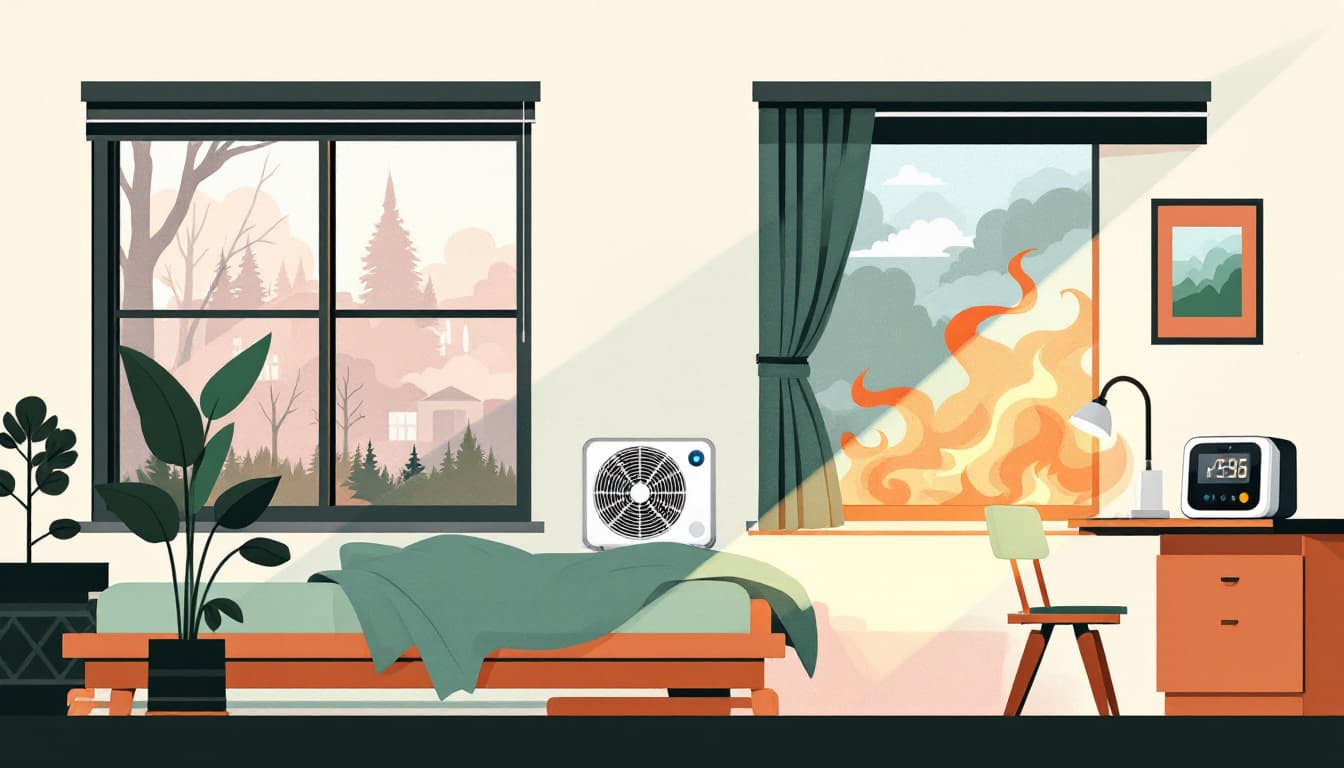
Build one room in your home into a clean-air refuge. Pick an interior room — typically a bedroom — and treat it as your smoke shelter. Keep the door closed during smoke events, use a portable air purifier with a true HEPA filter, and seal window gaps with painter's tape if outdoor AQI is above 150. You don't need to clean-room your entire house. You need one place where the air is reliably better.
Own at least one N95 per adult household member, stored where you'll actually find it. The CDC and Cal OSHA both recognize N95 respirators as effective against wildfire smoke PM2.5; surgical masks and cloth masks are not. A 10-pack costs under $20. Keep them in a kitchen drawer or a car glovebox — not a bin in the garage you'll forget about. Replace them every fire season.
Bookmark the SCAQMD's real-time AQI map, not just a weather app. Most weather apps display the Air Quality Index as a single number without showing you the hyperlocal variation that matters in Southern California. The SCAQMD's map — scaqmd.gov — displays readings by monitoring station, so you can see whether your specific part of the San Gabriel Valley or the Inland Empire is in a different risk band than the regional average. Make it a browser bookmark today.
Talk to any household members with respiratory conditions about their action threshold. For healthy adults, AQI 150 is the common guidance for reducing outdoor activity. For people with asthma, the threshold is lower — often 100 to 101. If someone in your household uses an inhaler, call their doctor's office and ask directly: at what AQI reading should this person stay indoors and run the air purifier? Get a number. Write it down.
The bigger picture
Southern California households have lived with wildfire risk long enough that it has started to feel normal. That normalization is the actual hazard. The goal here isn't a bunker or a bug-out plan. It's a household that can handle three to five bad-air days in a row without making decisions in a panic. A MERV-13 filter, a HEPA purifier, a box of N95s, and a bookmarked AQI map get you most of the way there for under $150 total. Fire season is already here.